How to Evaluate Your Short-Term Rental Cleaners
Use a scored checklist, timestamped photos, and monthly KPIs to evaluate your short-term rental cleaners and act on guest reviews without guesswork.

Jonathan Lalinec

To evaluate a cleaner in short-term rentals, measure three things: the condition of the property after each clean, the reliability of the visit (timing, turnaround, communication), and the impact on guest reviews. This is the approach described in a dedicated guide to evaluating short-term rental cleaners: observable criteria, verified by dated photos taken after every clean, then a monthly review of the few indicators that matter. Here is how to put it into practice, from building a scorecard to giving feedback to your team.
In brief
- Define the expected standard before you evaluate. A cleaner cannot be judged against an expectation that was never communicated.
- Replace subjective judgements ("clean bathroom") with observable yes/no criteria, weighted by their impact on the guest.
- Require timestamped photos of agreed areas after every clean. Those photos are the evidence that makes a score discussable without conflict.
- Track a small number of monthly indicators: compliance rate, re-cleans, turnaround time, and cleanliness comments in reviews.
- Share results quickly, in writing, with specific examples, then adjust training or task organisation accordingly.
Contents
- What you are really evaluating in a cleaner
- Step 1: set the standard before you evaluate
- Step 2: build an observable scorecard
- Step 3: inspect at the right moment, with evidence
- Step 4: track a few indicators every month
- Step 5: use guest reviews without over-relying on them
- Step 6: share results and help the team improve
- Our view
- Putting this method into practice with CleanClac
- Start this month
- FAQ
- Sources
What you are really evaluating in a cleaner
A short-term rental cleaner is not evaluated the same way as an office cleaning operative. The property changes occupants every two or three days, sometimes the same day, and every flaw is seen by a guest who can rate it publicly. Performance therefore comes down to three dimensions.

The result found in the property
This is the most obvious dimension: bathrooms, kitchen, floors, linen, windows, smells. Two elements that property managers often forget to measure also belong here: adherence to instructions (items put back in place, products used correctly, off-limits rooms left closed) and care of the property (no scratches, furniture repositioned, linen in the right place), as proposed in a room-by-room inspection checklist.
Reliability of the visit
A perfect clean that finishes after guests arrive is still a failure. Reliability covers punctuality, respect for the window between checkout and check-in, responsiveness when something unexpected happens, and quality of communication. Does the cleaner flag damage, a forgotten item, or a low stock on the same day?
Impact on guest reviews
This is the final indicator, but also the most delayed and the noisiest. On Airbnb, the overall rating is an average out of 5, accompanied by detailed sub-ratings including cleanliness. A review does not replace an inspection; it completes one.
Step 1: set the standard before you evaluate
The method starts with a document, not a score. The reference guide recommends defining the expected standard before any evaluation, and sticking to it. In practice:
- List the tasks for each room. A comprehensive list prevents oversights and misunderstandings. Our Airbnb cleaning task list covers 166 illustrated tasks you can draw from.
- Turn the list into a guided checklist that the cleaner follows during the job. Our cleaning checklist is available in 6 languages, useful if your team is not French-speaking.
- Formalise a protocol: room order, products, linen management, and how items should be reset. Our article on the professional cleaning protocol covers this foundation in detail.
- Specify which areas to photograph and the moment at which a clean is considered complete.
A cleaner who knows exactly what will be checked improves faster, and any discussion about a score stays factual.
Step 2: build an observable scorecard
The core principle of a good scorecard is reproducibility: two people inspecting the same property should reach the same score. To achieve this, the scorecard must rest on non-subjective criteria. "Clean bathroom" becomes "no limescale deposits, no hair in the shower, mirror without smears".
Yes/no, weighted by impact
Each line receives a yes or no answer. Criteria with a high impact on guests carry more weight: hair or marks in the shower and toilet, residual smells, stained linen. The compliance rate is then straightforward to calculate: points earned divided by points possible.
Example weighting, to be adapted to your own standard:
| Observable criterion | Weight | Why |
|---|---|---|
| No hair or marks in the shower and toilet | 3 | Top reason for negative guest comments |
| Clean linen, no stains or odours | 3 | Direct impact on comfort and reviews |
| Floors dust-free, including under the bed | 2 | Verifiable in a photo |
| Kitchen worktop and sink clean | 2 | Area guests inspect first on arrival |
| Consumables restocked (paper, soap, capsules) | 1 | Takes a few seconds to check |
| Bins emptied and bags replaced | 1 | Simple criterion, rarely disputed |
This table is an example of how to build a scorecard, not a standard. The weights should reflect what your own guests notice most.
Separating three types of issue
The scorecard becomes fairer when it distinguishes cleaning defects, physical damage, and missing items. A broken glass is not scored the same way as a poorly rinsed shower, and it is not handled the same way either. The first calls for feedback to the cleaner; the second requires a separate report and follow-up.
A simple inspection form
A practical form has one line per criterion, a single box among "compliant", "needs re-doing", or "critical", an observation field, a "photo: yes/no" note, and then the date and the inspector's name, as described in this inspection form template. Three levels are enough. More nuance makes scoring slower and less consistent.
Step 3: inspect at the right moment, with evidence
Inspection is best done immediately after the clean, before the property is used again. If you check later the same day, a floor may already have been dirtied by an occupant. The timing of the inspection matters as much as the scorecard itself.
Timestamped photos as a shared record
You cannot be present at every turnover. Photos of agreed areas, dated and linked to the checklist, replace the on-site visit. They serve three purposes: remote inspection, settling a dispute, and responding to a guest complaint. Our page on the cleaning report with timestamped photos shows how this tracking is organised in the app.
This approach of documenting the result of a clean and remotely checking key areas also works for managers with properties in different cities. The same scorecard, the same photos, regardless of the property.
You do not need to inspect everything
As your portfolio grows, it becomes unrealistic to inspect every turnover on-site. A cleaning services company recommends a credible rotating sample that covers the full portfolio over time, with a monthly joint inspection carried out in the presence of the contractor. For a co-hosting or property management operation, this might mean: systematic photos, a thorough inspection of one property in five each month, rotating across both properties and cleaners.

Step 4: track a few indicators every month
Too many indicators get in the way of analysis. For short-term rentals, five are enough.
| Indicator | Definition | What it reveals |
|---|---|---|
| Compliance rate | Weighted average score from the scorecard | Overall quality level |
| Re-clean rate | Share of properties that needed a second pass | Defects that slipped through inspection |
| Turnaround time | Time between guest checkout and property ready | Reliability and organisation |
| Cleanliness complaints | Guest reports linked to cleaning | What guests actually experienced |
| Online cleanliness rating | Cleanliness sub-rating in reviews | The trend over time |
These indicators match those described by a cleaning provider for quality management: compliance, re-cleans, turnaround, complaints, and online rating. If you manage consumables, add the number of stock-outs found when the cleaner arrives. Our page on stock management explains how to link supplies to cleans.
Setting realistic targets
Start from your current measurement, not an ideal. If the average compliance rate is 82%, aim for 88% the following quarter rather than 100% straight away. Track the trend over three months before drawing conclusions. A difficult turnover (late checkout, very dirty property, same-day back-to-back) says nothing about a cleaner's competence. For those situations, our guide to same-day turnover cleaning helps calibrate expectations.
Step 5: use guest reviews without over-relying on them
Reviews, arrival messages, and cleanliness sub-ratings are a quality control tool in their own right, as long as you use them methodically. A few rules:
- Tie each comment to a specific clean. Find the clean, the date, the cleaner, and the photos. A comment you cannot link to a clean is useless.
- Look for repetition. Three guests mentioning the same area in one month signals a process problem, not bad luck.
- Distinguish cleaning from property condition. A worn seal or a tired mattress is not the cleaner's responsibility.
- Compare with your scorecard. If the scorecard shows 95% compliance and reviews are complaining about cleanliness, your criteria are not capturing what guests actually see.
A review comes in several days after the clean and covers only one stay. It confirms or contradicts your inspections, but does not replace them.
Step 6: share results and help the team improve
An evaluation that stays in a spreadsheet changes nothing. For it to actually improve performance:
- Give feedback quickly, within 24 to 48 hours, with the photo and the relevant criterion. Factual feedback is better received than a general impression.
- Acknowledge what is compliant. A cleaner at 96% compliance should know that just as much as one who is at 80%.
- Train in stages. A continuous training approach proposes observation, then working in pairs, then independent work followed by a full quality check, with random checks after that.
- Write standards down, step by step, with products and the order of tasks, as recommended in expert tips for training cleaning staff.
- Fix the organisation before blaming the person. Tight schedules, insufficient linen stock, or confusing access instructions produce the same defects as carelessness.
Our view
At CleanClac, we see the same pattern every day. Evaluation rarely fails because of a lack of goodwill. It fails because of a lack of shared evidence. When the property manager judges on an impression and the cleaner has never seen the scorecard, the conversation quickly becomes a battle of opinions.
That is why we built the app around individual access for each cleaner on their smartphone. They receive their schedule, follow their checklist, and send their end-of-clean photos and videos. On your side, you have real-time reports, dashboards, and performance tracking with cleanliness levels, without chasing anyone by message.
We also hold to a no-commission model on services: the tool is there to organise your teams, not to sit between you and them. You can invite your own team, or find a local provider in an emergency, at no extra cost. Our conviction: a cleaner evaluated on clear criteria, with fast feedback, generally becomes your best asset for guest reviews.
Jonathan
Putting this method into practice with CleanClac
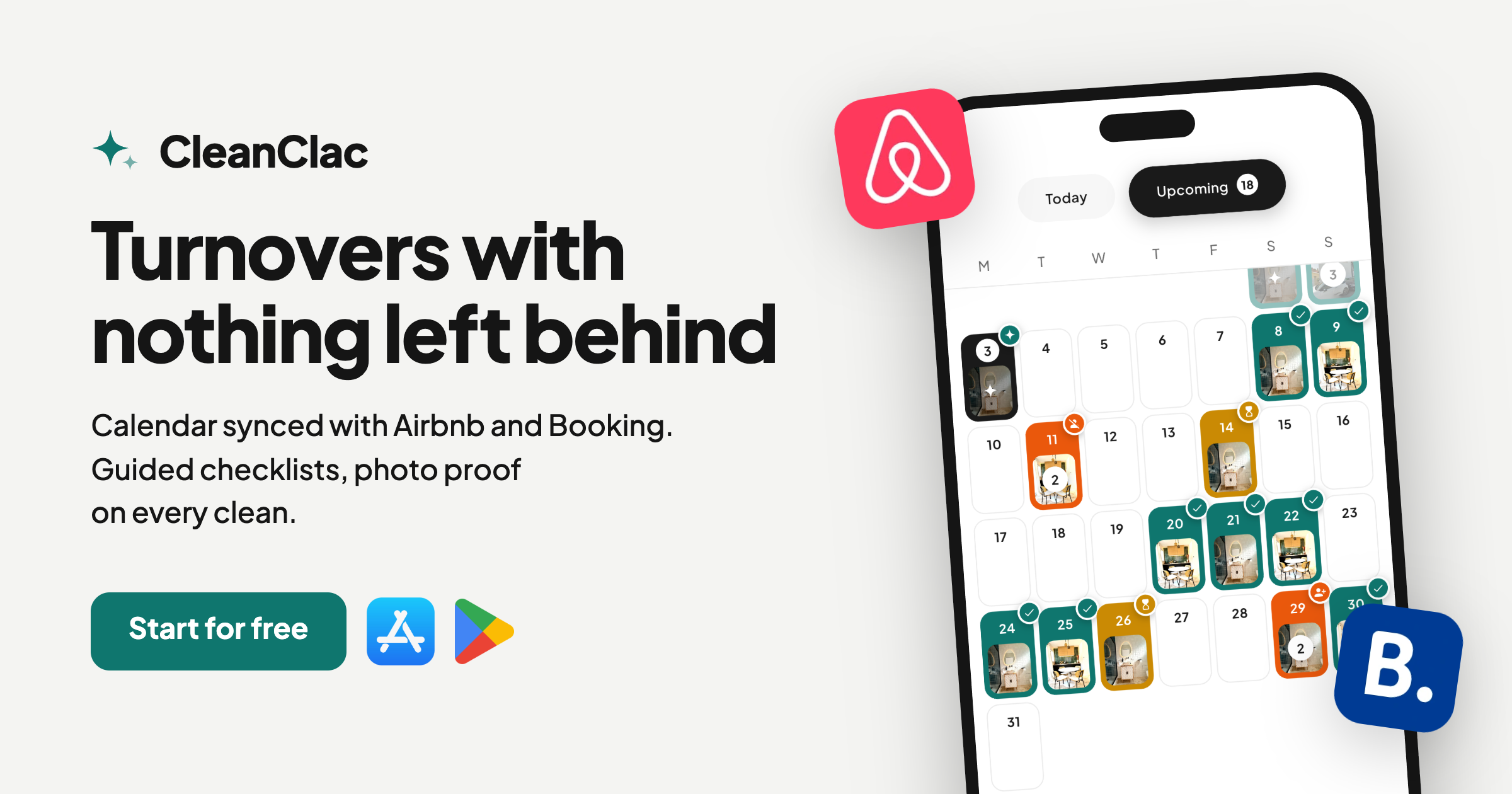
If you manage several properties, CleanClac automates cleaning scheduling from Airbnb, Booking.com, Vrbo, Abritel, and the main PMS, notifies each cleaner, and brings checklists, photos, and stock tracking together in one place.
Subscriptions are billed per active property: 2 properties at €9.99 per month, 3 or 4 properties at €14.99 per month, 5 properties at €19.99 per month, then €4 per month for each additional property. On annual billing, that is €59.99 per year for 2 properties and €119.99 per year for 5, with €24 per year for each additional property (full annual pricing detail). A free plan is available, and a dedicated cleaner app gives each cleaner their own access. To compare tools based on your needs, see our Airbnb cleaning software comparison, or discover CleanClac.
Start this month
You do not need a heavy project to get started. Here is a four-week plan:
- Week 1: write your standard and your 15 to 25 yes/no criteria, weighted. Share them with the team.
- Week 2: ask for photos of key areas after every clean and begin scoring a few properties.
- Week 3: calculate your first compliance and re-clean rates, and compare them with cleanliness comments in guest reviews.
- Week 4: hold an individual catch-up with each cleaner, photos in hand, and set a goal for the following month.
Adjust the pace to the season. At a beach or mountain property, turnovers come thick and fast in peak season, and sand, damp, or sports equipment change the criteria. Our guide to cleaning seasonal rentals and the seasonal deep clean guide both help you adapt your scorecard.
FAQ
What criteria should I use to evaluate an Airbnb cleaner?
Use three groups of criteria: visible results (bathrooms, floors, surfaces, linen), adherence to instructions, and care of the property. Each criterion must be observable and answered yes or no, with more weight given to what guests notice first. Reliability (punctuality, communication) is tracked separately.
How often should I inspect a rental property's cleanliness?
Take photos after every clean and carry out a more thorough inspection once a month on a rotating sample of properties, so every unit in your portfolio is covered over time. Inspect right after the clean, before guests arrive.
Are guest reviews enough to judge a cleaner?
No, they complement your inspections. A review comes in after the stay and can mix cleaning issues with the general condition of the property. Tie each comment to a specific clean, with its photos, and look for repeated patterns across several stays before drawing a conclusion.
How do I share a poor evaluation without putting the cleaner on the defensive?
Stick to facts: the photo, the criterion on the scorecard, and the date. Give feedback quickly, explain what was expected, and set a concrete goal for the next clean. Also mention what was done correctly, so the evaluation is not perceived as a penalty.
Sources
- Évaluation des nettoyeurs en location : méthode et grille
- How to Evaluate Your Short-Term Rental Cleaners
- Note Airbnb : fonctionnement de la notation
- Une grille de contrôle qualité du ménage, pièce par pièce
- Auditer la qualité du ménage de son prestataire
- Preuve de passage nettoyage et fiche de contrôle qualité
- Former ses agents de ménage à une qualité constante
- 10 Expert Tips for Training Cleaning Staff


