How to Evaluate Your Short-Term Rental Cleaners
Learn how to evaluate cleaners in short-term rentals: build a room-by-room checklist, track five monthly indicators, and give feedback that actually improves results.

Jonathan Lalinec

Evaluating a cleaner in a short-term rental comes down to measuring three things: the condition of the property after each clean, the reliability of each visit (timing, turnaround, communication), and the effect on guest reviews. The most effective approach is to define observable criteria, verify them with timestamped photos after every clean, and then run a monthly review of the indicators that actually matter. This article walks through the scoring grid, the control schedule, the indicators, and how to deliver feedback without alienating your team.
In brief
- Score what you can observe (surfaces, odours, linen, consumables), not a general impression. Use a room-by-room grid with yes/no criteria.
- Require proof after every clean: timestamped photos of each key area, linked to a checklist.
- Check closely during a new cleaner's first visits, then move to a monthly review of a handful of indicators.
- Cross-reference your grid with guest reviews and messages to spot recurring issues by property and by cleaner.
- Frame every problem with a photo, a corrective action, and a deadline. The goal is improvement, not punishment.
Table of contents
- Why cleaning quality affects your whole operation
- Define what a quality clean looks like before you evaluate
- Build a room-by-room scoring grid
- Practical checks after every clean
- Indicators to track every month
- Making use of guest reviews and complaints
- Giving feedback that drives improvement
- Our view
- Setting this up with CleanClac
- Sample evaluation schedule
- FAQ
- Sources
Why cleaning quality affects your whole operation
In short-term rentals, cleaning is almost always delegated, yet the host can never watch it happen in real time. Between stays, you depend on someone who works in a tight window, sometimes on a same-day checkout and check-in. A structured evaluation replaces blind trust with facts.
The platforms make the stakes clear. Airbnb describes cleanliness as the single most important element of five-star hospitality, and recommends that hosts clean the property themselves at least once before handing it over to a cleaner. There is a real practical reason for this: it gives you a personal benchmark for what "clean" means in your property, and therefore a reference point for judging someone else's work.
The Guest Favourite status points in the same direction. Airbnb states that these listings must maintain a very strong reliability record, with on average fewer than 1% of stays resulting in a quality-related contact with customer support. Inconsistent cleaning is one of the most direct causes of that kind of contact.
The staffing market is also under pressure. One US short-term rental publication reports that nearly 40% of property managers say they struggle to find reliable cleaning staff. Those figures are American, but the same logic applies in French tourist areas during peak season: once you find a good cleaner, it pays to understand why they are good and to help them stay that way.

Define what a quality clean looks like before you evaluate
You cannot score a shortfall without first stating the standard. Before any evaluation, write down what you expect between stays and hand it to every cleaner. A standard turnover clean typically covers:
- floors and surfaces, including skirting boards, handles, and light switches;
- disinfecting the kitchen (hob, sink, fridge, microwave);
- disinfecting the bathroom and toilet, with a check of grout and the drain;
- changing and laundering linen, making the beds;
- airing the property, checking for odours, cleaning mirrors and windows;
- restocking essentials (toilet paper, soap, coffee pods, bin bags);
- reporting damage, forgotten belongings, or missing items.
These points appear in most short-term rental cleaning guides. To go further, our illustrated list of 166 Airbnb cleaning tasks lets you build a custom scope for your property type, and the guided, illustrated cleaning checklist gives your cleaner a daily reference in their own language.
One important note: a coastal, mountain, or rural property has different constraints (sand, humidity, log burner, outdoor areas). Adapt your scope accordingly, as we explain in our guide to cleaning seasonal rentals by the sea, in the mountains, or in the countryside.
Build a room-by-room scoring grid
A good grid is built on observable criteria: two different people checking the same property should reach the same score. "Bathroom is clean" is subjective; "no limescale on the taps, no hair in the shower, no smears on the mirror" is not.

The principle: yes/no, weighted by severity
Each criterion gets a binary answer and a weight based on its impact on guests. A hair in the bath or a stained sheet matters more than dust on a high shelf. Here is a sample grid you can adapt.
| Area | Observable criterion | Severity |
|---|---|---|
| Bathroom | No hair or marks in shower, basin, or toilet | High |
| Bathroom | Mirror and taps free of smears | Medium |
| Kitchen | Hob, sink, and fridge clean and odour-free | High |
| Kitchen | Dishes put away, sponge and products in place | Medium |
| Bedroom | Clean linen, no stains, bed made to standard | High |
| Bedroom | Under the bed and tops of furniture dust-free | Low |
| Living area | Floors vacuumed and mopped, sofa free of crumbs | Medium |
| General | Property aired, no residual odour | High |
| Consumables | Minimum stock present (paper, soap, bags) | Medium |
| Reported issues | Damage or forgotten items noted with a photo | High |
You might assign 3 points to high-severity criteria, 2 to medium, and 1 to low, then calculate a compliance percentage. Keep the grid short: beyond around twenty criteria, nobody fills it in seriously.
Separating three types of issues
Always distinguish between:
- cleaning failures (dirt, something missed);
- physical damage (permanent stain, broken item, wear and tear);
- missing or displaced items.
This separation prevents you from blaming a cleaner for damage that dates from a previous stay, and gives you a usable record for maintenance or a platform claim.
Practical checks after every clean
You do not need to be on-site at every turnover. Three levels of checking work together.
Evidence-based checking
After every clean, the cleaner photographs the agreed areas: made bed, bathroom, kitchen, entrance, consumables. Photos are timestamped and linked to the checklist, so you can verify in two minutes from your phone. This is exactly what the Airbnb cleaning report with timestamped photos is designed for: every visit leaves a dated record you can consult if a dispute arises with a guest.
On-site checking
For a new cleaner, do a full in-person check on the first two or three cleans. This calibrates the expected standard and lets you correct bad habits early. Once that onboarding phase is done, a detailed check at every single clean becomes unnecessary and burdensome for everyone. A monthly visit covering a representative sample of your properties, using the grid above, is generally enough. Treat that as a sensible benchmark and adjust it to your volume and your guest feedback.
Results-based checking
The guest remains the best evaluator. Their reviews, their arrival messages ("there's hair in the shower"), and their cleanliness ratings are a free quality control, provided you use them systematically. The next section covers exactly that.
Indicators to track every month
A useful evaluation comes down to five indicators per cleaner or team, reviewed once a month. More figures do not make the evaluation more accurate, only heavier.
| Indicator | What it measures | How to calculate it |
|---|---|---|
| Guest cleanliness rating | Perceived result | Average cleanliness score for stays following each clean |
| Compliance rate | Grid adherence | Points scored / points possible across all checks |
| Redo rate | First-pass quality | Number of cleans redone / total cleans |
| Photo compliance | Evidence discipline | Cleans with all required photos / total cleans |
| Timing and responsiveness | Reliability | Late handovers, response time to messages |
| First-24-hour incidents | Issues visible on arrival | Cleanliness complaints received on check-in day |
Be careful with interpretation. A high redo rate can come from the cleaner, but it can also come from a poorly equipped property, a window that is too tight, or linen delivered late. Always read an indicator in context before drawing conclusions. For tight windows, our guide on same-day turnover cleaning explains how to maintain quality when checkout and check-in fall on the same day.
Consumables also deserve tracking: an empty stock at the start of a stay is a cleaning failure in a guest's eyes. Handling stock management clean by clean prevents the cleaner from being blamed by default for a missing toilet roll.
Making use of guest reviews and complaints
A single review is an anecdote; ten classified reviews are a trend. Keep a simple shared table with these columns:
- the property and the stay date;
- the cleaner who did the preceding clean;
- the issue type (hair, odour, dust, linen, consumables, kitchen);
- the severity (minor, inconvenient, blocking);
- the action decided and its close-out date.
After a few months, this table answers concrete questions. Does the same issue keep appearing in a single property (an equipment or instruction problem), or across all the properties handled by one cleaner (a method problem)? Do complaints cluster on express-turnover days?
Cleanliness is one of the most common complaint themes in accommodation. A 2026 academic study of negative hotel reviews in Malaysia found that cleanliness and hygiene failures account for 21.5% of complaints, often linked to process or maintenance failures. The context is Asian hospitality, not French short-term rentals, but the lesson holds: a cleanliness problem usually has an organisational cause, not just an individual one.
Giving feedback that drives improvement
Evaluation is pointless if the cleaner never sees it or experiences it as punishment. A few simple rules:
- Share expectations before the first clean: the checklist, the photos to take, the bed-making standard.
- Back every comment with a photo and context: "bathroom, shower, 2 pm, see photo" rather than "it was dirty."
- Prioritise: three points to fix are worth more than fifteen.
- Assign an action and check it at the next clean.
- Acknowledge what goes well: a good photo compliance rate or three months without a redo is worth saying out loud.
A short monthly quality catch-up fits the same spirit: it belongs to a culture of continuous improvement, not routine punishment. For a team of several people, a cleaning team management tool where each cleaner can see their schedule, their checklist, and your feedback avoids messages scattered across texts and chat apps.
If a cleaner still cannot meet the standard after clear, repeated feedback, it is reasonable to make a change. Have a fallback ready before you need it: being able to find a cleaner without a commission fee at short notice prevents a property from going unclean the night before a check-in.
Our view
We see the same situation every day: a host who does not evaluate their cleaning because they do not have time, and who discovers the problem in a three-star review. The time is missing because the oversight is manual, so it gets skipped.
Our belief is that an evaluation only sticks if it is a by-product of normal work. When the cleaner follows a checklist on their smartphone and takes photos as they go, the evidence exists with no extra effort for them or for you. You are no longer checking everything. You are looking at exceptions.
That is why we built CleanClac around simple, individual access for each cleaner, illustrated reports, stock tracking, and performance monitoring. We do not take a commission on jobs: your relationship with your team stays yours, and the tool is there to make it clearer, not to sit in the middle of it.
Our advice if you are starting out: pick ten criteria, not fifty, require five photos, and run a monthly review. In three months you will have more visibility than most property managers have in three years.
Jonathan
Setting this up with CleanClac
If you manage several properties, CleanClac automates clean scheduling from your platform bookings, notifies your cleaners, collects photo reports, and tracks stock. Each cleaner has their own mobile access, and the app integrates with the main PMS tools.
On pricing, the subscription is charged per active property. The rates published on our pricing page include a free plan, then €9.99 per month for 2 properties, €14.99 per month for 3 or 4 properties, and €19.99 per month for 5 properties, with €4 per month for each additional property. On annual billing, 2 properties cost €59.99 per year and 5 properties €119.99, with each additional property at €24 per year.
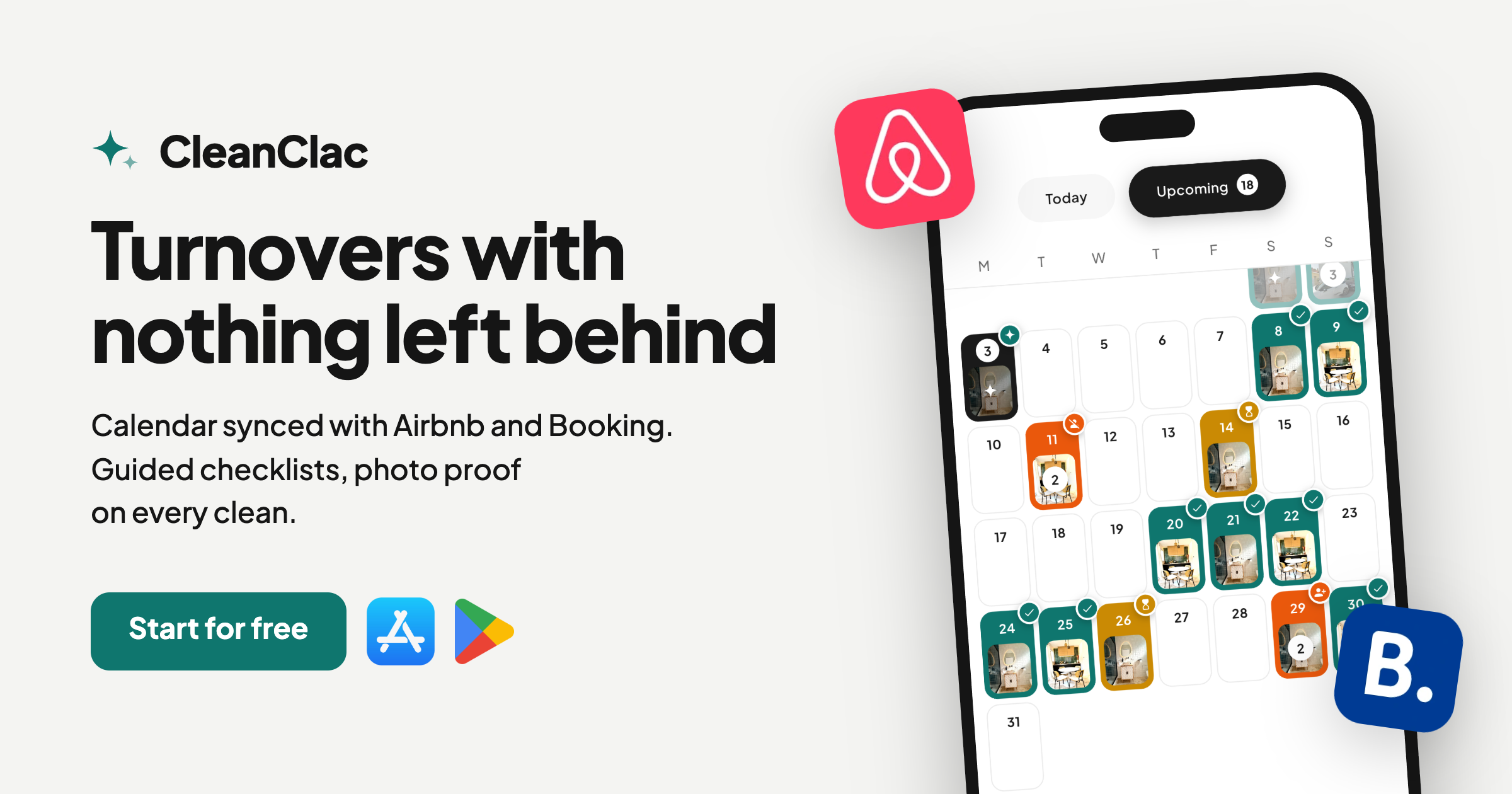
Your cleaners also have a dedicated cleaner app where they can view their schedule and complete their checklists.
Sample evaluation schedule
To keep the process manageable, here is a realistic rhythm. Adjust it to your number of properties.
| When | Action | Estimated time |
|---|---|---|
| Before the first clean | Hand over the checklist, scoring grid, and photo standard | 30 minutes |
| First 2 to 3 cleans | Full check on-site or via detailed photos | 15 minutes per clean |
| Every clean | Quick review of photos and reported issues | 2 minutes |
| Every week | Read guest messages and reviews, update the tracking table | 10 minutes |
| Every month | Calculate the five indicators, give feedback to the cleaner | 30 minutes |
| Every season | Deep clean and scope review | Varies by property |
The seasonal review is the moment to cover what turnover cleans do not reach: under furniture, bedding, outdoor areas, appliances. Our seasonal deep-clean protocol details what to include. Evaluate it with a dedicated grid rather than the one you use for regular cleans.
FAQ
How often should you evaluate a cleaner?
Do a thorough check on the first two or three cleans with a new cleaner, then move to a quick photo review after each clean and a monthly review of your key indicators. Detailed checks at every single clean are time-consuming and rarely necessary once your standard is established. Increase the frequency if cleanliness ratings start to drop.
Which criteria should you use to rate cleaning quality?
Choose observable criteria with yes/no answers, grouped by room: kitchen, bathroom, bedroom, living area, consumables, and reported issues. Weight them by their impact on guests, giving more importance to linen, toilets, and odours than to dust on high shelves. A maximum of around twenty criteria keeps the checklist usable.
How do you prove a clean was done if a dispute arises?
Require timestamped photos of key areas after every clean, linked to a completed checklist. This dated record lets you show the condition of the property at the end of the clean if a guest complains, and helps you distinguish a cleaning issue from damage that occurred during the stay.
What should you do if reviews keep mentioning the same problem?
Log reviews in a table by property, issue type, and cleaner. If the problem keeps appearing in a single property, check the equipment and your instructions. If it follows one cleaner from property to property, revisit the method with photos as evidence, set a corrective action and a deadline, then check at the next clean.
Do you need software to evaluate your cleaners?
No. A spreadsheet and photos sent by messaging app are enough to get started with one or two properties. Software becomes useful as your volume grows, because it centralises scheduling, checklists, photos, and stock tracking, and cuts the time you spend on oversight.
Sources
- Airbnb, Ensuring your place is sparkling clean
- Airbnb, Understanding Guest Favorites
- Short-Term Rental Cleaning Staff Shortages: Why 2026 Won't Improve
- Service failures and perceived fairness in Malaysian hotels (2026 study)


