Self check-in compliance guide for hosts in France
Learn how to run self check-in legally in France: police registration forms, secure access devices, and a cleaning protocol that protects every stay.

Jonathan Lalinec

Yes, self check-in is legal in France, provided you meet specific obligations around guest registration and access security. Three priorities must be in place before any automation: administrative compliance (police registration form, listing registration number), secure technical access (key safe, smart lock), and a reliable cleaning protocol between every stay. The sections below cover each of those three pillars in detail.
In brief:
- Administrative compliance means collecting an online police registration form for certain guests and verifying your property's registration number under the rules that apply in your local area.
- Access security should favour logged entry with a smart lock, or time-limited access codes, to reduce risk.
- The cleaning protocol must include timestamped photo evidence and a final inspection to guarantee a clean, compliant property before every arrival.
- Automating cleaning coordination through a dedicated platform ensures operational continuity and makes managing multiple properties viable.
- The success of self check-in depends mainly on strict application of administrative processes and consistent proof of cleaning quality, not on the particular access device you choose.
Table of contents
- Legality and obligations for self check-in in France
- Autonomous access options: pros, limits and compliance
- Self check-in operational flow: a step-by-step process
- Organising the clean between checkout and check-in: checklist and standard durations
- Planning and operational continuity: assignments, backup and automation
- Best practices and common mistakes to avoid
- CleanClac perspective: automating cleaning and self check-in coordination
- What self check-in really changes for hosts
- Automating cleaning to secure every self check-in
- Sources
- Frequently asked questions
Legality and obligations for self check-in in France
No French law prohibits self check-in. The question is not whether the practice is legal, but what obligations come with it, and those obligations are substantial for anyone letting a furnished short-term rental.
The first obligation concerns the individual police registration form, required for every non-EU guest who is also not a citizen of the European Economic Area or Switzerland. This form must be completed before or at the time of arrival, which creates a genuine practical challenge with self check-in since there is no in-person welcome at which to collect it. The practical solution is to build form collection into the pre-arrival process: send a digital form with the access instructions, before the code or lock is activated.
The second obligation relates to registering the rental itself. Most local authorities require a registration number, obtained from the town hall, which must appear on all listings and in some cases be reported to local authorities. The rules differ considerably from one commune to the next: some cities cap the number of nights allowed per year for a primary residence, others require a change-of-use permit for second homes. Checking the municipal order that applies to your specific address is therefore a prerequisite, before you even think about automating your welcome.
Some local authorities also regulate the physical devices used for autonomous access. Installing a key safe on a wall facing a public road, for example, may require a permit or be outright prohibited depending on local street regulations.
Three checks are essential before launching any self check-in protocol:
- Confirm whether the individual police registration form is required, based on the nationalities of the guests you expect.
- Verify your registration number and the letting conditions set by your commune's municipal order.
- Check local rules on installing access devices in public-facing spaces.
For any questions relating to the collection of personal data as part of these procedures, the CNIL is the reference authority, particularly where the access device includes a camera or digital logging system.
Autonomous access options: pros, limits and compliance
Three families of device dominate the self check-in market, and each carries a different risk profile.
The key safe with a code remains the most widely used option because of its low cost and simple installation. It suits isolated properties or hosts managing a small number of rentals, but it has a structural weakness: once shared, the code is hard to trace, and nothing prevents unauthorised reuse if the host forgets to change it between stays.
The smart lock corrects that weakness through logging. Every entry generates a timestamped record that can be checked remotely, making it possible to verify that a guest entered within the expected window and to detect any access attempt outside that slot. Installation costs are higher, and a stable network connection is required, which can be a problem in some rural areas.
The key-collection point, whether a local concierge service or a partner business, retains a human element while removing the need for the host to be present. This option reassures guests who are unfamiliar with digital locks, but it depends entirely on the collection point's opening hours, which limits flexibility for late check-ins.
- The key safe suits small volumes and tight budgets, but requires strict manual code rotation between every stay.
- The smart lock offers traceability and remote management, at the cost of connectivity dependency.
- The key-collection point reassures guests but constrains arrival times.
Whatever device you choose, the access code must remain temporary: activated a few hours before the stated arrival time and deactivated as soon as the guest checks out. Systematically rotating codes between every stay limits the risk of unauthorised access, as does keeping a separate emergency code for the host or a backup contact, never shared with guests.
Pro tip: always set an activation window shorter than the stay itself, for example two hours before the official check-in time, to minimise the period during which the code is live.
Self check-in operational flow: a step-by-step process
A reliable self check-in follows a precise sequence where each step prepares the next and reduces the risk of surprises at arrival.
- Pre-arrival: collect the information you need (estimated arrival time, number of guests, nationality for the police form) via an automated message sent 24 to 48 hours before the stay.
- Document verification: if the individual police registration form is required, have it completed online before access is activated, never after.
- Access activation: generate or activate the code a few hours before the stated check-in time, never the evening before, to keep the code's validity window as short as possible.
- Welcome message: automatically send the access instructions, house rules, and useful contacts at the exact moment the code is activated.
- Post-arrival check: a confirmation message asking the guest to report any issue within the first hour of arrival lets you detect an access or cleanliness problem quickly.
- Incident management: have an on-call contact reachable by phone and a clear escalation procedure for cases where the guest cannot get into the property.
Automated communication is the backbone of this flow, but it does not replace human vigilance. An access incident left unresolved for more than fifteen minutes after it is reported degrades the guest experience rapidly and can lead to a negative review, regardless of the property's quality.
Pro tip: always use two communication channels for access instructions (in-app message and SMS), as some international guests will not have mobile data when they arrive.

Organising the clean between checkout and check-in: checklist and standard durations
The clean between two stays follows the logic of a full reset of the property, room by room, rather than a quick tidy. A turnover cleaning checklist systematically covers the bedroom, bathroom, kitchen, living areas, and outdoor spaces, and ends with a final inspection.
In the bedroom, all bed linen is changed, surfaces are dusted, and touch points (light switches, door handles) are disinfected. The bathroom requires a systematic check for limescale, replacement of towels, and restocking of welcome toiletries. The kitchen calls for a check of the fridge, appliances, and crockery, an area that is often overlooked yet generates a significant share of guest complaints. Living areas and outdoor spaces (terrace, balcony, entrance) complete the checklist, before a final inspection signs everything off.
Standard cleaning durations vary logically with property size: a studio or one-bedroom typically takes between 1.5 and 2.5 hours; a two-bedroom generally requires a proportionate amount of time, typically two to three hours; a three-bedroom takes between 3 and 4 hours, with a 30-minute final inspection added in every case.

The four-hour buffer between an 11 am checkout and a 3 pm check-in remains the most stable operational reference for a two-bedroom property, according to Boring Host. Shrinking that window noticeably increases the risk of items being missed on the checklist.
To validate a turnover without always visiting in person, three types of evidence are generally sufficient:
- Timestamped photos of each key room, sent by the cleaner at the point of sign-off.
- An explicit confirmation from the cleaner in the app or by message, marking the property as ready.
- An occasional spot-check by the host, 10 to 15 minutes long, carried out at random to verify the actual quality of the work.
On linen, the practical rule recommended across the industry is to keep three complete sets per bed: one in use by the current guest, one in the wash, and one clean and immediately available. This prevents a laundry delay from blocking a turnover.
Planning and operational continuity: assignments, backup and automation
Managing one property with self check-in leaves some room for improvisation. Managing several does not. A single incident without a contingency plan can cascade across multiple check-ins on the same day.
- Assign cleans by time slot and priority: properties with the earliest afternoon check-in go to the front of the queue for available cleaners.
- Identify a backup cleaner in advance, rather than scrambling for a replacement at the moment a delay is confirmed.
- Use an external local provider as a last resort, via a cleaning company directory or a matching platform, when internal resources fall short.
- Automate the chain from PMS to cleaning task to photo proof to guest message. According to RapidEye, this is what allows hosts to scale from a handful of properties to several dozen without multiplying manual coordination work.
The one-hour-before-check-in control point, often called the "3 pm check" in English-language operational guides, structures this continuity. At that precise moment, every property must be marked ready or escalated, with a proactive message sent to the guest if a delay is confirmed. Tracking the percentage of turnovers validated on time and the average incident resolution time gives a concrete basis for adjusting cleaner capacity before complaints start to accumulate.
Best practices and common mistakes to avoid
Three mistakes appear consistently in negative reviews linked to self check-in. The permanent access code that is never changed between stays comes first: it exposes the host to unauthorised entry and complicates any investigation if something goes wrong. The absence of a post-clean inspection comes second, relying entirely on trust in the cleaner with no photo proof. The police registration form that is forgotten or collected too late comes third, leaving the host with an administrative breach that is very difficult to remedy once the guest has already arrived.
The best practices that correct these mistakes are straightforward to implement:
- Rotate the access code between every stay, without exception.
- Require a timestamped photo of each key room before considering a clean complete.
- Build police form collection into the automated pre-arrival message.
On the legal and insurance side, verifying that your public liability policy covers damage caused by a third-party contractor is a precaution that is too often overlooked, as is limiting the retention period for access data you collect.
Pro tip: put your quality expectations in writing with every cleaner. Clear instructions significantly reduce disputes about the state of the property.
CleanClac perspective: automating cleaning and self check-in coordination
Self check-in shifts the verification burden from the welcome to the clean. Without a host present to assess the property's condition, proof of the work done becomes the only quality guarantee. CleanClac addresses this directly by giving each cleaner individual smartphone access, with automatic notification as soon as a booking triggers a cleaning need.
Each cleaner can document their visit with timestamped photos, viewable in real time by the property manager, reconstructing remotely the inspection the host can no longer carry out in person. Supply tracking is integrated into the same workflow, preventing a clean from being marked complete when a welcome item is missing.
Integration with the main PMS platforms automatically links an Airbnb, Booking.com, or Vrbo reservation to an assigned cleaning task, with no manual re-entry, reducing the risk of a clean being missed on days with multiple turnovers.
What self check-in really changes for hosts
Most guides on self check-in focus on the access technology, smart lock versus key safe, as if the choice of device determined the success of the stay. That is the wrong priority. The access technology simply replaces a physical key with a code: it guarantees neither the cleanliness of the property nor administrative compliance, and those are the two areas where real risk is concentrated.
The real challenge of self check-in is the absence of a human filter at arrival. Without an in-person welcome, no mistake corrects itself on the fly. A rushed clean, a missed police form, or a badly communicated code is discovered directly by the guest, not by the host. That means the rigour of the cleaning protocol and administrative discipline matter far more than whichever access gadget you choose.
Prioritise in this order: compliance first (police form, registration), then systematic proof of cleaning, and only then the convenience of the access device. Hosts who reverse that order discover their weak points at the worst possible moment, in front of a guest who has already arrived.
, Jonathan
Automating cleaning to secure every self check-in
Self check-in depends entirely on the reliability of the previous clean. Without a host to verify the property's condition, the photo record is the only safety net before the next guest arrives. CleanClac automates this chain by connecting your bookings to cleaning scheduling, with immediate notification to the cleaner and real-time tracking of every property's status.
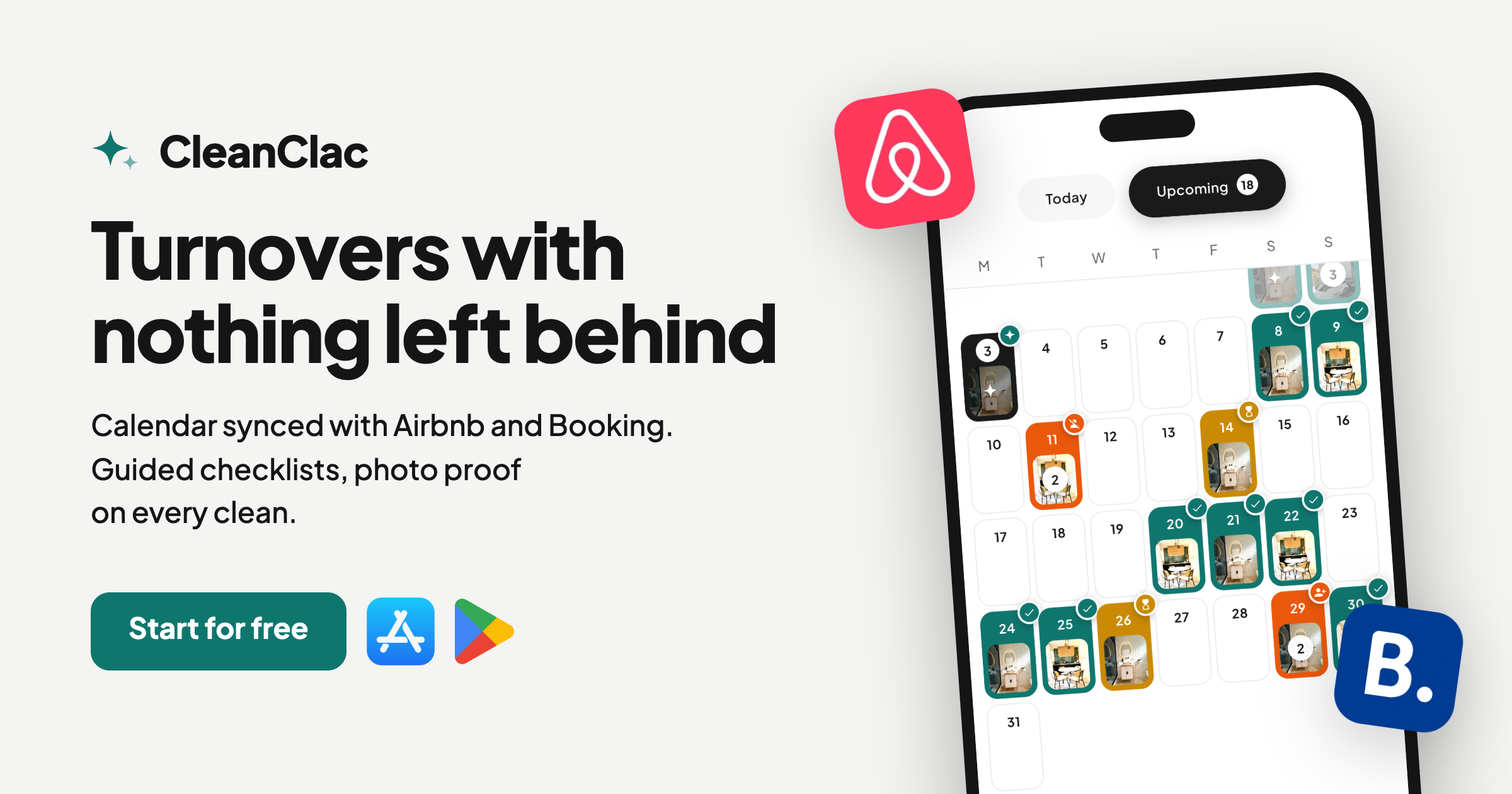
The app offers individual smartphone access for each cleaner, with no commission taken on jobs, and integrates with the main PMS platforms on the market. Plans start from several properties, with pricing tiers visible on the pricing page. Check the available plans to find the one that fits the number of properties you currently manage.
Sources
To go further on the compliance and operational aspects covered in this guide, these resources allow you to verify the most sensitive points:
- Vacation Rental Turnover Cleaning Checklist 2026
- Airbnb checkout and cleaning turnover: 2026 Guide · Boring Host
- How to Manage Back-to-Back Vacation Rental Turnovers | RapidEye
- La vidéoprotection | CNIL
Before implementing anything, always check the municipal order for your commune, as local rules vary considerably from one town to the next.
Frequently asked questions
What is self check-in?
Self check-in is an arrival method where the guest accesses the property without a physical welcome from the host, using a code, a smart lock, or a key-collection point. In France it is subject to the same administrative obligations as a traditional welcome, including the individual police registration form for guests who require one.
What are the usual check-in times?
The most common operational standard places check-in at around 3 pm, with checkout at 11 am the same day, according to Boring Host. That four-hour window gives enough time to complete a full clean in a two-bedroom property.
What is the difference between check-in and checkout?
Check-in is the moment the guest takes possession of the property and receives access. Checkout marks their departure and the end of their stay. The turnover clean that prepares the property for the next arrival happens between those two moments.
What is a check-in?
A check-in is the formality by which a guest officially begins their stay in a property, whether through an in-person welcome or a self check-in with autonomous access.
How do you avoid cleaning delays before a self check-in?
Identifying a backup cleaner in advance and automating the notification as soon as a booking is confirmed significantly reduces the risk of an unexpected delay. Tools like CleanClac let you track the status of each property in real time and trigger an alert before the critical check-in time.


