Booking cancellation affects a clean: what to do now
When a booking cancellation wipes a scheduled clean, follow this step-by-step workflow to sync your PMS, notify your cleaner, and avoid platform penalties.

Jonathan Lalinec

When a booking cancellation removes a scheduled clean from your calendar, never delete the task blindly. Check the cancellation source in your PMS or the relevant OTA first, let the status sync with your management tool, then confirm or reschedule the clean. Notify your cleaner straight away and keep a timestamped record of the reason. This sequence prevents duplicate tasks and disputes with the platforms.
In short:
- Always check the exact status in the PMS or the OTA before cancelling or rescheduling a cleaning task, to avoid sync errors.
- Allow up to 24 hours for a cancellation to propagate via BUS or iCal feed before treating the change as final.
- Automate the archiving of evidence and team communication to reduce errors and simplify dispute management.
- For a last-minute cancellation, inform your cleaning staff quickly while keeping accurate documentation to contest any penalties.
- Smart handling of lead times, evidence, and notifications matters more for compliance than the technical sophistication of your tool.
Table of contents
- Immediate checklist for the manager and the cleaning team
- How a cancellation propagates between the PMS, the OTA, and your SaaS
- Step-by-step: cancelling or rescheduling a clean in your SaaS
- Refunds, platform penalties, and ranking impact
- Three workflow models for a cancelled clean
- What I take away from watching these cancellation flows
- Cleanclac automates cancelled-clean management
- Sources
- Frequently asked questions
Immediate checklist for the manager and the cleaning team
You have between 30 and 60 minutes to respond correctly after a cancellation notification, or your team's schedule falls apart. Here is the action order that works in real operations:
- Identify who triggered the cancellation: the guest, the OTA, or yourself via the IPM. Note the exact time of the event.
- Check the PMS or channel manager before making any change, because some integrations delay the display of the new status.
- Update the task in your cleaning SaaS: cancelled, rescheduled, or set to standby, depending on what the source platform confirms.
- Send a push notification or SMS to the cleaning team, with an alternative if needed, such as a slot swap or a backup provider via a cleaning company directory.
- Adjust the supplies earmarked for that property and inform the owner if the calendar changes in a visible way.
That last step is often dismissed by busy managers. It prevents unnecessary stock orders for weeks when the property sits empty.
How a cancellation propagates between the PMS, the OTA, and your SaaS
A cancellation never propagates instantly everywhere, and that is where most scheduling errors begin. On Airbnb, the host is notified immediately when a guest cancels: the calendar unblocks and the refund applies according to the chosen policy. The process changes dramatically once you go through a native integration or an iCal feed, where latency can reach several hours.
With Vrbo, reservation statuses travel through the BUS/API and the update can take up to 24 hours before the cancellation is visible on the manager's side. Booking.com works differently: the platform offers the OTA_HotelResModifyNotif endpoint to retrieve modifications and cancellations, provided you poll the API regularly and acknowledge changes.

Pro tip: set an internal rule of 24 hours before treating a BUS or iCal cancellation as final, and keep an audit log that records every status correction. This buffer stops you from releasing a cleaner on a cancellation that will itself be reversed.
Step-by-step: cancelling or rescheduling a clean in your SaaS
Once the status is confirmed, your process in the management tool must stay identical every time, with no improvisation:
- Refresh the imported booking and check the "cancellation status" field before touching the cleaning task itself.
- Apply an automatic task cancellation only if the PMS confirms the status without ambiguity. Otherwise, lock the task manually while you wait for confirmation.
- Record the reason and a piece of evidence, a screenshot or a timestamp, then trigger the refund or the release of reserved supplies where relevant.
- Set up automatic backup rules and zone-based assignments in advance, so a freed cleaner can be reassigned without manual intervention.
That last step is a game-changer during busy periods. A cleaner freed at 10 a.m. can cover an urgent job 30 minutes away, provided your SaaS can automatically re-offer available slots by area rather than leaving a blank schedule.
Refunds, platform penalties, and ranking impact
Not all cancellations are equal in the eyes of OTAs. A guest-initiated cancellation is neutral for you, while a partner-initiated cancellation can affect your ranking and trigger penalties on certain platforms.
In that case, a cancellation waiver request may apply if you document the situation properly:
- Gather evidence of force majeure: a technical outage, property damage, or a proven logistical impossibility.
- Keep your message threads with the guest and screenshots of the problem encountered.
- Contact the OTA's support within its stated deadline, often just a few days.
One point that is often overlooked: changing your cancellation policy never applies retroactively to bookings already confirmed.
Three workflow models for a cancelled clean
Cancellation scenarios repeat themselves in almost the same way in real operations. Here are three workflows you can reproduce as-is:
- Guest cancellation, 48 hours or more before check-in: cancel the task in the SaaS, release the cleaner immediately for another job, and update the owner with an automatic notification.
- Modification with a late checkout: simply shift the window of the existing task, notify the cleaner of the new slot, and adjust the allocated cleaning time if the window becomes tight.
- Last-minute cancellation or cancellation after check-in: document the situation systematically, dispute with the platform if the charges seem unjustified, and offer the owner quick replacement options.
A concrete example illustrates workflow 1 well. When an Airbnb booking cancels via the native integration, the app automatically unassigns the cleaner from the task, archives the last available photo evidence in the property's history, and notifies the owner and the cleaner in parallel.
Automating cleaning turnovers rests on three pillars: PMS sync, reliable assignment rules, and systematic photo verification. This trio sharply reduces coordination errors and the time wasted correcting schedules.
This type of flow, documented by SuiteOp on automating cleaning turnovers, is what most specialist SaaS tools are trying to replicate today.
What I take away from watching these cancellation flows
The number-one priority is not the most sophisticated tool: it is real-time sync combined with assignment rules that do not depend on constant manual intervention. Most platform penalties stem from a lack of evidence, not a lack of good faith. Automating logs, photos, and timestamps protects the manager and the owner equally. Training your cleaning team on cancellation procedures matters just as much as the technology, because a cleaner who understands why a task has disappeared from the schedule communicates far better with the end client.
, Jonathan
Cleanclac automates cancelled-clean management
Handling every multi-platform cancellation by hand ends up costing more time than the clean itself. This solution syncs bookings from several platforms with cleaning tasks, notifies the relevant cleaners in real time, and automatically archives reports with photo evidence in case of a dispute.
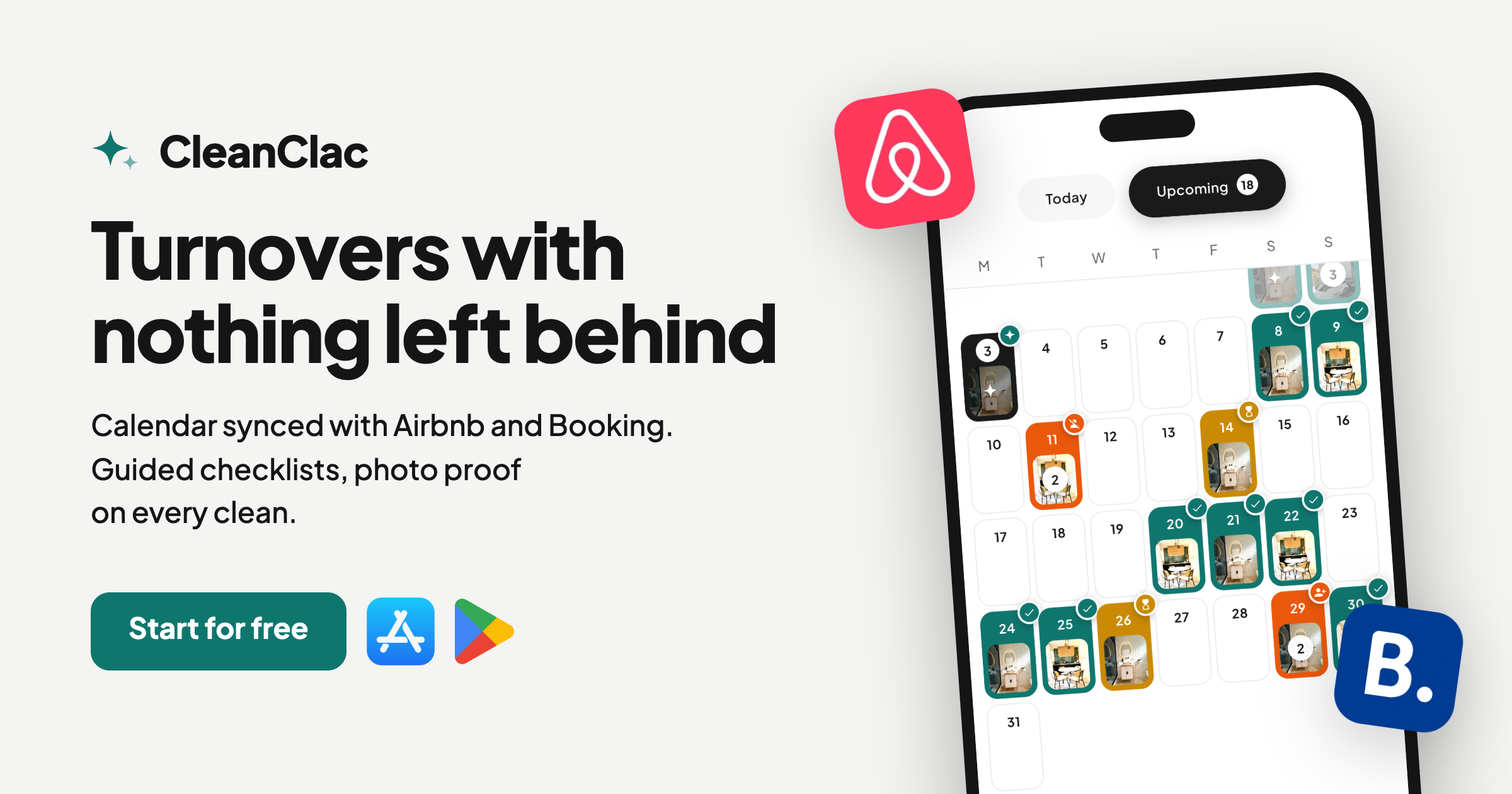
The app gives each cleaner individual mobile access, making organisation straightforward without complex manual management. Inventory tracking limits unnecessary orders for properties that have recently been vacated. Pricing starts at 9.99 € per month for two properties, with a free plan to test how it works. Cleaners can explore their dedicated space on the cleaner app before the team has even fully onboarded. Try the sync on your first properties today.
Sources
- If your guest cancels their reservation · Airbnb Help
- Retrieving modified/cancel reservations · Booking.com Connectivity
- Automate cleaning schedules for short-term rentals · SuiteOp blog
Frequently asked questions
What should you do first after a cleaning task is cancelled?
Check the actual status in the PMS or the OTA before touching the task in your SaaS, then notify the cleaner with the reason. This check prevents you from cancelling a task based on information that has not yet been confirmed.
How long does sync between the OTA and the SaaS take?
It depends on the integration. Vrbo reports up to 24 hours via its BUS/API, while Airbnb notifies the host almost immediately. Always allow a reasonable buffer before treating a status as final on indirect integrations.
Does a host cancellation hurt my ranking on the platforms?
A cancellation initiated by the partner can affect your ranking on certain OTAs, unlike a cancellation made by the guest. That is why documenting the reason remains essential if you need to request a waiver.
What should you do if the cancellation happens after the guest has checked in?
Document the situation with photos and message threads, then dispute any charges with the platform's support team if you believe the penalty is unjustified. Then offer the owner a quick replacement solution for the rest of the calendar.