Cleaning Delays in Short-Term Rentals: What to Do
Learn why cleaning delays happen in short-term rentals and how to prevent them with better scheduling, linen stock, and backup cleaners.

Jonathan Lalinec

A cleaning delay is straightforward to define: the turnover of a property between two bookings is not finished in time for the next guest's check-in. The decisions made calmly before a crisis hits are what separate a scalable cleaning operation from one that collapses at the first unexpected problem.
In brief:
- A cleaning delay most often comes from manual scheduling, insufficient linen stock, or an unplanned absence, all of which increase the risk of disputes and lost revenue.
- Preventing delays requires precise documentation, systematic photo checks, and a safety buffer of around 30 minutes built into every turnover.
- Automated management through an app like CleanClac optimises task assignment, photo traceability, and stock tracking, cutting human error considerably.
- Checklists, escalation protocols, and backup plans structure a fast response when something goes wrong and limit the impact of any delay.
- The growth of the short-term rental sector makes digital tools essential for maintaining a consistent standard, because even a minor delay can immediately damage your reputation and your revenue.
Table of contents
- Why do cleaning delays happen and what do they really cost?
- Which preventive measures actually reduce cleaning delays?
- Which checklist and escalation templates to use
- How management apps reduce the risk of delays
- What cleaning delays really reveal about your operation
- CleanClac: the tool built to prevent delays at scale
- Sources
- Frequently asked questions
Why do cleaning delays happen and what do they really cost?
A delay never occurs without an identifiable cause. Five causes come up repeatedly among short-term rental managers:
- A schedule managed by hand (texts, spreadsheets, phone calls) that is not synced with bookings in real time.
- Insufficient linen stock, which stalls the entire rotation cycle the moment a laundry run falls behind.
- An unplanned cleaner absence with no replacement plan defined in advance.
- Urgent maintenance discovered during a clean (a leak, a breakdown, damage) that extends the job without alerting anyone.
- Overlapping bookings, where checkout and check-in are too close together to allow realistic cleaning time.
The impact goes well beyond one unhappy guest. Airbnb gives guests 72 hours to report a cleanliness issue, which opens the door to a partial refund, a property reassignment, or a dispute that weighs on the host's account. And cleanliness is not just a compliance issue: a study published in the Journal of Regional Science shows that a high cleanliness rating increases revenue by around 17.5% and occupancy by around 16.5% for short-term rentals. Every unmanaged delay erodes both figures at once.
Pro tip: A 20-minute delay seems harmless, but it often triggers a chain reaction: the next cleaner arrives late for their own job, the photo report never gets sent, and the manager only finds out when the guest is already complaining at the front door.
The rapid growth of the short-term rental sector has created a clear demand for inspection and standardisation tools capable of handling this volume without multiplying human errors.

Which preventive measures actually reduce cleaning delays?
Preventing a delay always costs less than fixing one. Four areas, tackled in this order of priority, build a reliable operation:
- Document a standard procedure room by room. A written SOP spells out the order of tasks, the areas to check, and the time allocated per room. Hostfully notes that this documentation makes quality reproducible, regardless of which cleaner is on the job.
- Make photo checks mandatory at every turnover. Each cleaner finishes their job by taking photos of critical areas and sending them before leaving the property.
- Build in a buffer day or safety margin. The most widely used rule of thumb is to subtract around 30 minutes from the estimated cleaning time as a buffer. If the job looks likely to run over, block the night or send a second cleaner rather than risk a negative review.
- Set par levels for linen and supplies. Three sets of linen per bed is the most commonly cited starting point. Outsource laundry if the volume exceeds internal capacity.
The choice of staffing model, in-house, outsourced, or hybrid, depends mainly on property volume and location. A directory of local contractors lets you cover peaks and absences without sacrificing quality standards, while an in-house team is often preferable below a certain portfolio size.
Which checklist and escalation templates to use
A checklist does not replace training, but it makes quality control independent of any individual cleaner's memory. Three documents cover the essentials of a tight turnover.
- Standard cleaning checklist: task order by room, products to use, sign-off points before moving to the next room.
- Final inspection checklist: high-risk areas (bathrooms, kitchen, bed linen), a mandatory photo for each, automatic timestamp via the app in use.
- Operational escalation template: who to contact first, when to add a second cleaner, and at what point to block the booking.
| Situation | Recommended action | Responsible |
|---|---|---|
| Delay detected mid-clean | Notify the manager, adjust the buffer | Cleaner |
| Cleaner absence confirmed | Find a local replacement | Manager or coordinator |
| Insufficient time before check-in | Send a second cleaner to the property | Manager |
| Deadline passed with no solution | Block the booking, contact the guest | Manager |
Once this kind of operational grid is posted and known by the whole team, it cuts decision time at the critical moment when every minute counts for avoiding a negative review.
How management apps reduce the risk of delays
Automation does not replace a sound organisation. It executes that organisation faster. A cleaning management app brings four functions that directly affect delay risk:
- Automatic task assignment as soon as a booking is confirmed, with mobile visibility for every cleaner.
- A photo-proof workflow built into the report, removing uncertainty about the actual state of the property.
- Fast replacement search when a cleaner is absent, without relying on a manually maintained roster.
- Linen and supply stock tracking, to flag a shortage before it blocks a turnover cycle.
Photo inspections backed by a standardised checklist let you onboard a new cleaner in hours rather than weeks, because the expected standard is explicit and verifiable remotely. Automation handles volume and traceability, but it does not replace human judgement when unexpected damage appears or a guest is difficult on site. The tool informs faster; the decision stays with the manager.
What cleaning delays really reveal about your operation
Treating cleaning as a side task, handled on the fly between bookings, is the most common mistake among managers who are just starting out. It is a full operation in its own right, with its own metrics: average turnover time, complaint callback rate, trend in cleanliness-related reviews. Managers who track these numbers month after month invest early in documented processes rather than reacting to one delay after another. That gap only widens as the portfolio grows.
, Jonathan
CleanClac: the tool built to prevent delays at scale
The SOPs, par levels, and buffer times described above remain paper rules if no one enforces them day to day. That is exactly what CleanClac automates: cleaning schedules are triggered directly from Airbnb, Booking.com, Abritel, and Vrbo bookings, with no manual re-entry and no risk of a tight overlap being missed.

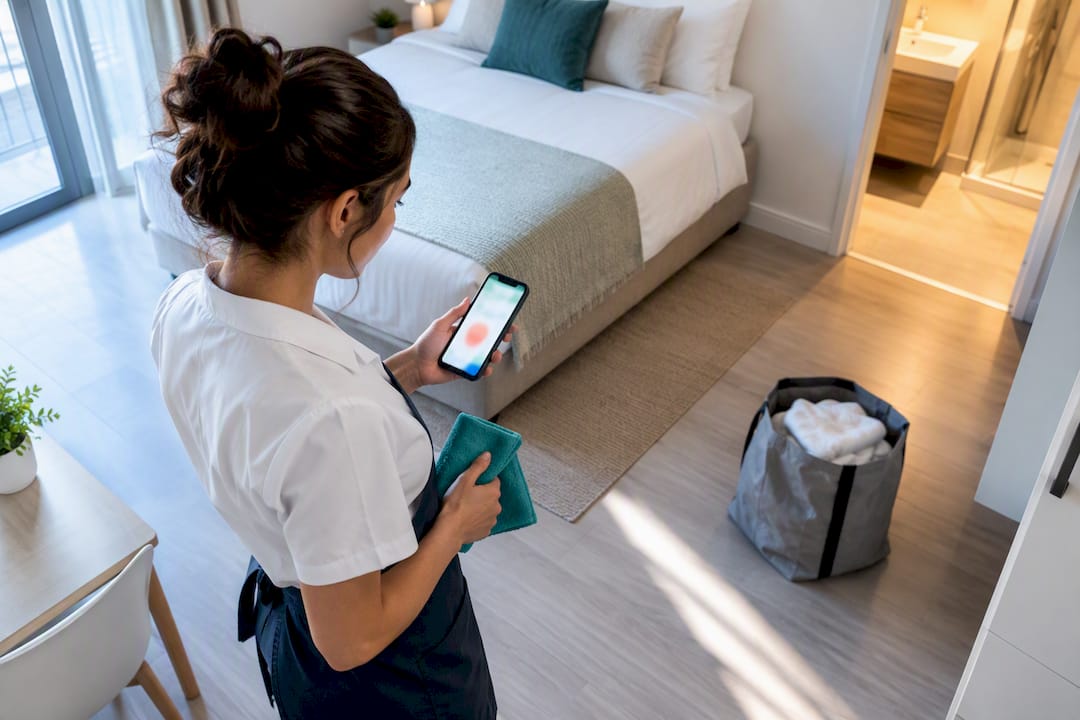
Each cleaner has their own mobile access, receives a notification as soon as a job is assigned, and submits a photo report at the end of their visit. This makes systematic photo verification genuinely workable across an entire portfolio. Linen and supply stock tracking is built into the same dashboard, and when a cleaner is unavailable, you can find a local contractor without any commission surcharge. Plans start with a free tier and scale by property count: 9.99 € per month for 2 properties, 14.99 € for 3 or 4, 19.99 € for 5, with 4 € per month for each additional property. Visit the pricing page to start a trial, or the page for cleaners if you already manage a team you want to activate.
Sources
- Do clean listings perform better? (JORS, 2022)
- Hidden Markets in the Short-Term Rental Boom (AMTP proceedings, 2025)
- Vacation rental housekeeping: how to set up a consistent cleaning operation (Hostfully, 2026)
- Airbnb help: Report a cleanliness issue
Frequently asked questions
What is a cleaning delay in short-term rentals?
It is a gap between the planned end of cleaning and the next guest's check-in time, leaving the property unavailable at the promised time. It most often results from a schedule that is not synced with bookings, or from an unforeseen issue on the team's side.
How long does a guest have to report a cleanliness issue?
Airbnb gives guests 72 hours after check-in to report a cleanliness issue and open a resolution request. After that window closes, the room to negotiate with the platform shrinks considerably.
Should cleaning be handled in-house or outsourced?
It depends mainly on the number of properties and the reliability of the local team available. A small in-house team works well below a certain volume, while a hybrid model, with a directory of local contractors on standby, covers peaks and absences without sacrificing a consistent quality standard.
How does an app like CleanClac help in practice?
CleanClac automates task assignment as soon as a booking is confirmed and notifies each cleaner through their own mobile access. Real-time photo reports and supply tracking reduce the risk of oversights that cause the majority of avoidable delays.
Does cleanliness really affect rental revenue?
Yes. A study published in the Journal of Regional Science found that properties perceived as particularly clean see revenue rise by around 17.5% and occupancy by around 16.5%. It is one of the few operational levers with such a direct and measurable effect on revenue.