Hiring Airbnb Cleaners: the method that scales
Hire and manage Airbnb cleaners with a booking-linked app: structured jobs, timestamped photos, and automatic assignments instead of manual scheduling.

Jonathan Lalinec

Hire and manage your cleaners through an app integrated with your booking calendar: post a structured job, require timestamped photo inspections, and automate assignments instead of juggling schedules by hand. CleanClac handles all three in a single tool.
In brief:
- Automated cleaner assignment with timestamped photo checks is essential to prevent missed turnovers and reduce staff turnover.
- Thorough candidate vetting, including a practical trial, references, and insurance, ensures reliable cleaners from day one.
- Systematic inspection for 30 to 60 days locks in quality and allows you to reduce intensive supervision over the long term.
- Standardising logistics with pre-stocked carts and splitting work across larger properties improves productivity.
- Using a connected app to track jobs, supplies, and performance metrics gives you an objective overview and makes managing at scale far easier.
Table of contents
- The operational workflow for hiring and assigning your Airbnb cleaners
- Writing the job posting and the criteria that filter out the right candidates
- How to structure onboarding and quality checks
- Organising rounds and preparing supplies to save time
- Which metrics to track to manage cleaner performance
- Pitfalls to avoid when hiring at scale
- What I have seen in the field
- CleanClac simplifies hiring and tracking your Airbnb cleaners
- Sources
- Frequently asked questions
The operational workflow for hiring and assigning your Airbnb cleaners
Hiring Airbnb cleaners follows a straightforward sequence, but most property managers skip steps once they go beyond three or four properties. Here is the order that avoids that trap:
- Define the actual need: number of properties, turnover frequency, average floor area per rental.
- Post the job with clear criteria rather than a vague listing.
- Pre-screen on references and stated availability.
- Verify identity, insurance, and a first trial clean.
- Create the cleaner profile directly inside your chosen app, with individual mobile access.
Once the profile is created, each cleaner must be linked to the booking calendar. Two options exist: automatic assignment, which triggers the job as soon as a reservation ends, or manual assignment, better suited to the test phase with a new cleaner. To set these rules up effectively, define from the start:
- an acceptable travel radius around each property;
- real availability windows, not assumed ones;
- valid proof of professional liability insurance.
The State of Vacation Rental Operations report highlights that the operational layer lags behind revenue tools in terms of automation, precisely because these basic rules are not established from day one.
Writing the job posting and the criteria that filter out the right candidates
A vague posting attracts vague applications. An effective template always specifies:
- the nature of the work (full clean, laundry, quality check);
- the estimated time per property type (a studio is not the same as a three-bedroom with a garden);
- the pay, per job or per hour;
- the equipment required, including a smartphone compatible with the tracking app;
- languages spoken and the key-access method (key box, fob, or code).
The screening step must never rely on declarations alone. Have candidates carry out a paid trial clean on a real turnover, with a checklist to complete and identity verification running in parallel. Ask for at least two verifiable references from previous clients or employers.
On the contractual side, four clauses prevent unpleasant surprises: up-to-date insurance, cover arrangements in the event of absence, a confidentiality commitment regarding property access, and a payment schedule agreed at signing.
Pro tip: Never sign a contract before watching the cleaner work in a real property. A good interview tells you nothing about the quality of the actual work.
How to structure onboarding and quality checks
The onboarding period determines half the final result. Industry guides recommend inspecting 100% of turnovers during the first 30 to 60 days, before switching to targeted spot checks.
The process works as follows:
- First month: every clean is inspected, with a room-by-room checklist and a timestamped photo at each step.
- Sequential locking: the cleaner cannot sign off on the next room without completing the previous one, which eliminates recurring oversights.
- Gradual transition: after 30 to 60 days with no issues, reduce the frequency to occasional spot checks.
- Escalation on failure: immediate feedback, a shadowing session with an experienced cleaner, then reassessment before returning to the normal schedule.
A digital checklist connected to the PMS and requiring one photo per step remains, according to SuiteOp, the most reliable method for maintaining compliance as your property count grows. A paper checklist depends on the cleaner's goodwill; a checklist locked inside an app depends on the structure itself.
The figure to remember: according to an industry survey, nearly 40% of hosts and property managers say they struggle to find reliable cleaning staff, which makes rigorous onboarding all the more important for retaining good cleaners once you find them.
Organising rounds and preparing supplies to save time
Time lost at turnover rarely comes from the cleaning itself. It comes from the logistics around it. Pre-stocked carts, replenished in advance with standardised products, linen, and consumables, eliminate unnecessary back-and-forth and ensure a consistent clean from one property to the next.

For larger units (more than three bedrooms, multiple bathrooms), a split workflow makes a real difference: two cleaners cover zones simultaneously rather than working through the property in sequence. Operational guides report efficiency gains of 30 to 40% on larger properties using this method.
Three settings in the app prevent stock-outs mid-season:
- automatic low-stock alerts by product and by property;
- consumption tracking by cleaner to flag abnormal usage;
- a replenishment list generated automatically before a busy weekend.
Pro tip: Standardise the contents of your carts before you standardise your procedures. A cleaner searching for a product wastes more time than a cleaner working through a slightly long checklist.
Which metrics to track to manage cleaner performance
Without data, supervision amounts to gut feeling. A useful operational dashboard tracks at a minimum:
- checklist compliance rate, by cleaner and by property;
- average time per turnover, compared against the expected benchmark for that property type;
- rate of failures or re-cleans flagged by guests;
- number of complete photo reports submitted per job;
- frequency of last-minute replacements.
These metrics enable concrete decisions: a cleaner whose compliance rate drops triggers corrective training before any guest notices. An average time drifting upward on a specific property usually points to a layout or supply issue, not a skills problem.
A good dashboard filters by property, by cleaner, and by period, so you can tell whether a gap is a one-off or a structural problem. It also provides the objective basis for adjusting pay or renewing a contract.
Pitfalls to avoid when hiring at scale
WhatsApp and spreadsheets work for two or three properties. Beyond that, messages get lost, schedules fall out of sync, and nobody knows who should step in when a cleaner cancels at the last minute. This dependence on informal communication is one of the leading causes of missed turnovers.
The fixes to apply straight away:
- automate assignment as soon as a reservation ends, with no manual step;
- set an automatic escalation rule if a cleaner does not confirm the job within a given window;
- always keep one or two backup cleaners identified in advance.
To scale without sacrificing quality, start with a pilot group of three to five cleaners, standardise your procedures on that group, then expand.
What I have seen in the field

The property managers who succeed at hiring do not find perfect cleaners on the first try. They are the ones who build verification into the process before extending trust: systematic photo inspections, carts prepared in advance, strict onboarding for the first few weeks. The shortcut that actually works is automating assignment. The moment you remove the manual layer between a reservation and a cleaning job, missed turnovers almost disappear on their own.
The paper checklist is still the default for many managers, and that is precisely their blind spot. It relies on memory and goodwill. A workflow locked inside an app, with mandatory photo proof at each step, relies on the structure itself. Between the two, this is not a matter of preference: it is a matter of scale. Prioritise automation before the perfect checklist; the other way around never works as well as you imagine.
, Jonathan
CleanClac simplifies hiring and tracking your Airbnb cleaners
Unlike a shared spreadsheet or a WhatsApp group, some apps connect your booking calendar directly to cleaning job assignments, with no commission charged on your cleaners.
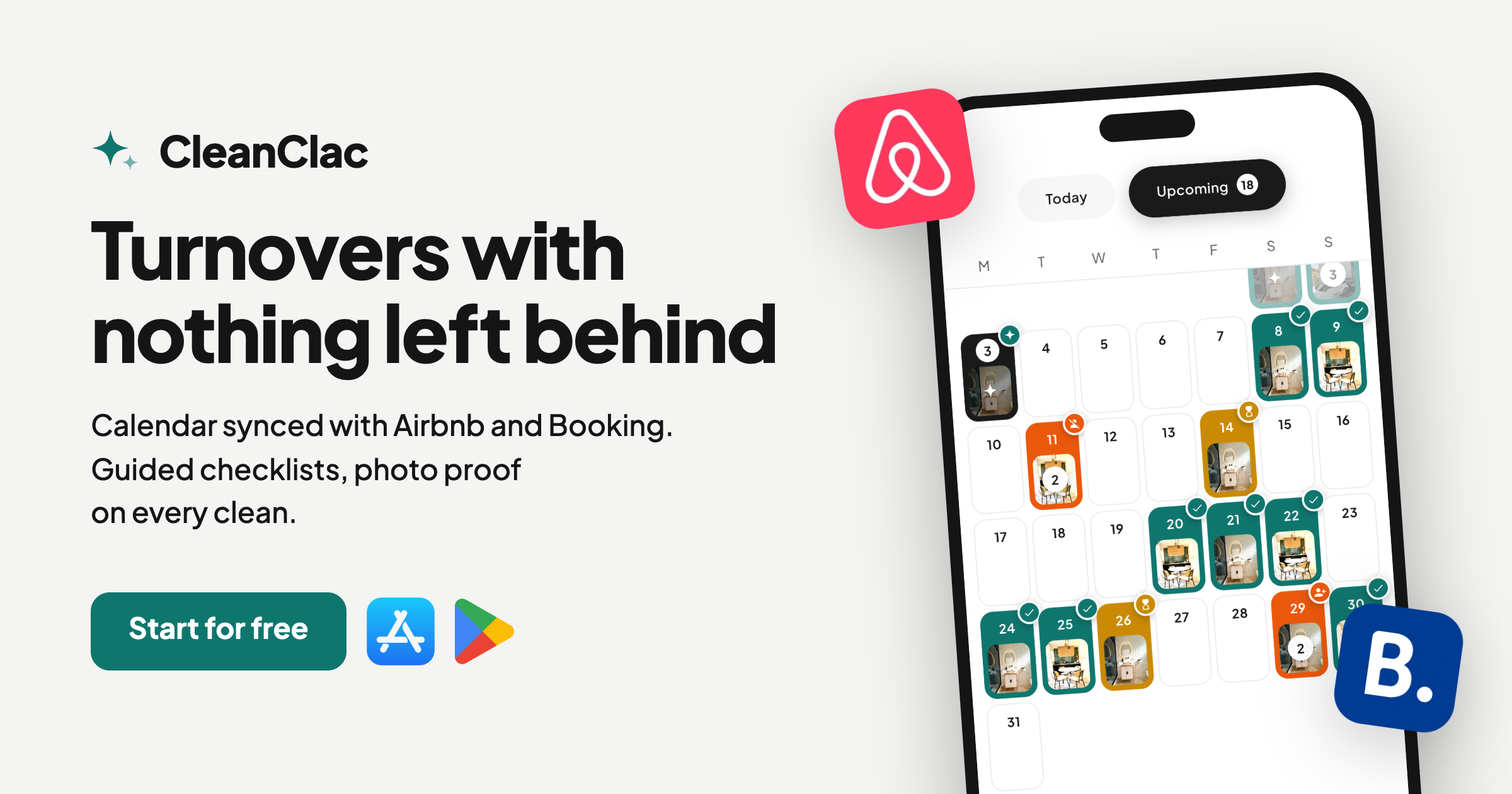
Each cleaner has their own mobile access to view their jobs, submit photo reports, and flag an issue, without you having to manage every exchange individually. Supply tracking and replenishment alerts are built directly into the app, preventing stock-outs mid-season. If you are ever short-staffed, you can also browse the directory of local cleaners to find cover with no extra cost.
To see what it costs for your number of properties, pricing starts at €9.99 per month for two properties, with a tier at €14.99 for three or four and €19.99 for five or more. Your cleaners can use the dedicated cleaner app free of charge to manage their daily jobs. Try it on your first turnovers this week.
Sources
Frequently asked questions
What does it cost to hire an Airbnb cleaner?
The cost depends on the number of properties and the per-job rate you negotiate, but the software that manages assignments starts at €9.99 per month for two properties on CleanClac.
How long does it take to hire a reliable cleaner?
Allow roughly one to two weeks between posting the job and the first trial clean, then 30 to 60 days of systematic inspections before reducing the frequency of checks. That intensive onboarding period is the most reliable safeguard against recurring mistakes.
How do you verify a cleaner candidate's reliability before hiring?
Ask for at least two verifiable references, proof of liability insurance, and have the candidate carry out a paid trial clean on a real turnover using a checklist. Identity verification must be completed before the cleaner is given access to any keys.
Should you use an app instead of WhatsApp to manage your cleaners?
Yes. Once you have more than two or three properties, informal messages get lost and schedules fall out of sync easily. An app like CleanClac automatically links reservations to cleaning jobs and gives each cleaner individual mobile access to their own schedule.
Which metrics should you track to evaluate a cleaner's performance?
Checklist compliance rate, average time per turnover, and the number of complete photo reports submitted are the three most actionable metrics. A dashboard filterable by property and by cleaner lets you spot a problem quickly, before a guest complains.