Preventing Cross-Contamination in Short-Term Rentals
Learn how to prevent cross-contamination between guest stays with a proven cleaning protocol, the right disinfectants, and simple traceability tools.

Jonathan Lalinec
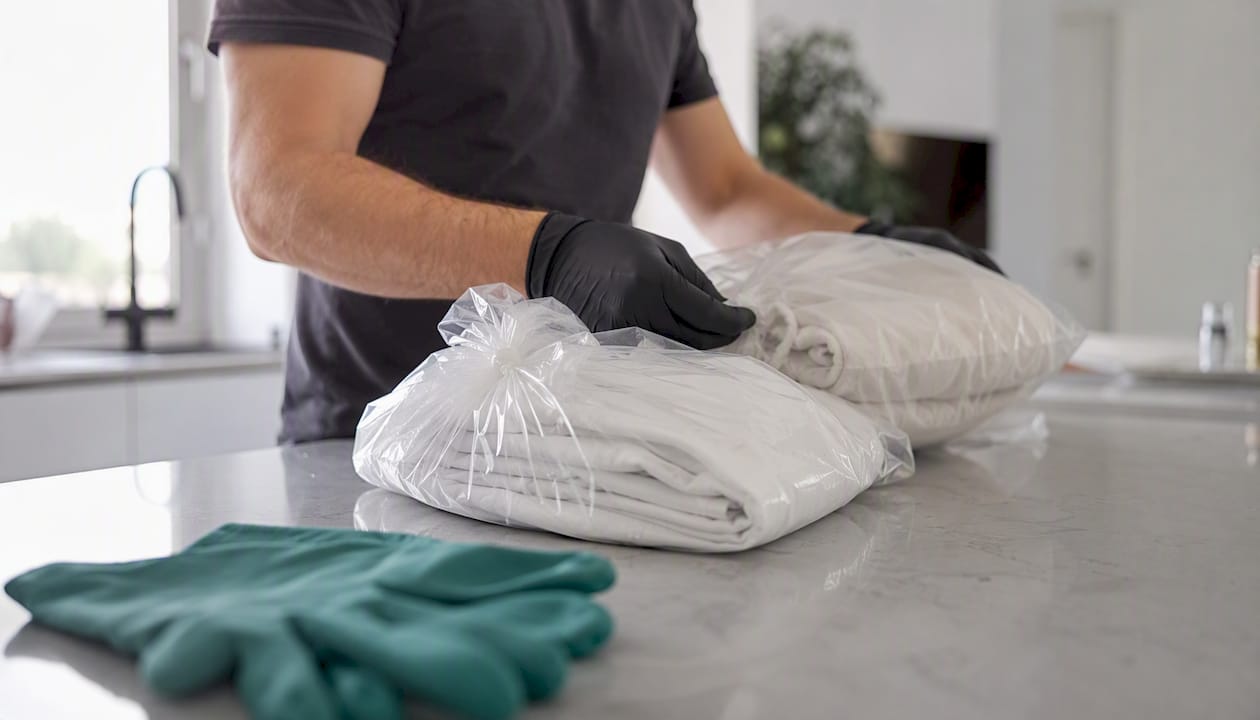
To prevent cross-contamination between stays, apply this sequence immediately: ventilate for the recommended duration, collect and seal dirty linen, clean surfaces from top to bottom, carry out targeted disinfection if warranted, then close with a timestamped inspection. Three standards govern this protocol: NF EN 14065 (RABC method) for the linen circuit, EN 14476 for virucidal products, and EN 13727 for bactericidal products.
Actions to take as soon as the guest checks out:
- Open all windows for 10–20 minutes before starting the clean
- Never shake dirty linen: place it directly into a sealed bag
- Wash linen at ≥ 60 °C, or quarantine it for 24 hours in a sealed bag if that temperature cannot be reached
- Clean surfaces before applying any disinfectant
- Prioritise high-touch points: door handles, light switches, remote controls, taps
- Close out with a timestamped photo inspection and log it in a digital record
Key takeaways
Preventing cross-contamination in short-term rentals comes down to a fixed sequence: ventilation, linen containment, cleaning, targeted disinfection, timestamped inspection. Apply it consistently at every turnover.
| Point | Details |
|---|---|
| Required sequence | Ventilate, contain linen, clean top to bottom, disinfect if warranted, timestamped photo |
| Linen: the 60 °C rule | Wash at ≥ 60 °C or quarantine 24 hours in a sealed bag; never shake dirty linen |
| Conditional disinfection | Disinfect only when the gap is under 5 hours, contamination is suspected, or a vulnerable guest is expected |
| Product standards to check | EN 14476 (virucidal) and EN 13727 (bactericidal) on the product label; NF EN 14065 for linen |
| Systematic traceability | Timestamped photo and cleaner's signature at every visit, stored in a digital log |
Contents
- Your operational checklist between stays
- Detailed protocol: sequence, timing, and critical points
- Managing linen with the RABC method (NF EN 14065)
- Cleaning or disinfection: how to choose and which products to use
- Digital tools that guarantee traceability between stays
- Organising your team and training your cleaners effectively
- When to call in a professional disinfection company
- Monitoring compliance across multiple properties with simple KPIs
- Room-by-room checklist for your cleaners (printable version)
- What traceability actually changes over time
- Automate your protocol with Cleanclac
- Sources
- Frequently asked questions
Your operational checklist between stays
A short checklist posted on the cleaning cart reduces oversights and ensures consistent execution regardless of who is doing the work.
Steps in order:
- Ventilate the property for the recommended duration with all windows open
- Put on PPE: disposable gloves, shoe covers, mask if contamination is suspected
- Collect linen in a sealed bag without shaking it; do not set bags down on clean surfaces
- Clean all surfaces (top to bottom, room by room)
- Disinfect high-touch points if the gap between stays is under 5 hours or if contamination is suspected
- Inspect each room using a standardised checklist
- Take a timestamped photo of each room at the end of the clean and log it in the record
Pro tip: Enable automatic timestamping on your smartphone before you start. The final photo counts as evidence in a dispute: hygiene professionals now consider this an operational standard (source).
Detailed protocol: sequence, timing, and critical points
The order of tasks is not arbitrary. Handling the linen before touching surfaces prevents infectious agents from being carried from one area to another.
Recommended sequence:
- Wait and ventilate for the recommended duration: do not enter closed rooms immediately after checkout
- Collect linen (sealed bags, dedicated dirty-linen carts)
- Clean surfaces from top to bottom: light fittings, high furniture, worktops, floors
- Treat priority high-touch points
- Clean bathrooms last: bathroom, then toilet
- Final room-by-room inspection using a standardised checklist
- Timestamped photo and cleaner's signature in the log
Priority high-touch points to treat every time:
- Door and window handles
- Light switches and plug sockets
- Remote controls (TV, air conditioning, shutters)
- Taps (kitchen and bathroom)
- Worktops and appliance buttons
- Toilet flush and seat
- Stair rails and drawer handles
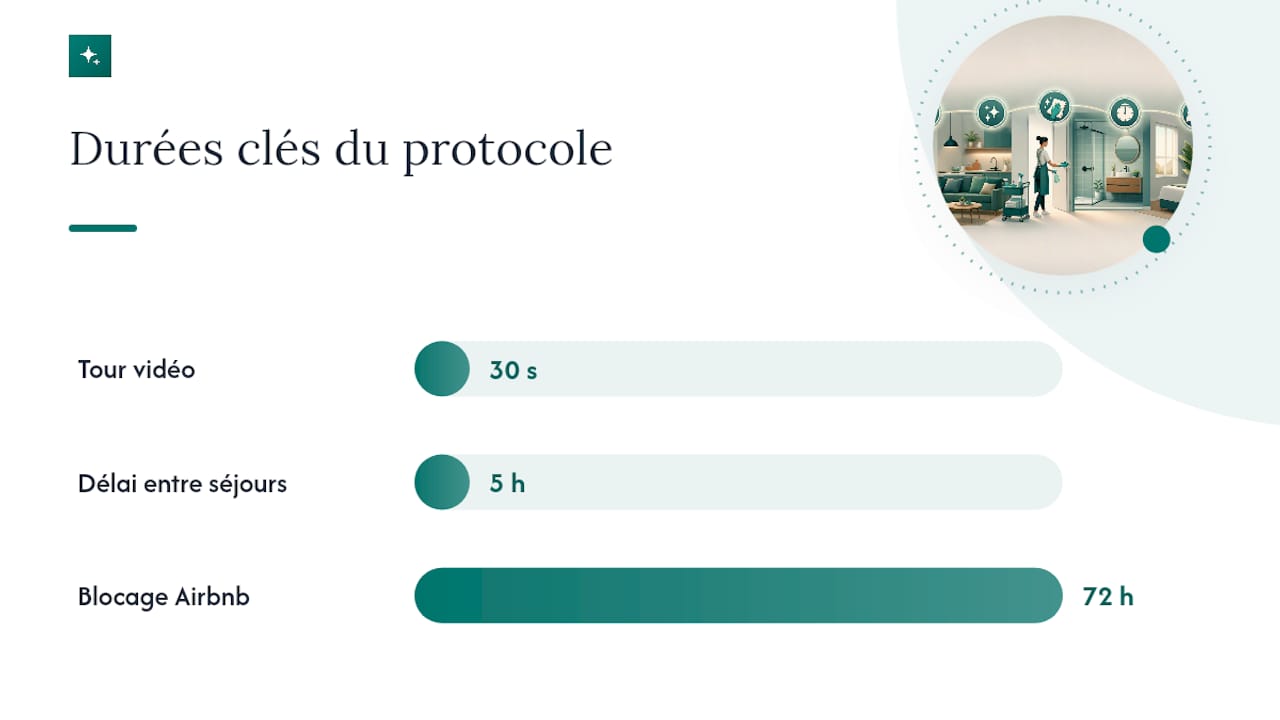
When the gap between stays is under 5 hours, targeted disinfection of high-touch points becomes recommended, not optional. Airbnb offers an automatic 72-hour blocking option between stays for hosts who want to lock in that buffer.
Pro tip: Record a quick 30-second walkthrough video (before and after) in addition to still photos. Video captures details that a static image misses and strengthens your evidence in a dispute.
Managing linen with the RABC method (NF EN 14065)
The RABC method (standard NF EN 14065) defines a clean/dirty linen circuit with identification of critical biocontamination points. Designed for the hotel industry, it applies to short-term rentals with a few practical adjustments.
Core principles:
- Keep dirty and clean linen physically separate at all times (separate carts, dedicated areas)
- Apply the forward-flow rule: clean linen must never cross paths with dirty linen
- Sort by category before washing (sheets, towels, duvet covers)
- Wash at ≥ 60 °C when the fabric allows; quarantine for 24 hours in a sealed bag if that temperature cannot be reached
Small properties do not need heavy infrastructure. Simple rules are enough: sealed labelled bags (red for dirty, white for clean), two separate carts, and a clearly identified holding area for linen being processed.
When to outsource laundry? As soon as the volume exceeds your capacity to wash at ≥ 60 °C, or when the gap between stays does not allow a full cycle. In that case, require your supplier to provide a written protocol, temperature logs per cycle, and batch traceability.
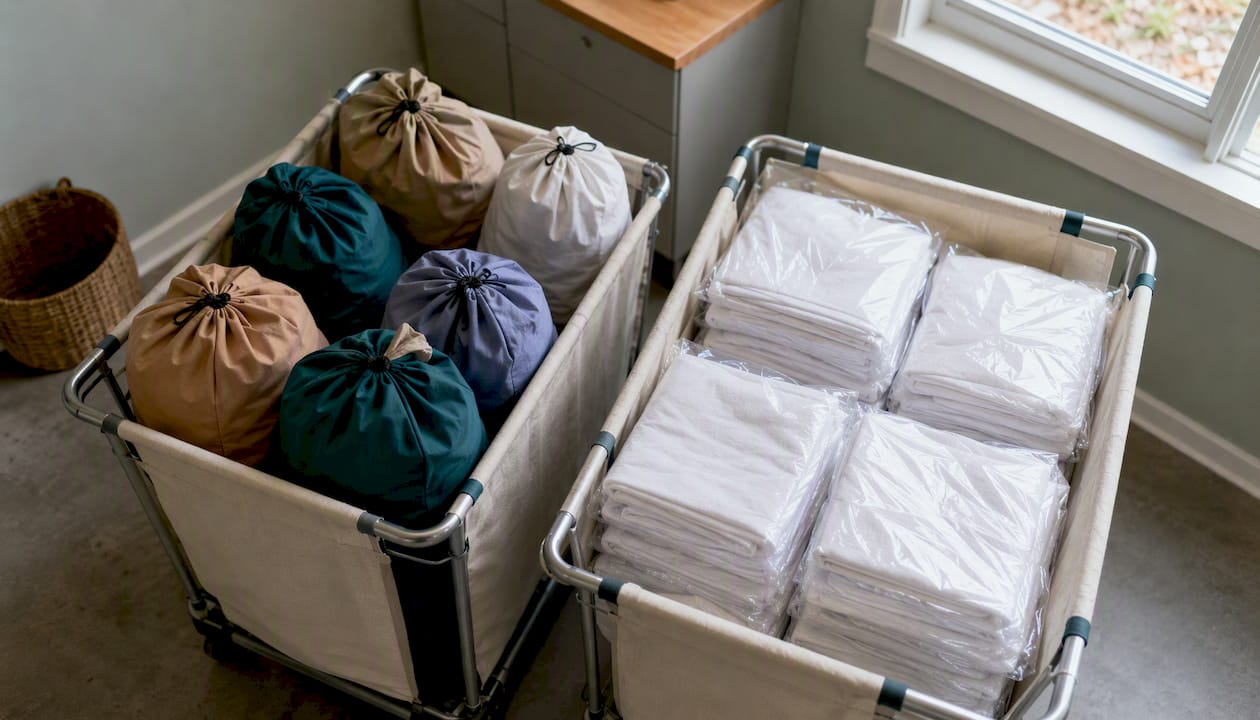
Pro tip: Build linen checks into your digital workflow: one photo of the labelled bag at collection, one photo of the folded linen when it goes back into service. Two taps that close the traceability loop.
Cleaning or disinfection: how to choose and which products to use
Cleaning removes visible dirt and mechanically reduces the microbial load. Disinfection reduces micro-organisms to a level considered safe, but it only works on a surface that is already clean. Applying a disinfectant to a dirty surface wastes the product entirely.
| Situation | Recommended action |
|---|---|
| Standard stay, gap over 5 hours | Thorough clean is sufficient |
| Gap under 5 hours between stays | Clean, then targeted disinfection of high-touch points |
| Suspected contamination (guest was ill) | Clean, then full disinfection of all surfaces |
| Vulnerable guest expected | Clean, then preventive disinfection of bathrooms and kitchen |
Compliant products to use:
- EN 14476-certified virucidal product for hard surfaces (handles, taps, toilet)
- EN 13727-certified bactericidal product for worktops and kitchen areas
- Properly diluted bleach, following usage instructions and allowing sufficient contact time; never mix with another product
ADN Tourisme guidance stresses a point that is often overlooked: cleaning before disinfecting is not optional, it is a condition of effectiveness. On textiles, bare wood, and electronic screens, avoid bleach and use disinfectant wipes compatible with the surface instead.
Digital tools that guarantee traceability between stays
Timestamped visual records have become the most useful evidence in guest disputes. A photo report produced in 30 seconds is worth more than a lengthy message thread when you need to prove the condition of a property at check-in.
Key features of a cleaning management app:
- Automatic task assignment based on the booking calendar (Airbnb, Booking.com, Abritel, Vrbo)
- Timestamped room-by-room checklists with tick boxes and integrated photos
- Digital cleaner sign-off at the end of each visit
- Supplies and product stock management
- Integration with leading PMS platforms for automatic synchronisation
Real-world use cases:
- A cleaner cancels at the last minute: reassignment is handled in the app, no phone call needed
- A guest disputes the condition of the property: the timestamped photo report closes the dispute in seconds
- You manage 10 properties: the dashboard centralises the progress of every clean in real time
Pro tip: Set up an automatic alert if a checklist has not been completed 30 minutes before the next guest's arrival. This safety net catches oversights during busy turnover periods.
Cleanclac brings all of these features together: automated scheduling, photo and video reports, and mobile access for every cleaner, with no complex manual management. To compare the cleaning software options available in France, a dedicated comparison is available.
Organising your team and training your cleaners effectively
The quality of a sanitation protocol depends as much on execution as on design. Without written procedures and systematic final inspections, quality depends on individuals rather than on the system.
Standardising procedures:
- Write a task sheet for each type of visit (refresh clean, full changeover, deep clean) with a reference time for each task
- Assign a colour code to microfibre cloths: red for the toilet, yellow for the bathroom, blue for general surfaces, green for the kitchen
- Standardise cart contents (products, PPE, cloths) so every cleaner finds the same kit at every property
Essential PPE per visit:
- Disposable nitrile gloves (change between each high-risk room)
- Hand sanitiser
- Disposable shoe covers
- Surgical mask if recent contamination is suspected
Recommended training programme:
- Initial onboarding: 2 hours covering the full protocol, product standards, and app use
- Monthly refresher: 30 minutes focused on non-conformities identified the previous month
- Timestamped training log: date, cleaner's name, topics covered, signature
Pro tip: Record a 10-minute reference clean and share it with your cleaners as a private video. A reference video reduces inconsistencies in interpretation more effectively than a written document alone.
When to call in a professional disinfection company
Four situations justify going beyond your internal protocol and contacting a specialist contractor.
- Suspected or confirmed contagious illness in a guest (gastroenteritis, flu, Covid-19)
- Inability to apply a compliant linen protocol (machine breakdown, too little time)
- A gap of under 2 hours between stays at a property where a vulnerable guest is expected
- Presence of pests or mould requiring specific chemical treatment
Documents to require from the contractor:
- A written protocol detailing the products used and their certifications (EN 14476, EN 13727)
- Temperature logs if laundry is outsourced
- A signed, timestamped service report
The orders published on Legifrance set out the obligations that apply according to the property's classification. Check the texts currently in force for your category before finalising your reference protocol.
Pro tip: Keep the technical data sheets for the products you use (including their EN certification numbers) in a quality file that is always accessible. In a dispute or inspection, it is the first document requested.
Monitoring compliance across multiple properties with simple KPIs
Formalising protocols and carrying out systematic final inspections are the most effective levers for maintaining a high cleanliness score on booking platforms.
KPIs to track every week:
- Non-conformity rate per clean (number of failed checklist items / total checklist items)
- Average time per room (variance against the reference time)
- Percentage of final inspections completed with a timestamped photo
- Cost per occupied room (CPOR) per property
Simple audit method:
- Use a standardised inspection checklist (the same one across all properties)
- Carry out spot audits: inspect 1 property in every 5 each week, rotating
- Log the inspector's name, date, and any issues found
- Trigger a corrective action within 48 hours for any repeated issue
Pro tip: A weekly dashboard with these four KPIs fits on a single page. Share it with your cleaners: transparency about results reduces drift more effectively than verbal reminders.
Room-by-room checklist for your cleaners (printable version)
Entrance and hallway
- [ ] External and internal door handles cleaned
- [ ] Light switches wiped
- [ ] Floor vacuumed and mopped
- [ ] Coat hooks and storage checked (no guest belongings left behind)
- [ ] Timestamped photo taken
Living room
- [ ] Remote controls disinfected
- [ ] Furniture and table surfaces wiped
- [ ] Cushions and throws repositioned or changed
- [ ] Floor vacuumed and mopped
- [ ] Timestamped photo taken
Kitchen
- [ ] Worktop disinfected (EN 13727)
- [ ] Hob knobs and fridge handle wiped
- [ ] Crockery checked (clean and put away)
- [ ] Bin emptied and bag replaced
- [ ] Timestamped photo taken
Bathroom
- [ ] Taps and mixer tap disinfected
- [ ] Basin, shower or bath cleaned
- [ ] Linen changed (dirty linen in a sealed bag)
- [ ] Floor mopped
- [ ] Timestamped photo taken
Bedroom(s)
- [ ] Bedding changed (sheets, pillowcases, duvet covers) washed at ≥ 60 °C or quarantined for 24 hours
- [ ] Drawer handles and light switches wiped
- [ ] Floor vacuumed and mopped
- [ ] Under bed and inside wardrobes checked
- [ ] Timestamped photo taken and cleaner's initials noted
The same checklist is available as a digital version with automatic timestamping in Cleanclac, for use on-site without printing. You will also find more cleaning tips for short-term rentals on the Cleanclac blog.
What traceability actually changes over time
Most managers who roll out a sanitation protocol follow it correctly in the first few weeks, then standards slip. The reason is almost always the same: the protocol relies on the cleaners' memory rather than on a system that enforces it.
Formalising and timestamping every task is not an administrative burden. It is the only way to catch a drift before it generates a negative review or a dispute. Running a digital checklist for 30 days and measuring three KPIs (non-conformity rate, percentage of final inspections completed, average time per room) is enough to get an objective picture of how your operation actually works.
Automate your protocol with Cleanclac
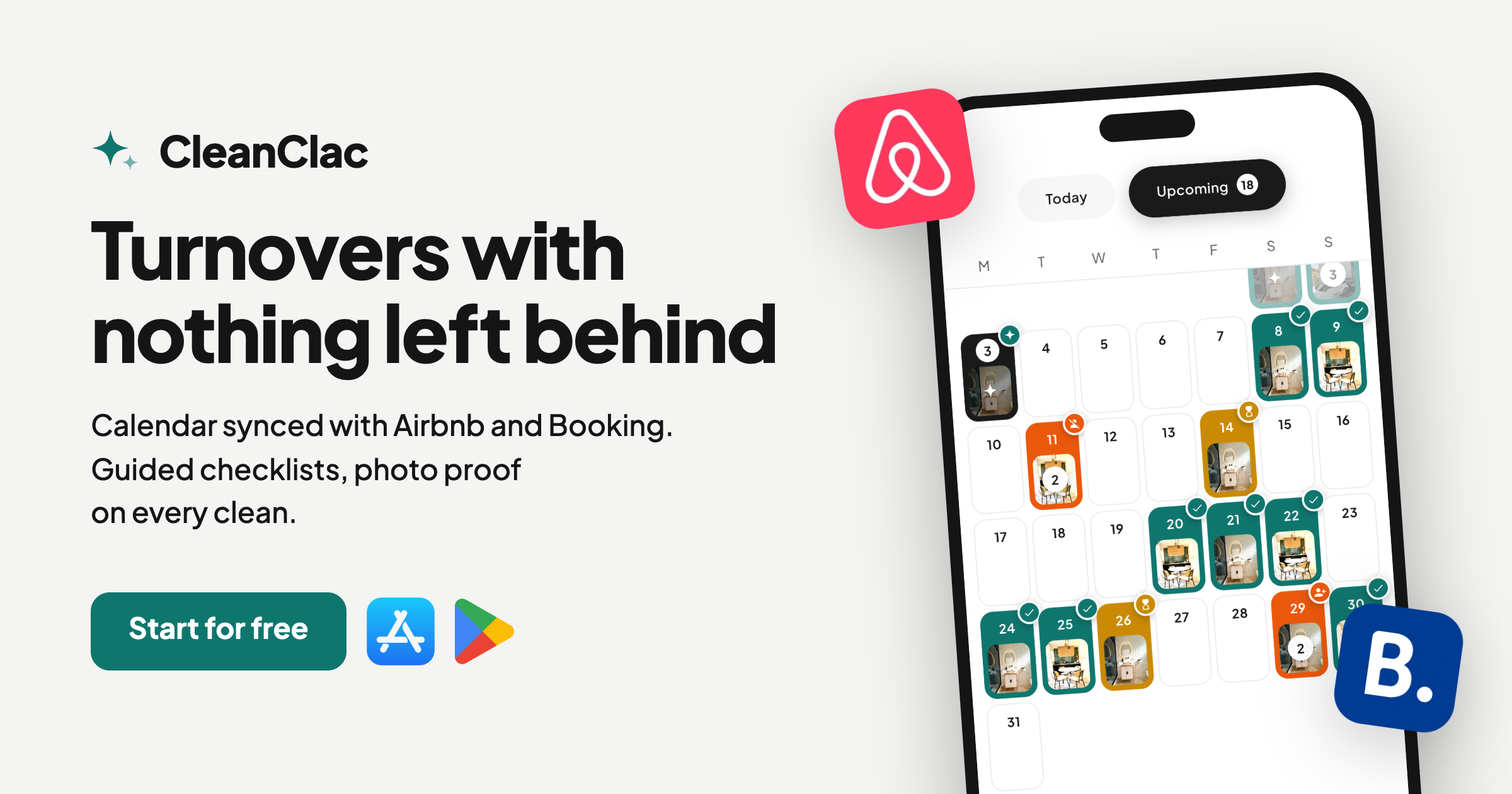
Cleanclac syncs your booking calendar (Airbnb, Booking.com, Abritel, Vrbo) and automatically triggers cleaning tasks with timestamped checklists, photo and video reports, and mobile access for every cleaner. When something unexpected comes up, the local cleaner marketplace lets you find a replacement without any break in service.
Discover Cleanclac and try automated cleaning management for free.
Sources
- Preventing cross-contamination: advice for your teams · Socoldis
- Hotel cleanliness protocols · INH nettoyage hôtelier
- A new cleaning protocol available for hosts in France · Airbnb News
- JORF · classification order (extract) · Legifrance
Documents to keep in your quality file: technical data sheets for disinfectants (with EN certifications), external laundry records (temperature logs), timestamped photo reports for every visit, cleaner training log.
This article provides general information and is not a substitute for advice from a qualified medical professional. Consult a qualified health professional about your specific situation before acting on this content.
Frequently asked questions
What temperature should linen be washed at between stays?
Wash at ≥ 60 °C when the fabric allows. If that temperature cannot be reached, seal the linen in a closed bag and quarantine it for 24 hours before reuse.
Is disinfection always required between stays?
No. A thorough clean is enough for a standard stay when the gap between guests is more than 5 hours. Targeted disinfection becomes necessary when the gap is under 5 hours, when contamination is suspected, or when a vulnerable guest is expected.
What is the RABC method and how does it apply to short-term rentals?
The RABC method (standard NF EN 14065) defines a clean/dirty linen circuit with identification of critical biocontamination points. In practice, two separate carts, sealed labelled bags, and a dedicated holding area are enough to apply it in a small property.
How do you prove a property was clean when a guest arrived?
A timestamped photo of every room, taken at the end of the clean and stored in a digital log, is the most effective evidence in a dispute. Hygiene professionals now consider this an operational standard.
Which disinfectants should you choose for short-term rentals?
Choose products certified EN 14476 (virucidal) for hard surfaces and EN 13727 (bactericidal) for kitchen areas.


