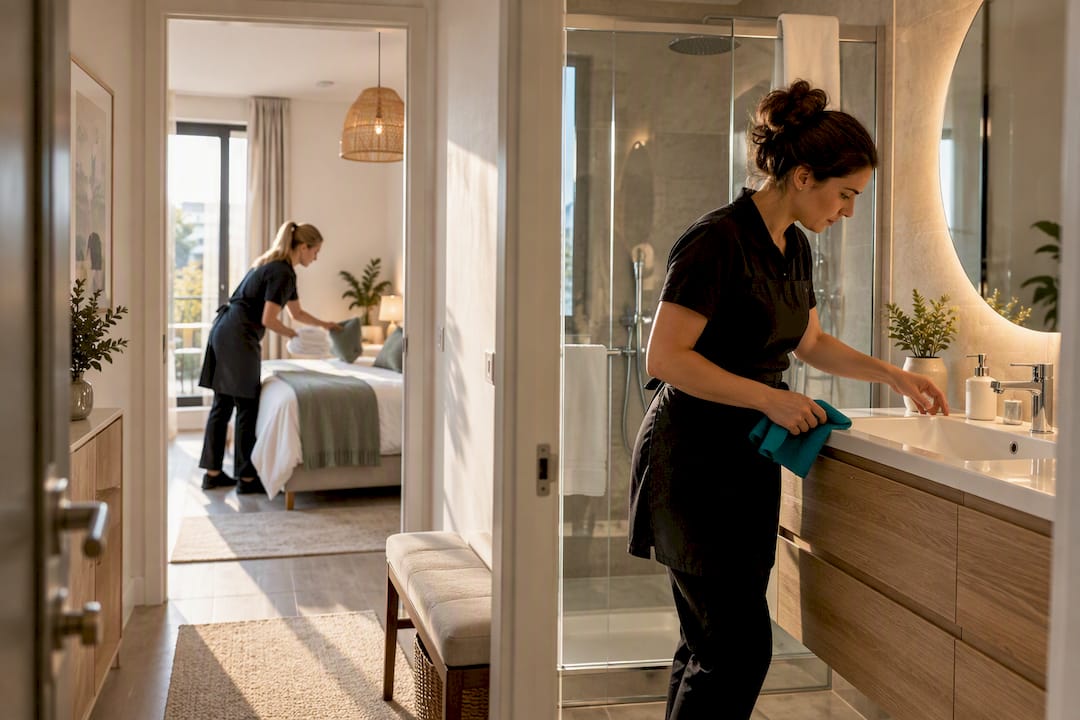
Post-party cleaning checklist for short-term rental hosts
Short-term rental hosts: get your property ready for the next guest by securing the space, removing waste, and swapping linen fast after a party.

Jonathan Lalinec
First priorities: secure the property, sort and remove waste, then assess the extent of the damage. That assessment determines whether you run a standard turnover or a full restoration. The goal is always the same: a property ready for the next check-in, with no nasty surprises for the incoming guest.
In brief:
- The time a post-party clean takes varies with the size of the property and the intensity of the event, ranging from half a day to a full day for serious damage.
- Keep a buffer linen stock of at least three sets per sleeping place so you can handle post-party emergencies without depending on laundry turnaround times.
- Timestamped photos of damage taken before any work begins drastically reduce disputes and make it easier to charge for repairs or replacements.
- When a party leaves significant stains, persistent odours, or major breakage, switch to a full restoration rather than a standard turnover.
- Automating and centralising tasks through an app makes it easier to manage urgent turnovers after damage, while ensuring rigorous quality control with checklists and photo evidence.
Table of contents
- Step-by-step operational checklist for a post-party clean
- How long to allow depending on property size and party scale
- When to trigger a full restoration
- How to reduce the workload with checkout instructions
- What standardised procedure guarantees reliable quality control
- How to manage linen and buffer stock after a party
- Which cleaning products to choose by surface type
- How to clean appliances that took a beating during the party
- What to do with leftover food after a party
- How to deodorise a property properly after a party
- How to prevent mould and persistent bad odours after a party
- Practitioner's view: buffer night or same-day turnover?
- CleanClac simplifies coordination of your post-party turnovers
- Sources
- Frequently asked questions
Step-by-step operational checklist for a post-party clean
A successful post-party clean follows a logical sequence, not a different improvisation each time. Here is the order most experienced concierge teams use:
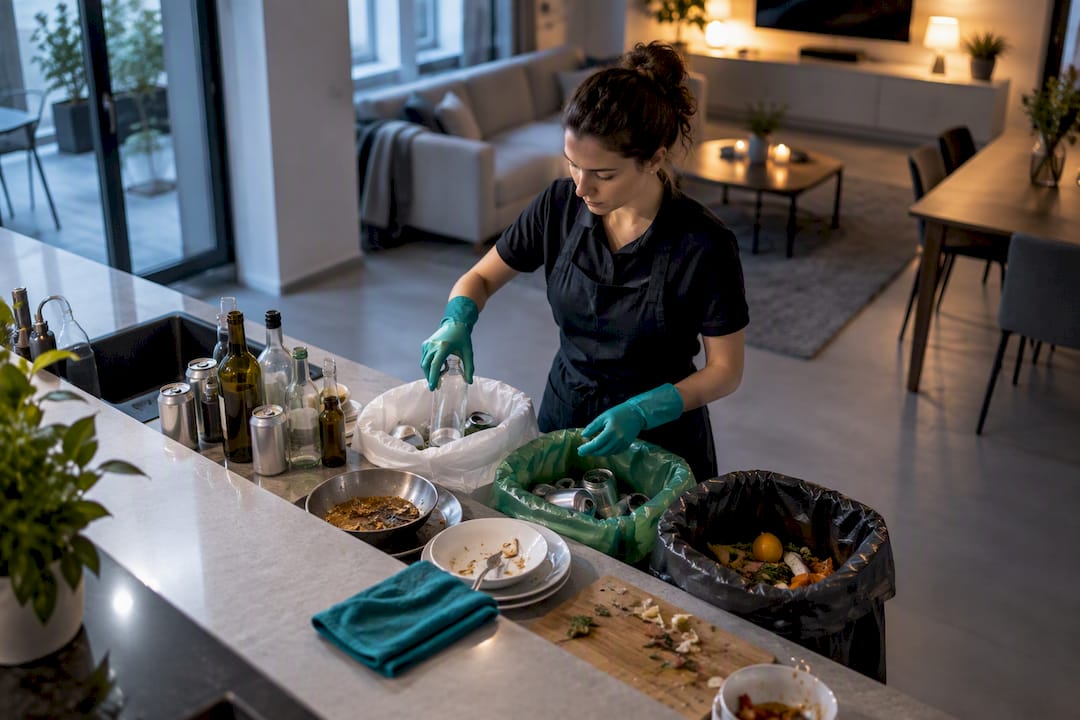
- Waste: remove bags, bottles, cigarette butts and confetti before anything else, including outdoor areas (balcony, terrace, garden).
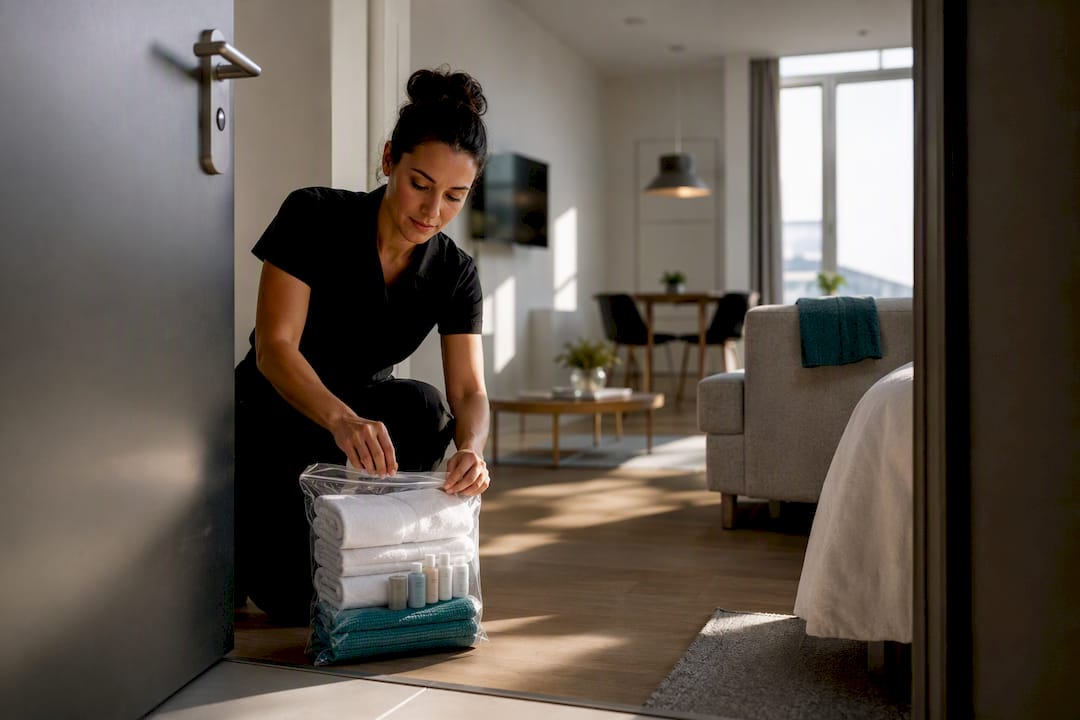
- Linen: strip soiled sheets, towels and pillowcases, replace them with the buffer stock kept on site.
- Kitchen: clear leftover food from the fridge, wash up, degrease the hob and oven.
- Stains: treat stains on fabric surfaces (sofa, rug) and floors as a priority, before they set.
- Restocking: replenish toilet paper, soap, coffee, bin bags and other consumables.
- Reset: reposition furniture, cushions and décor to match the property's visual reference.
- Final inspection: full visual check with timestamped photos.
Three checks are non-negotiable before you close the door: no broken glass (under furniture, in corners), all electrical installations in good order (extension leads, fairy lights left plugged in), and no personal belongings left behind by guests. The quick inspection checklist used by concierge services before confirming in the PMS follows exactly this logic.
Keeping a permanent stock on site (vacuum cleaner, microfibre cloths, degreaser, bin bags, spare linen) speeds up every visit and avoids back-and-forth trips that eat into the time between bookings.
Pro tip: Take a photo of the property after every successful turnover. That visual record of the "perfect setup" gives the whole team a reference point and reduces uncertainty for cleaners on future visits.
How long to allow depending on property size and party scale
The time a post-party clean takes depends mainly on two factors: the floor area of the property and the intensity of the event that just took place. A studio after a dinner with friends is nothing like a house after a 30-person birthday party with a pool and garden.
- Studio or one-bedroom: generally quick for a standard turnover, longer if the party left marks on fabric surfaces.
- Two- or three-bedroom apartment: allow more time, especially with several bedrooms to restore and a well-used kitchen.
- House with outdoor space: the time increases significantly as soon as you have to deal with a terrace, pool or garden on top of the interior.
- Guests brought pets: an extra pass is often needed for hair and odours, and this is routinely underestimated when planning the schedule.
The time and cost ranges by property type confirm that a standard turnover is a clean optimised for speed, but how much work it involves varies considerably with the size of the property and the services required.
The number of guests and the time the party ended directly affect your margin for manoeuvre. A party that runs late into the night with a check-in booked for a tight slot leaves little room for improvisation. The simple rule: if the state of the property when your team arrives exceeds what a standard turnover can handle in the available window, it is better to postpone or refuse the same-day turnover than to hand over a property that has not been properly cleaned.
When to trigger a full restoration
Some signs make it clear that a simple turnover will not be enough. You need to switch to a deep clean, or bring in a specialist contractor.
- Significant stains on the sofa, mattress or rug that resist quick treatment.
- Vomit or bodily fluids requiring thorough disinfection.
- Significant breakage (crockery, furniture, glass) that poses a safety risk or a replacement cost.
- Signs of undeclared occupation or a clearly exceeded guest count.
- Persistent odours of tobacco, cannabis or alcohol embedded in textiles.
The procedure is always the same: document with photos before any work begins, calculate the cost of restoration, charge the responsible guest according to the booking conditions, then bring in specialists if needed. A post-event clean can take half a day to a full day depending on the extent of the damage. Some contractors can attend within 24 to 48 hours depending on availability. That lead time directly shapes your decision: if the next check-in falls before that window closes, you either need to block the following booking or find a contractor who can come sooner. Warn the next guest without delay rather than managing the crisis at the last minute.
How to reduce the workload with checkout instructions
A well-thought-out welcome guide limits the scale of the clean before your team even arrives. A few simple instructions are enough, as long as they are realistic for guests at the end of a stay.
- Collect bin bags at a designated collection point (without asking guests to take them to the street).
- Leave keys in the agreed place (key box, reception, under the doormat).
- Close windows and turn off the heating or air conditioning before leaving.
- Report any incident that occurred during the stay (breakage, breakdown, damage).
Avoid asking guests to do the washing-up, vacuum, or remake the beds. Those tasks are the cleaner's job, and requiring them creates unnecessary friction and can even generate negative reviews. The boundary is simple: a basic tidying instruction, yes; an actual cleaning task, no.
Pro tip: Always ask for a timestamped photo before and after your team's visit in sensitive areas: shower, bedding, kitchen. This practice prevents the vast majority of damage disputes, provided the evidence is linked to a clear checklist.
This welcome guide can be embedded directly in your guest welcome guides, with automatic reminders sent before checkout.
What standardised procedure guarantees reliable quality control
A standard operating procedure (SOP) reduces variability between teams and properties. The principle: every visit follows the same task order and the same acceptance thresholds, regardless of which cleaner handles it.
- Fixed task order (waste, linen, kitchen, stains, restocking, reset).
- Clear acceptance thresholds: what counts as "clean" for this specific property, with defined visual benchmarks.
- Final inspection checklist, carried out at eye level as an incoming guest would see it for the first time.
- Systematic evidence: photos required for every sensitive area, a minimum number of shots per room, automatic timestamping.
Documenting sensitive areas with timestamped photos and linking them to a standardised checklist prevents the overwhelming majority of disputes about the condition of a property.
This level of rigour is hard to maintain manually when you manage several properties and several cleaners. Tools that send automatic notifications and centralise evidence significantly reduce the risk of a missed turnover or a rushed inspection. Each cleaner gets individual access to their assignment for the day, and photo reports are automatically sent back to the manager.
How to manage linen and buffer stock after a party
Linen is often the factor that blocks a same-day turnover, far more than surface cleaning. A party frequently leaves several sets of sheets and towels stained or odorous, and they need to be replaced immediately without waiting for the laundry to come back.
The most reliable solution is to keep a sufficient buffer stock. The industry best practice is three sets of linen per sleeping place: one in use, one clean in reserve, one being washed or treated. That margin allows you to absorb a difficult turnover without depending on an external laundry service whose timing might not work in your favour.
For multi-property managers, two options coexist: outsourced laundry, which delivers professionally cleaned linen but adds lead time and a recurring cost, or in-house management with a machine on site, which is faster but heavier to organise. Many hosts combine both: outsourced laundry for large volumes, a local buffer stock to absorb post-party or unexpected urgencies. If you manage several properties, structuring this logistics in a dedicated linen and laundry guide prevents stock-outs at the worst possible moment.
Which cleaning products to choose by surface type
Not every surface reacts the same way to the residue of a lively party: spilled alcohol, kitchen grease, candle wax and red wine each need a different approach.
On hard surfaces (tiles, worktops, plastic), a standard degreaser is usually enough. On fabric surfaces (sofa, rug, curtains), use a specific stain remover tested on a small patch first, as some products discolour delicate textiles. On treated wood, avoid harsh products that dull the varnish. A simple mild soap diluted in water often does a better job.
For managers concerned about environmental impact, or whose guests explicitly request it, eco-certified products (Ecocert-labelled or equivalent) work well for routine maintenance but can fall short on ingrained alcohol or old grease stains. In those cases, keep a stronger product for targeted treatment rather than using it across the whole property. The key is always to test the product on a discreet area before general use, especially on furniture or flooring you do not yet know well.
How to clean appliances that took a beating during the party
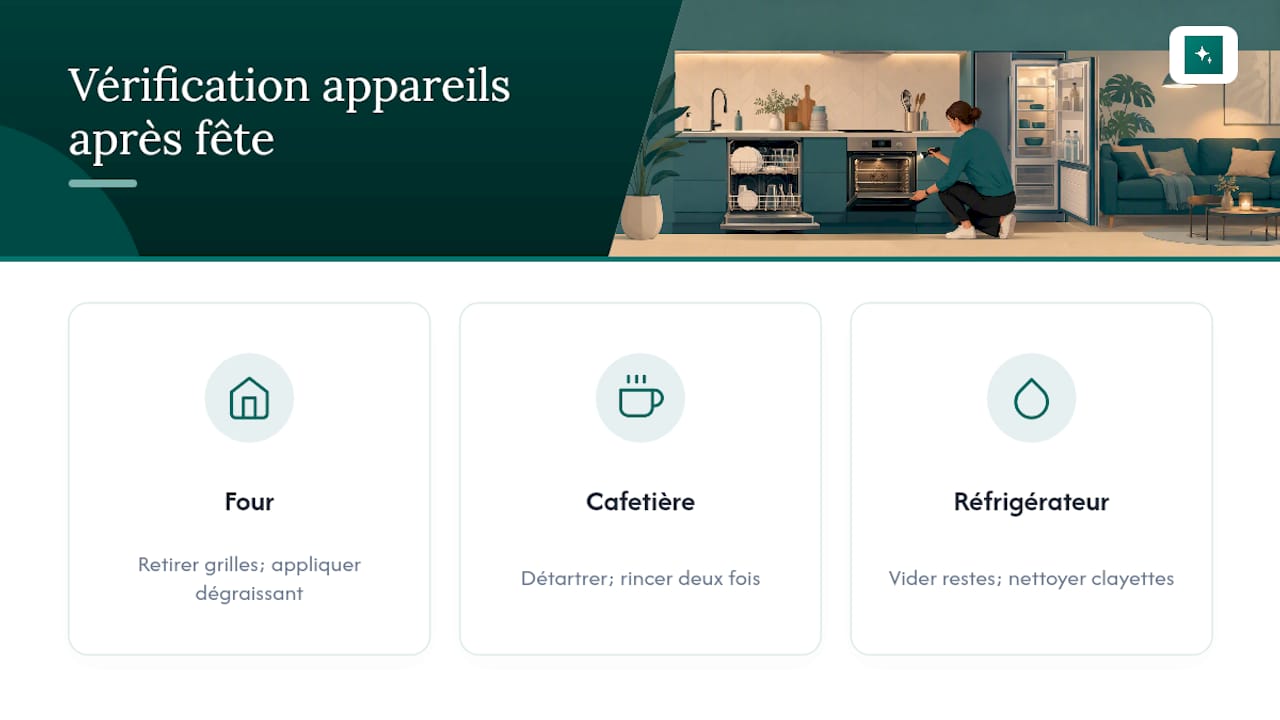
The oven, coffee machine and fridge typically absorb the heaviest use during a party, and they are also the appliances most often overlooked during a quick turnover.
For the oven, remove the racks and trays as soon as the visit begins, before the grease hardens. A degreaser left to work for a few minutes avoids prolonged scrubbing. If the oven was used for several dishes in a row, a pyrolysis or steam clean cycle (depending on the model) is more effective than a simple wipe-down.
For the coffee machine, descale regularly after heavy use, especially on capsule or bean-to-cup models that quickly accumulate limescale and oily residue. A cycle with hot water and a little diluted white vinegar, followed by two rinse cycles, is enough in most cases.
For the fridge, always clear out any leftover food, check dates and wash the shelves with soapy water. A persistent smell in the fridge almost always means something has been forgotten in a corner, usually behind the vegetable drawer.
These three appliances deserve a systematic check written into your checklist, as they generate the most guest complaints when they are overlooked during a restoration.
What to do with leftover food after a party
A party almost always leaves food and drink that need to be dealt with quickly, before they become a source of odours or insects.
The priority is to remove all perishable food within hours of the visit, without waiting for the next pass. Always check the fridge, freezer and cupboards, as forgotten leftovers in a corner are the leading cause of persistent odours reported by incoming guests.
For sorting, follow local recycling guidelines: glass, cans and bottles go to the appropriate streams, food waste goes to the compost or organic bin where the local authority provides one, and packaging goes into standard recycling. A poorly sorted property can attract fines from the local authority, and it also damages the property's reputation.
Practical tip: keep separate bags on site for different waste streams (glass, general waste, recyclables) rather than a single bag. This speeds up the team's visit considerably and avoids a cleaner having to sort through kilos of mixed waste by hand at every post-party turnover.
How to deodorise a property properly after a party
Odour is often what gives a recent party away, even when everything looks visually clean. Smoke, alcohol, the combined fragrance of many guests: these smells embed themselves in textiles and the ambient air far longer than you might expect.
The first step, often skipped, is thorough ventilation: open all windows for at least 30 minutes before starting to clean, even in winter. That single step eliminates a good proportion of volatile odours before any chemical treatment is applied.
Then target the textiles that hold odours: curtains, cushions, rugs and the sofa. An odour-neutralising spray (not just a fragrance that temporarily masks the smell) is more effective than a standard air freshener. For stubborn cases, baking soda sprinkled on a rug or sofa, left overnight and then vacuumed up, absorbs embedded odours effectively.
Avoid strong room fragrances as a substitute for proper cleaning. They mask the problem without solving it, and a guest who is sensitive to artificial scents can react negatively, sometimes more so than to a faint residual odour.
How to prevent mould and persistent bad odours after a party
Some post-party problems do not appear immediately. They develop in the days that follow if moisture or residues have not been properly treated.
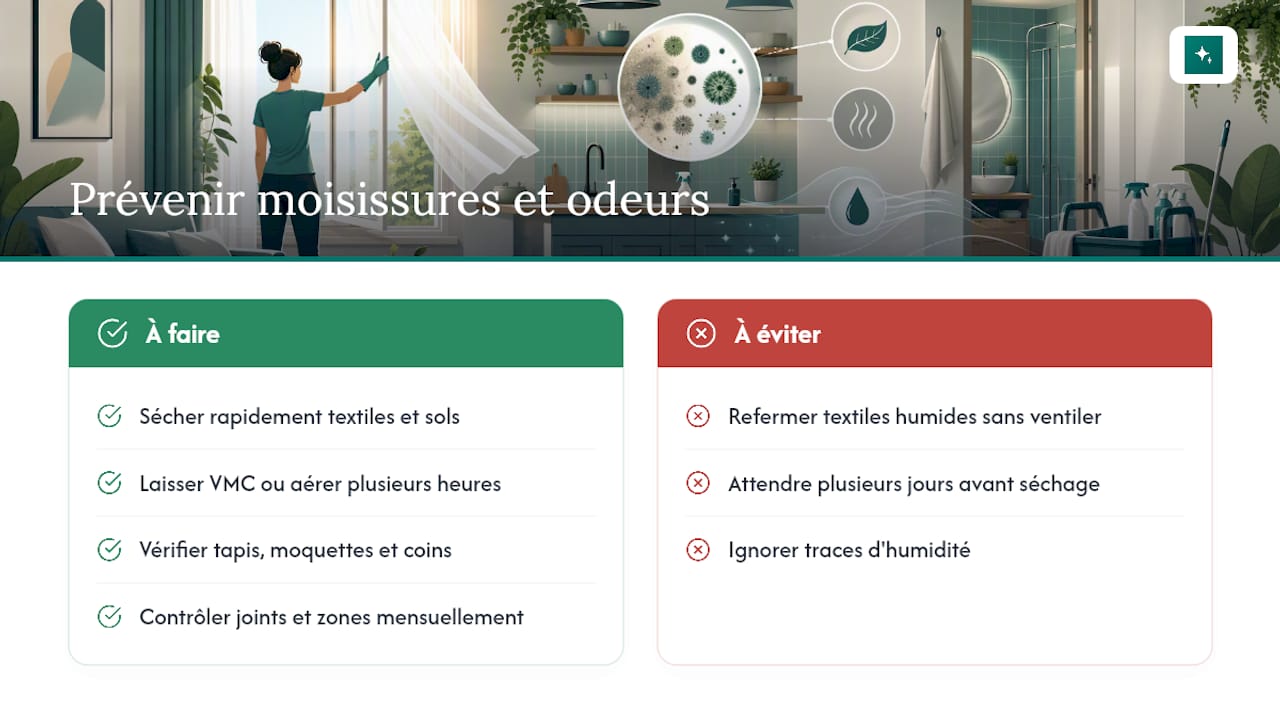
Spilled moisture (drinks, condensation from a crowded room, an overused bathroom) is the main cause of mould if it is not dried quickly. Always check rugs, carpets and the corners of furniture after a well-attended party, especially in a property with limited natural ventilation.
A simple trick: leave the mechanical ventilation running or keep windows open for several hours after the clean, not just during it. Residual moisture in textiles can take longer to evaporate than the cleaning itself. A damp textile closed up in an unventilated room is the classic recipe for a musty smell that appears two or three days later, right when the next guest has already arrived.
For properties that host parties regularly, a routine visual check of bathroom seals and at-risk areas (under the sink, around windows) allows you to spot the early signs of mould before it takes hold. That is not a task for every turnover, but it earns its place in a monthly or quarterly inspection.
Practitioner's view: buffer night or same-day turnover?
The question comes up after every party handled in a short-term rental: force the same-day turnover, or block a buffer night as a precaution? A buffer night costs one night's revenue, but it eliminates the risk of handing over a poorly restored property or cancelling at the last minute. A forced turnover works out fine most of the time, until the day it fails with a guest already on the way.
My view: if your portfolio regularly hosts parties, a systematic buffer night costs less in the long run than a single viral negative review. For properties that are only occasionally festive, outsource the restoration at the first sign of serious damage rather than exhausting your regular team. And build your buffer linen stock before the busy season, not during it.
, Jonathan
CleanClac simplifies coordination of your post-party turnovers
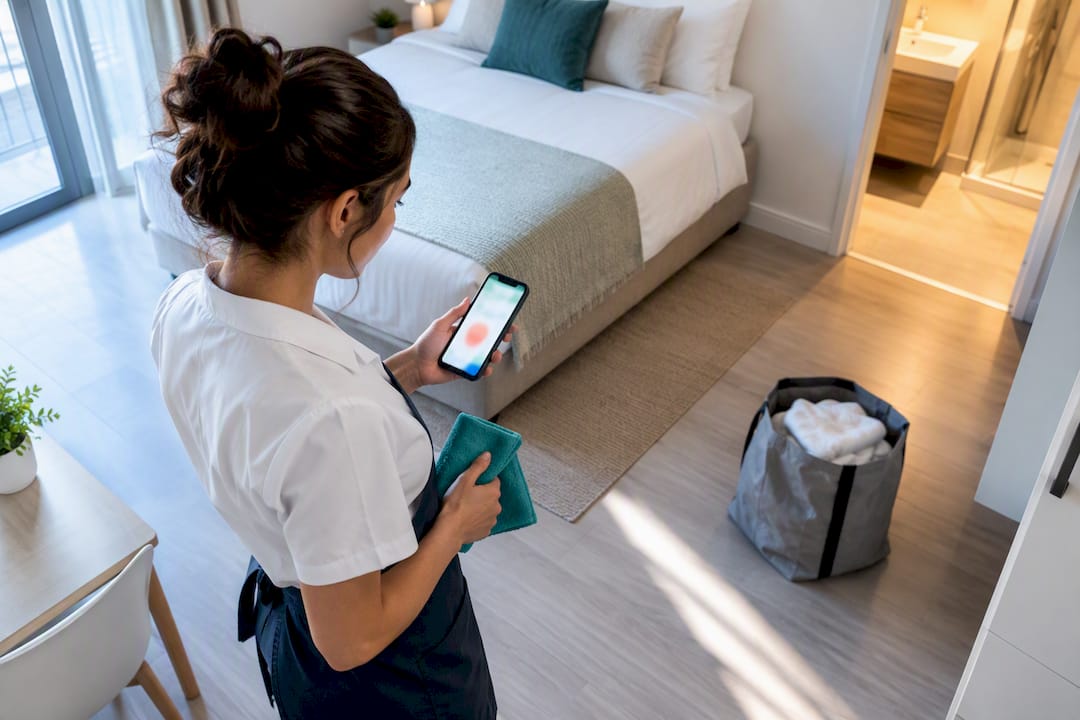
Among the options available, managing post-party turnovers manually, by scattered calls and messages, remains the slowest method and the one most prone to human error. An app can automate cleaning schedules based on bookings across various platforms and automatically notify the relevant cleaner as soon as a visit needs to start, including urgent ones after a party.

Each cleaner can have individual mobile access: they receive their assignment, document the visit with photos, and the manager monitors the property's condition in real time from a dashboard. That traceability is particularly useful for gathering evidence when damage needs to be charged, a critical point after a party that went wrong. If an unexpected situation leaves you without an available cleaner, you can also search for a local contractor directly through the cleaning company directory.
Check the Cleanclac plans and pricing to choose the right option for the number of properties you manage, or explore the dedicated app for cleaners to invite your team today.
Sources
For more on turnaround times, costs and linen best practices, see also this guide to choosing holiday rentals, useful for anticipating the standards guests expect.
- Cleaning in short-term rentals: organisation, costs and turnover checklist | Détent'toit
- Post-event cleaning: restoration after a party or event | SOS Nettoyage Extreme
- Airbnb checkout: process for concierge services · Tweelo
Frequently asked questions
How long does a post-party clean take?
It depends heavily on the size of the property and the scale of the party. A post-event clean can take anywhere from half a day to a full day for serious damage, compared with under an hour for a standard turnover with no major incident.
Should you always keep a buffer linen stock?
Yes, it is a recommended practice for keeping turnovers on schedule without depending on laundry turnaround times. The industry standard is three sets of linen per sleeping place, enough to absorb a difficult party without blocking the next booking.
How do you charge for damage caused by a party?
Document all damage with timestamped photos before any work begins, calculate the cost of restoring the property, then charge the guest according to the booking conditions they accepted. This documentation prevents the vast majority of disputes at the claims stage.
Does Cleanclac help manage an urgent turnover after a party?
Yes, the app automatically notifies the available cleaner and centralises photo reports so you can monitor the property's condition in real time. Pricing starts with a free plan or paid plans depending on the number of properties managed.
When should you refuse a same-day turnover?
Refuse or reschedule the turnover if the extent of the damage (major stains, breakage, strong odours) exceeds what a team can handle in the window available before the next check-in. It is better to warn the next guest in advance than to hand over a property that has not been properly restored.