Cleaning traceability for short-term rentals
Learn what to record after every turnover: timestamps, checklists, photo evidence, anomaly tracking and when to switch from paper to digital tools.

Jonathan Lalinec

Cleaning traceability in a short-term rental means being able to say, for every guest checkout: who cleaned, when, which areas were covered, what evidence exists, and what issues were found. In practice it rests on four things: a task assigned to a named person, a checklist completed on site, timestamped photos, and a history you can review when a bad review or a dispute arrives. This guide covers what to record, how to organise the process between stays, and when to move from paper to digital.
In brief
- Cleaning traceability creates a reliable history: it lets you prove what was done, how long it took, and respond quickly to issues.
- A useful record captures the date, times, cleaner's name, areas covered, consumables used, anomalies found and visual evidence.
- A signature alone does not prove the property is clean: you also need a quality checklist and before-and-after photos.
- Digital tracking produces proof at the moment of action, whereas a paper form is often filled in or scanned at the end of the day.
- For a host or a property management company, the real gain is twofold: fewer disputes and fewer manual follow-ups.
Contents
- Why track cleaning between stays
- What to record at every clean
- Signature, checklist, photos: what actually proves anything
- Organising the process from assignment to ready status
- The quality checklist before guests arrive
- Tracking consumables as carefully as the clean itself
- Paper or digital: which to choose
- Moving to automated tracking with CleanClac
- Guests and transparency: showing the clean
- The indicators to review every month
- FAQ
- Sources
Why track cleaning between stays
In a short-term rental, cleaning is the most repeated operation and the least verified one. The owner is rarely on site, the next guest arrives a few hours after the previous one checks out, and the smallest oversight (a hair in the shower, an unemptied bin, a stained sheet) ends up in a public review. Traceability makes this work visible.
Professionals in the cleaning industry define it in broadly the same way: it records and precisely tracks cleaning activity in a given area, creating a history. That history serves to demonstrate that commitments were met, to prove what was done and how long it took, and to respond to anomalies, as explained in a guide by MoveWORK. In hospitality, the same logic extends to QR codes, entry and exit timestamps and inspection photos.
For a short-term rental, there are three practical uses:
- Proving: when a guest makes a complaint or a disagreement arises with a contractor, you have dated facts, not memories.
- Managing: you can spot which properties take the longest, which areas are repeatedly redone, and which cleaners need extra support.
- Anticipating: anomalies and low stock levels surface before the next arrival, not after.
What to record at every clean
The level of detail depends on the property, the type of service and how thorough you want the trail to be. A two-room bed and breakfast has different needs from a property management company running forty apartments. Even so, there is a common baseline that appears in most cleaning report templates.
The minimum baseline
- The date and start and end times in HH:MM format. The actual duration is the most useful figure for adjusting your pricing and scheduling.
- The cleaner's full name, not just initials.
- The property and areas covered: entrance, kitchen, living room, bedrooms, bathroom, outdoor spaces.
- The tasks completed, ideally drawn from a standardised task list rather than free text.
- Anomalies found: breakage, stains, faults, forgotten items, smells, damp.
- Consumables used or needing restocking: cleaning products, toilet paper, capsules, soap.
- Visual evidence: before-and-after photos, video where needed.
This list matches the fields that insurer Allianz Entre Pros lists as essential in a service report: date and times, agent's name, area treated, anomalies or observations, and a validation signature.
What short-term rentals add
A turnover clean has requirements that an office clean does not. Add these to your record:
- linen status: sheets changed, towels counted, stains reported;
- welcome kit level: soap, paper, basic supplies;
- condition of beds and bathrooms, which account for most negative cleanliness reviews;
- items left behind by guests, with a photo and the date they were found;
- reset of staging details: lights, shutters, thermostat, keys or key box.
To know what to check room by room, you can draw on a list of 166 illustrated Airbnb cleaning tasks, then trim it down to the version that suits your property.
Signature, checklist, photos: what actually proves anything
A common mistake is assuming that a signed form counts as proof. A signature confirms that someone filled in the form. It does not show that cleanliness standards were met, which is why a separate quality control checklist is worth using, as the Easy to Clean website points out.
There are three levels of proof, and they complement each other:
| Level | What it establishes | Limitation |
|---|---|---|
| Signed form | That a cleaner declares the work was done | Does not prove the result |
| Mobile checklist with ticked items | That each task was reviewed in order | Still declarative if no photo supports it |
| Timestamped before-and-after photos | The actual state of the property at a precise moment | Require consistent framing across visits |
In hospitality, digital proof relies on a QR code or NFC chip scan, a timestamp, a mobile checklist and inspection photos, with anomalies flagged and tracked. An individual host does not need all of that, but the principle translates: proof must be generated at the moment of action, not reconstructed later.
Useful photos, not a large number of photos
A photo is only useful if you can compare it to something. Define a fixed set of shots for each property: the made bed, the bathroom, the kitchen worktop, the living room floor, the terrace. Ask for the same angles every time. Eight to twelve well-framed photos are worth more than fifty random ones. A cleaning report with timestamped photos groups these images by area and by visit, so you are not hunting through a messaging thread to find them.
If you are unsure how to store this evidence, this comparison of timestamped photo proof tools sets out the criteria that matter when a dispute arises.
Dealing with anomalies rather than hiding them
Tracking only has value if it also records what could not be done. An inaccessible area (a locked cupboard, an unopened cellar) must not be marked as done by default: the gap is noted, explained and followed up. This approach to managing gaps, as Easy to Clean argues, helps you correct the organisation rather than conceal problems. In practice, each anomaly gets:
- a photo and a short description;
- a responsible party (you, the contractor, the owner);
- a status: reported, in progress, resolved;
- a resolution date.
Organising the process from assignment to ready status
Traceability is a chain. If any single link relies on memory or a verbal message, there is a gap in the history. The following sequence works for one property or for a portfolio of dozens.
- The booking creates the task. As soon as a reservation is confirmed on Airbnb, Booking.com, Abritel or Vrbo, the checkout clean is scheduled. Entering this by hand for every booking is the first source of missed cleans.
- The task is assigned to a named person, automatically by area or availability, or manually. They receive a notification.
- The cleaner opens their checklist on their phone on arrival and works through it task by task.
- They take their photos at the end of each area, before leaving.
- They flag anomalies and low stock in the same place, without a separate message.
- The manager reviews the report and either approves it or requests a redo.
- The property moves to "ready" status, visible before the next arrival.
To formalise what needs to happen at each stage, a professional cleaning protocol for rentals gives a base you can adapt to your properties. Its value lies as much in what it allows as in what it requires: a cleaner who knows what is expected forgets less.
Deep cleans
Seasonal tasks (windows, mattresses, appliances, terraces) fall outside the usual turnover rhythm. They deserve their own record, with a defined frequency and a dated trace. The seasonal deep clean protocol can serve as a template for these visits.
The quality checklist before guests arrive
It is worth distinguishing the cleaner's checklist (what they do) from the inspection checklist (what you verify). The second is shorter and focuses on the result. A quality control form by area ideally includes a score, photos, corrective actions and a signature, following the model proposed by the Dibodev website.
An example checklist scored from 1 to 5 for each point:
- Entrance and living room: floor free of visible dust, surfaces clear, sofa without stains.
- Kitchen: worktop and sink clean, fridge empty or checked, dishes put away, bin emptied.
- Bedrooms: clean linen without creases or stains, under-bed area checked, wardrobe cleared.
- Bathroom and WC: grout and taps mark-free, no hair, toilet clean, towels in the right number.
- Consumables: soap, toilet paper and basic supplies available for at least one stay.
- Welcome details: property aired, temperature set, keys or key box working.
A guided and illustrated cleaning checklist available in several languages is useful when your cleaners do not all speak the same language: the image replaces a written instruction that might be misread.
Tracking consumables as carefully as the clean itself
Cleaning is not only about the physical work: it also uses up products, linen and supplies. A property that runs out of toilet paper at 10 pm generates a negative review just as quickly as a dirty bathroom. Stock levels are in fact one of the elements a good turnover report should contain, alongside before-and-after photos, linen condition and anomalies, according to an e-book by Sanilut.

Good practice is to have the cleaner report the stock level at every visit, then trigger a reorder when it falls below a threshold you set (for example fewer than two rolls, or less than one spare set of linen). Stock management linked to cleaning records removes the need to update a spreadsheet by hand and gives you the real consumable cost per property.
Paper or digital: which to choose
A paper form remains defensible for a single property managed by yourself with a regular cleaner. It needs no tools. Its weaknesses appear as soon as volume grows.
| Criterion | Paper form | Digital tracking |
|---|---|---|
| When proof is created | Often filled in or scanned at the end of the day | Generated at the moment of action |
| Photos | Attached separately, hard to link to the form | Tied to the area and the visit |
| Retrieval | Requires finding the folder or the scan | History searchable by property and date |
| Overview | None without manual entry | Real-time dashboard |
| Stock or anomaly alerts | Via a separate message | Surfaced in the same workflow |
Digital tracking generates proof at the moment of action and aggregates it into a real-time dashboard, whereas a paper form scanned in the evening only produces a late trace, as the Clean Coming blog notes in the context of hospitality. The same point applies equally to property management companies.
For digital tools to last, three things matter: a simple interface (your cleaners will not read a manual), individual phone access, and compatibility with your existing booking tools.
Our view: tracking without burdening your cleaners
At CleanClac, we start from one observation: a traceability system that makes life harder for the cleaner simply will not be used. If the cleaner has to navigate three screens per room, they will fill everything in at the end, from memory, and the proof loses its value. That is why we built the app around individual smartphone access, with a deliberately simple interface designed to be used on the spot.
We also believe traceability should work for everyone. For the manager, it cuts follow-ups and disputes. For the cleaner, it protects their work: dated photos show the state in which they left the property. For this reason, our model charges no commission on services. The tool is there to organise, not to sit in the middle.
Finally, traceability is only worth something if it fits into your existing habits. We work to be compatible with the main property management systems and to schedule cleans from bookings, so tracking starts without any manual entry. Our advice: start with one property, measure the actual duration of cleans over a month, then roll the method out to the rest of your portfolio.
Jonathan
Moving to automated tracking with CleanClac
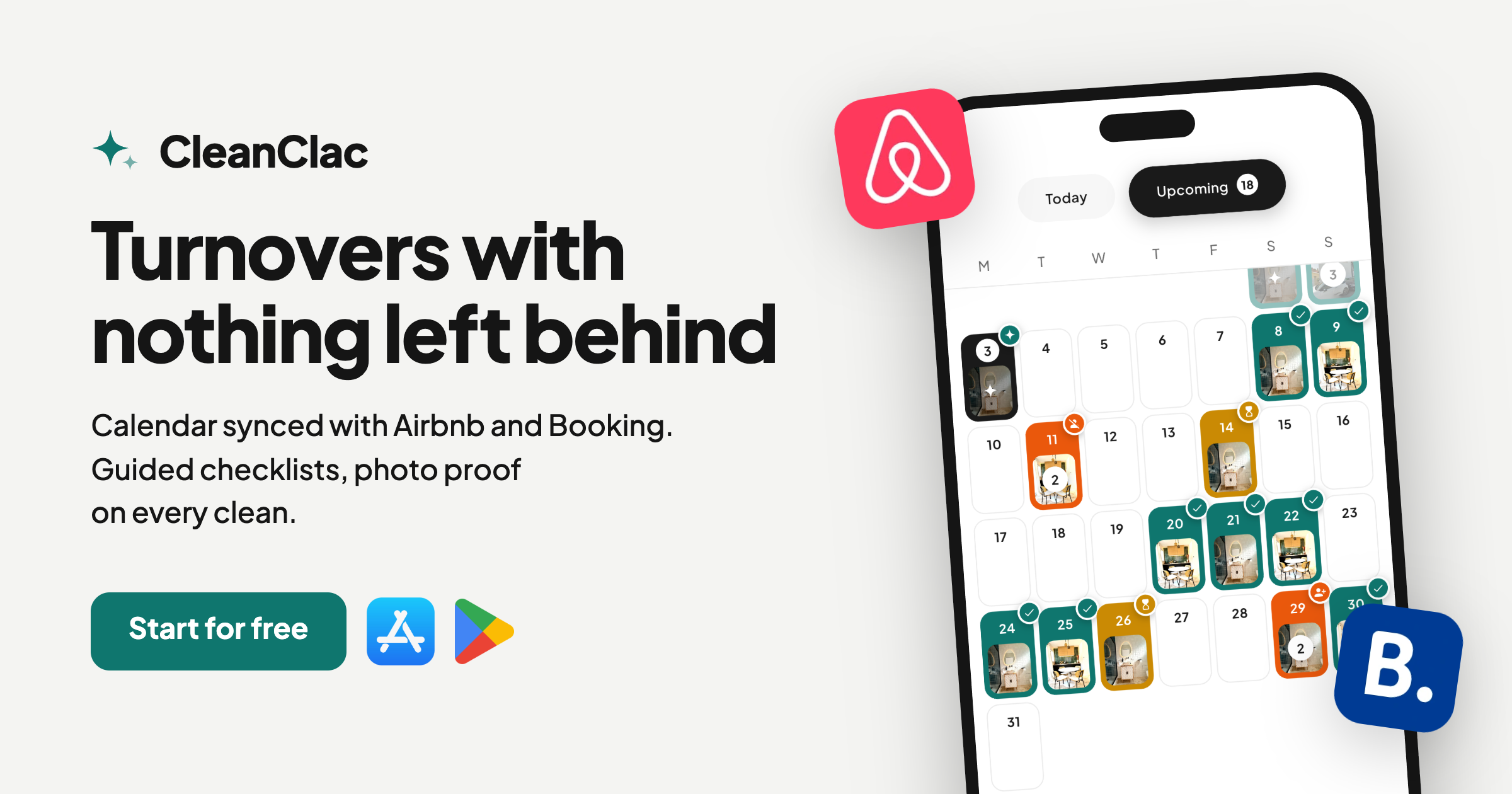
If you manage several properties, CleanClac connects bookings to cleans: automatic scheduling, cleaner notification, smartphone checklist, photos and videos, cleaning report, stock tracking and a dashboard. A per-active-property subscription lets you match the cost to the size of your portfolio.
The prices published on the pricing page are as follows: a free plan, 9.99 € per month for 2 properties, 14.99 € per month for 3 or 4 properties, 19.99 € per month for 5 properties, then 4 € per month per additional property. On annual billing, 2 properties cost 59.99 € per year, 5 properties 119.99 € per year, and each additional property 24 € per year, according to the 2026 price comparison. A dedicated app for cleaners is also available on the cleaners page.
Guests and transparency: showing the clean
Traceability is not only for internal use. Part of its value comes from the confidence it gives guests. Letting guests know that the property has been cleaned, with clear information about what was done and when, reduces doubt on arrival. That is the idea behind a cleaning card for guests, which makes visible what usually only shows up in reviews.
Common mistakes
- Settling for a "done" message with no proof or detail.
- Adding too many fields until nobody fills them in.
- Not defining which shots to take: each cleaner photographs something different.
- Leaving anomalies without follow-up, which is effectively the same as not reporting them at all.
- Never reviewing the history: average durations and repeatedly redone areas are a goldmine of information for adjusting the time you allocate.
The indicators to review every month
Tracking exists to inform decisions. MoveWORK recommends recording task compliance, inspection results, areas needing a redo and average operation duration in order to plan corrective action. Applied to short-term rentals, this produces a five-line monthly dashboard:
- Average clean duration per property, compared to the time billed or planned.
- Number of redos requested after inspection.
- Anomalies reported and average time to resolution.
- Consumable shortages discovered on guest arrival.
- Cleanliness comments in reviews, matched back to the relevant visits.
Matching reviews to visit records is the most telling exercise: when a comment about cleanliness comes in, you can find the visit, the name, the photos, and know whether the problem lies with the work itself, the time allowed, or a lack of supplies.
A one-month example rollout
Take a host with three apartments and two cleaners. Week 1: define a checklist for each property and a list of eight required photos. Week 2: connect booking calendars so cleans are created automatically. Week 3: spend five minutes reviewing each report and note any redos. Week 4: compare actual durations to planned durations and adjust the time slots. This is an example of a method, not a guaranteed outcome. What matters is making each week measurable.
FAQ
Is cleaning traceability required for a short-term rental?
We have not identified any general requirement for individual hosts to keep a cleaning traceability record. It is a management practice that becomes very useful as soon as you delegate cleaning or manage several properties. If you operate a property subject to specific health regulations, check with your local authority.
What should you photograph?
Photograph the areas guests see first and those that drive reviews: the made bed, bathroom, kitchen, floors and terrace. Add any anomaly (stain, breakage, damp) with a wide shot and then a close-up. Use the same angles every time so you can compare them.
Is a signature enough to prove a clean was done?
No. It confirms that the cleaner filled in the form, not that the result meets your standard. Pair it with a quality checklist, before-and-after photos and a timestamp so the proof rests on verifiable facts.
Should you go digital for a single property?
Not necessarily. With one property and a regular cleaner, a simple checklist and photos kept in a dated folder can be enough. Digital tools become worthwhile when the number of properties, cleaners or booking platforms makes manual coordination unreliable.
How long should you keep cleaning reports?
Keep them at least for as long as a dispute with a guest or a contractor can arise, then align with the rules that apply to your management documents. If photos show people or personal belongings, limit access and retention time, and ask your accountant or a legal adviser about your specific situation.
Sources
- MoveWORK: creating a cleaning traceability record
- Allianz Entre Pros: writing a service report
- Easy to Clean: cleaning tracking and traceability
- Clean Coming: digital cleaning traceability in hospitality


