Consumable Kits for Short-Term Rentals: Complete Guide
Choose the right consumable kits for your short-term rental: compare suppliers, control cost per turnover, and never run out of stock again.

Jonathan Lalinec
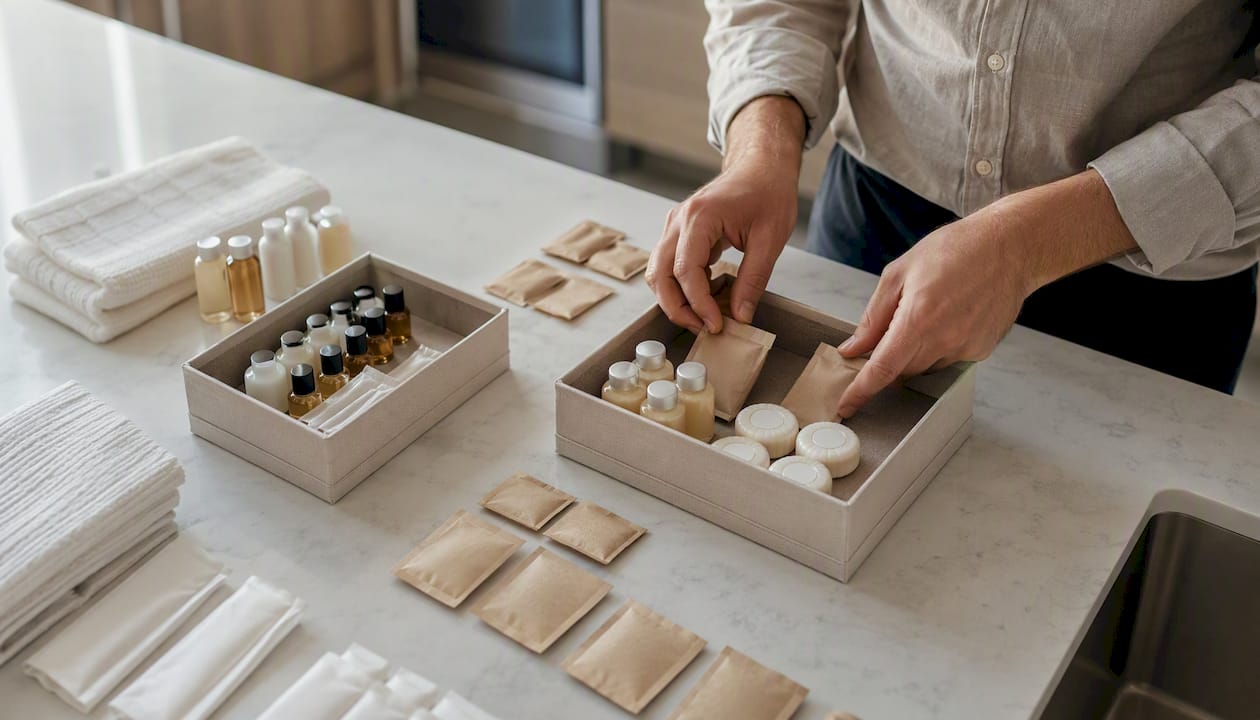
For most studios and apartments, a standard hygiene kit (soap, shampoo, shower gel, toilet paper) combined with a basic kitchen kit (coffee, tea, washing-up liquid) covers 80% of guest expectations for a cost per turnover of between €4 and €12. Premium properties gain from adding a gourmet or premium kit. Here is the shortlist by profile:
- Budget / studio: single-use cleaning kit (Grand Vent, Suet, Vésine, Bise) + basic hygiene kit (Taravo TRAVELCARE or Lot) · goal: keep cost per turnover low.
- Standard / family apartment: complete bathroom kit + cleaning kit (Kitotel Cleaning welcome kit or Kit-ménaG-01) + kitchen kit · between €6 and €8 per turnover.
- Premium / holiday home: Premium welcome kit or zen box welcome kit + gourmet kit (Kitotel Gourmet welcome kit) + logo personalisation · between €9 and €12.
- Families: standard kit + snacks, unbreakable glasses, Isle TRAVELCARE or Viaur TRAVELCARE hygiene kit.
- Business travellers / multi-property concierge: Kitotel or StayKit with express delivery, low MOQ and branding option.
- Pet-friendly properties: standard kit + disposable bowl and waste bags.
A well-calibrated kit reduces post-checkout support contacts, improves ratings and pays for itself quickly over the length of the stay.
Key takeaways
A well-calibrated consumable kit costs between €4 and €12 per turnover and pays for itself through higher ratings and fewer support contacts.
| Point | Details |
|---|---|
| Cost per turnover | Between €4 and €12 depending on the service level; bulk buying reduces this cost significantly. |
| Category priorities | Bathroom first, then kitchen, then cleaning supplies: that is the order of impact on guest satisfaction. |
| Supplier choice | LittleBOX for price, Kitotel for range and express delivery, La Centrale du Concierge for branding. |
| Uninterrupted restocking | Set reorder alerts for each item and order every 3 to 4 weeks to avoid both stockouts and overstocking. |
| Cleanclac | Automates stock tracking and reorder alerts directly from cleaning reports, for multi-property managers. |
Table of contents
- Which consumable kit should you choose? The comparison table
- What does each kit contain? Details by category
- How to choose the right kit for your property
- Where to buy your consumable kits in France
- How to budget and manage your orders
- How to restock consumables without running out
- Legal requirements: what consumables are not
- What experience teaches about welcome kits
- Cleanclac: automate consumable tracking and cleaning schedules
- Sources
- Frequently asked questions
Which consumable kit should you choose? The comparison table
Suppliers available in France cover very different positions: from a cleaning kit at under €1.50 per unit at LittleBOX to branded gift boxes for concierge services.
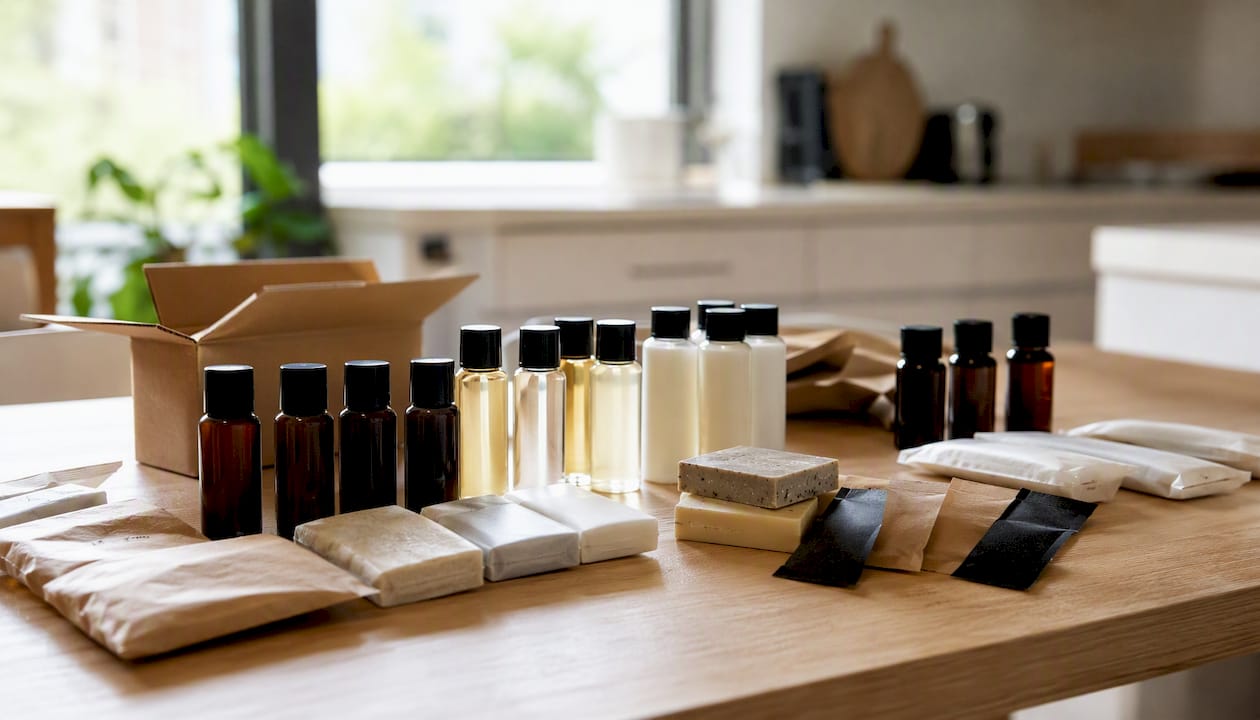
Quick verdict: LittleBOX and the single-use cleaning kits (Grand Vent, Mistral, Sirocco, etc.) lead on price. Kitotel dominates on range and express delivery for concierge services. La Centrale du Concierge stands out for visual personalisation. StayKit and the Premium welcome kit suit hosts who want a ready-to-place box with no assembly required.
What does each kit contain? Details by category
The checklist recommended by hospitality professionals consistently puts the bathroom first, then the kitchen, then cleaning products. Here is what is expected in each category.
Bathroom kit (complete bathroom kit, Kitotel Bathroom welcome kit, TRAVELCARE and ANYAH hygiene kits, bathroom wiping kit):
- Hand soap (single-dose sachet or mini bottle)
- Shampoo and shower gel (individual mini bottles)
- Toilet paper (minimum 2 rolls)
- Bath towels or wiping cloths
- Hairdryer (fixed equipment, not a consumable, but check at every turnover)
Cleaning kit (Kitotel Cleaning welcome kit, Kit-ménaG-01, cleaning welcome kit, Grand Vent, Suet, Vésine, Poulen, Blizzard, Norois, Bise, Mistral, Galerne, Libeccio, Auro, Autan, Nordet, Aïgal, Aspre, Narbonnais, Couchant, Carcenet, Drau, Burdeos, Sirocco, Garbí cleaning kits):
- Washing-up liquid dose or dishwasher tablet
- Fresh sponge
- Bin bag (1 or 2 depending on property size)
- Disinfectant wipe or single-dose multi-surface spray
Kits-accueil offers these items as single doses or sachets, which simplifies storage and reduces waste.
Kitchen kit:
- Coffee and/or tea portions (2 to 4 depending on length of stay)
- Individual sugar sachets
- Single-dose salt and pepper
- Washing-up liquid (if not included in the cleaning kit)
Gourmet kit (Kitotel Gourmet welcome kit):
- Local or regional products (biscuits, jam, honey)
- Specialty coffee or premium herbal tea
- Personalised welcome card
Family kit:
- Individual children's snacks
- Unbreakable glasses or cups
- Isle TRAVELCARE or Viaur TRAVELCARE hygiene kit (sizes suited to children)
Pet-friendly kit:
- Disposable bowl
- Waste collection bags
- Paw-cleaning wipe
Packaging formats. The individual sachet (single-use cleaning kits) is the most economical and easiest to store in large quantities. The box or gift set (Kitotel, Premium welcome kit, zen box) offers a superior visual presentation but takes up more space. The cube format (cube-format welcome kit, La Centrale du Concierge) allows strong visual personalisation, which is relevant for concierge services that want to display their brand. Mini hygiene bottles (TRAVELCARE, ANYAH) meet the hygiene requirements of short stays by guaranteeing that each guest receives an unopened product.
How to choose the right kit for your property
Four variables determine the right choice, in this order: guest profile, number of turnovers per month, budget per turnover and storage capacity.
-
Define your guest profile. Couples on a weekend break: a bathroom kit plus cleaning kit is enough. Families with children: add the family kit and check hygiene formats. Business travellers: quality coffee and sufficient toilet paper matter more than gourmet extras. Guests with pets: prepare a pet kit separately.
-
Calculate your target cost per turnover. Simple formula: multiply the unit price of the kit by the number of kits ordered, then divide by the number of turnovers expected over the period. Example: 200 kits at €1.20 = €240, for 40 turnovers per month = €6 per turnover. Bulk buying can reduce this cost significantly depending on the supplier.
-
Assess your storage capacity. Single-use sachets (Grand Vent, Norois, Galerne and similar cleaning kits) store flat in a standard cupboard. Gift boxes (Premium welcome kit, zen box) require more volume. If you manage several properties, a centralised storage space with labelling by category becomes essential.
-
Ask your supplier these questions before ordering:
- Exact list of components with the weight or volume of each item
- Photos of the actual packaging, not just the marketing visual
- MOQ (minimum order quantity) and volume discount thresholds
- Delivery times and shipping costs for your region
- Availability of eco certifications or biodegradable packaging
- Personalisation options (logo, card, message)
-
Compare ready-to-place vs. in-house assembly. A ready-to-place kit (StayKit Complète is the most polished example) eliminates assembly time and guarantees a consistent presentation. In-house assembly gives you full control over components and cost, but requires time and rigorous organisation.
Pro tip: Always test a kit over 5 to 10 turnovers before ordering in volume. Note the actual usage rate of each item: a shampoo that is never opened at checkout means you can reduce the quantity or switch to a smaller format.
Where to buy your consumable kits in France
Specialist short-term rental shops (LittleBOX, Kitotel, StayKit, WelcomeHost, kits-accueil.fr): these are the suppliers best suited to hosts and property managers. They understand the constraints of fast turnovers, offer packaging designed for single doses, and some provide express delivery. Kitotel stands out for its segmented range and low MOQ, making it a credible option for concierge services that want to test several formats without committing to full pallets.
Suppliers with personalisation (La Centrale du Concierge, Kitotel, cube-format and rectangular-format welcome kits): for managers who want to add their logo or a welcome message to the packaging. La Centrale du Concierge offers a visually customisable cube-format welcome kit with unit prices listed on its website. Personalisation is a low-cost marketing lever with a high perceived impact in the premium segment.
General marketplace (Amazon.fr): useful for one-off purchases or quick tests of a specific product. Reserve it for emergencies or initial exploration only.
- Choose a specialist shop if you manage more than 5 properties or more than 15 turnovers per month.
- Use Amazon.fr only to test a product before ordering it in volume elsewhere.
- Go with a personalisation supplier as soon as your positioning is premium or you run a concierge service with its own visual identity.
How to budget and manage your orders
The cost per turnover typically falls between €4 and €12 depending on the service level: a basic kit (hygiene + cleaning) around €4–6, a full standard kit around €6–8, a premium kit with gourmet extras and personalisation between €9 and €12. LittleBOX single-use cleaning kits go down to around €0.95–1.50 per unit, which allows you to build a very economical base kit by combining several products.
Reducing cost per turnover:
- Group your orders over 4 to 6 weeks to reach volume discount thresholds.
- If you manage several properties, centralise purchases on a single supplier account to consolidate volumes.
- Always compare shipping costs: on small orders they can represent 15 to 25% of the total.
Goods-received checklist:
- Verify that the number of kits received matches the purchase order exactly.
- Open a sample (5% of the batch) to check that the components match the product specification.
- Photograph any discrepancy before contacting the supplier: this is the standard procedure for any claim.
- Store by category (bathroom / cleaning / kitchen / gourmet) with clear labelling and the date of receipt.
Pro tip: Negotiate an annual framework agreement with your main supplier once you exceed 20 turnovers per month. Most specialist shops will agree to a guaranteed unit price in exchange for a committed annual volume, which secures your costs and simplifies planning.
How to restock consumables without running out
Managing consumable stock is the weak point for most hosts who run several properties. A five-step workflow makes it systematic.
-
Standardised inventory. Define a fixed list of products for each property (kit type, quantity per turnover) and revise it no more than once a quarter. A stable list is what makes restocking predictable.
-
Reorder thresholds. For each product, set an alert threshold (e.g. stock remaining for fewer than 10 turnovers) and an order threshold (e.g. order when 15 turnovers' worth remains). These two levels prevent both stockouts and overstocking.
-
Order frequency. An order every 3 to 4 weeks is generally optimal for managers of 5 to 20 properties. Order less often and shipping costs accumulate; order more often and stock ties up cash.
-
Storage by category. Keep bathroom, cleaning, kitchen and gourmet items in separate zones, ideally in labelled bins. Kit preparation time drops from 8 to 10 minutes to under 3 minutes when storage is organised by category.
-
Quality control on delivery. Apply the checklist described in the previous section to every delivery, without exception.
Metrics to track: cost per turnover (target: stable or falling), usage rate by item (identifies unnecessary components), kit preparation time, number of guest queries related to missing consumables.
Cleanclac integrates stock and supplies management directly into its cleaning scheduling app. When a cleaner flags a low stock item during a visit, the alert appears in real time in the property manager's dashboard, with no need to check property by property manually. This link between the cleaning report and restocking is what reduces stockouts on high-turnover properties.
Pro tip: Pair every cleaning report with a quick check of remaining consumables. With Cleanclac, this step can be built into the end-of-visit checklist, turning every cleaner's visit into a stock control point.
Legal requirements: what consumables are not
Decree n° 2015-981 sets the minimum list of mandatory equipment for any furnished rental in France: complete bedding, shutters or curtains in bedrooms, appliances (refrigerator, hob, oven or microwave), sufficient crockery, kitchen utensils, a table and chairs, storage, lighting and cleaning equipment. These items relate to the property's fixtures and fittings, not to consumables.
Consumables (soap, shampoo, coffee, toilet paper, washing-up liquid) are not legally required. They are commercially expected, particularly on platforms such as Airbnb or Booking.com, where their absence generates negative reviews and support contacts.
- Do not substitute a mandatory fixture with a consumable: a missing oven cannot be offset by a quality coffee maker.
- Check your property's compliance with the decree separately from your welcome kit.
- For current obligations, consult Service-public and the official texts applicable to furnished rentals.
What experience teaches about welcome kits
The most common mistake is not choosing the wrong supplier. It is over-stocking the kit out of a desire to do things well, then finding that half the items are never used. A gourmet kit with six local products in a studio rented mainly during the week by business travellers generates waste and pushes up the cost per turnover without improving ratings.
The fix is simple: after 10 turnovers with a new kit, compare the usage rate item by item.
The other underestimated lever: measuring the impact of a kit change on reviews and support contacts. If the number of messages saying "no toilet paper" or "no coffee" drops after introducing a new kit, you have proof the investment is justified. Without that measurement, you are managing blind.
Cleanclac: automate consumable tracking and cleaning schedules
Managing consumable kits manually works up to 3 or 4 properties. Beyond that, stockouts and forgotten reorders become a recurring source of friction for both cleaners and guests.
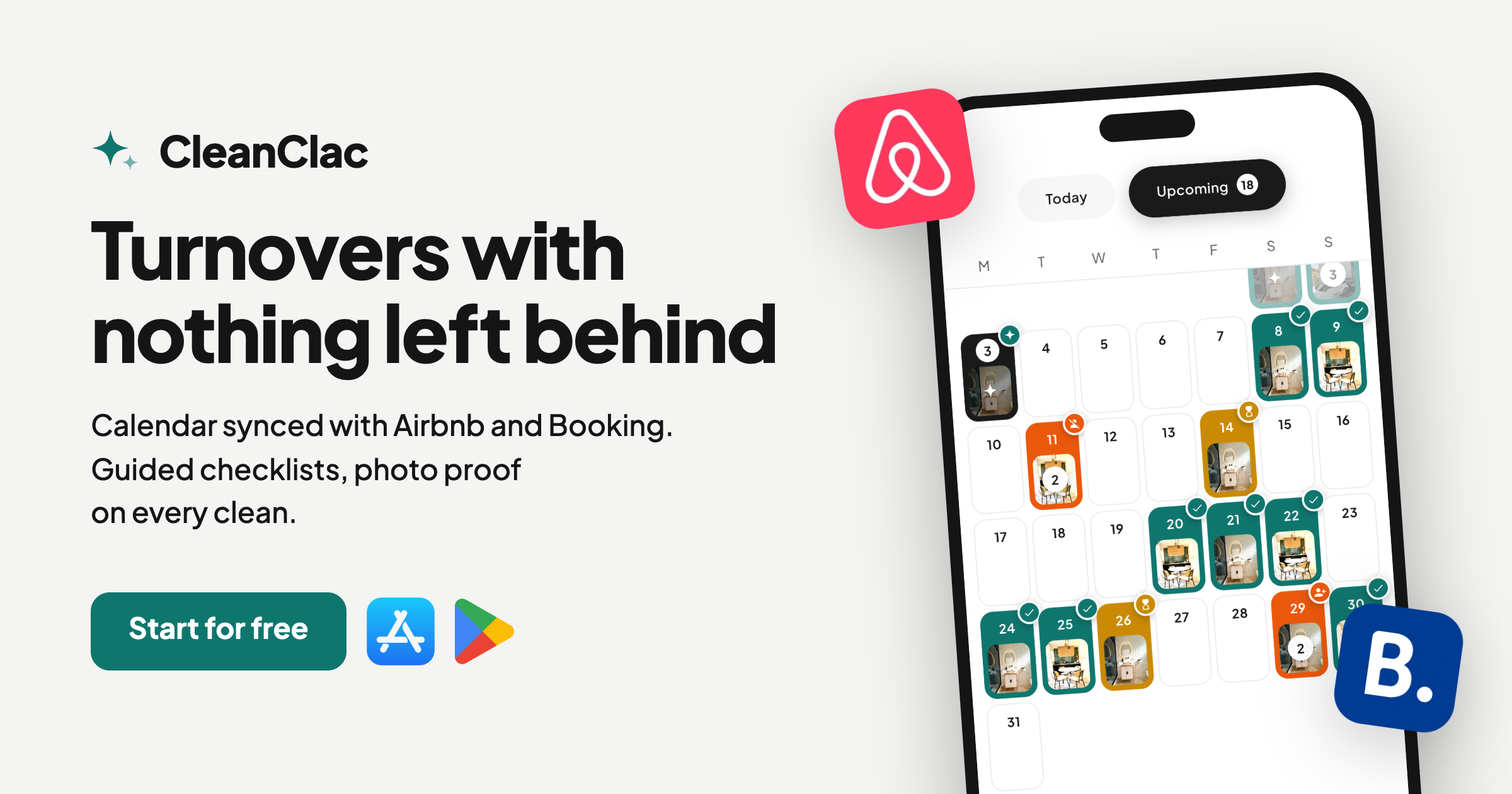
Cleanclac solves this by connecting consumable tracking directly to the cleaning schedule. Each cleaner has mobile access to their intervention checklist; when they flag a low-stock item, the alert appears immediately in the property manager's dashboard. Cleaning reports include photos and a supplies status, making it possible to plan orders without a physical visit. For managers running multiple properties on Airbnb, Booking.com or Abritel, this real-time visibility over stock and cleaning schedules concretely reduces post-checkout calls related to missing consumables. Try Cleanclac for free and see how many turnovers you can manage without a stockout.
Sources
- Kit d'accueil Airbnb : la liste complète 2026 · Tweelo
- Kit de bienvenue Airbnb, la checklist pour des avis 5 étoiles - Welcome Host
- Kitotel · Kit d'accueil Airbnb
- Kits d'accueil pour location - LittleBOX
Frequently asked questions
What is legally required in a furnished rental in France?
Decree n° 2015-981 requires bedding, appliances, crockery, kitchen utensils and cleaning equipment. Consumables (soap, coffee, toilet paper) are not legally mandatory but are commercially expected on booking platforms.
What supplies are essential for a short-term rental?
Beyond the legal minimum, guests consistently expect soap, shampoo, shower gel, toilet paper, washing-up liquid, coffee or tea, and a welcome guide with access codes and local recommendations to reduce post-checkout questions.
What budget should you allow for consumables in a short-term rental?
What welcome gift should you offer in a short-term rental?
A gourmet kit with local products (biscuits, jam, honey) and a personalised card is the most appreciated touch in the premium segment. For tighter budgets, a quality portion of coffee and a handwritten note are enough to create a lasting positive impression.
How do you avoid running out of consumables between turnovers?
Set a reorder alert for each item (e.g. stock remaining for fewer than 10 turnovers) and place an order every 3 to 4 weeks. With Cleanclac, cleaners report low stock directly from their mobile checklist, which triggers a real-time alert in the property manager's dashboard.


