Cleaning Service Contracts: Template and Key Clauses
Download a complete cleaning service contract template. Learn which clauses protect both parties and how to build a spec sheet that holds up in a dispute.

Jonathan Lalinec

Start by downloading a cleaning service contract template suited to French law, then customise it beginning with the spec sheet. That sequence genuinely protects both parties, well before the first visit. A verbal agreement may technically hold, but it proves nothing in a dispute: a written contract sets out the scope, price, term and responsibilities in a form that can be enforced.
Three references to cite at the point of signing:
- Legifrance for the applicable legislation and the cleaning industry collective agreement.
- The national collective agreement for the cleaning industry, which governs staff transfers, pay conditions and the sector's social obligations.
- The Cleanclac checklist for short-term rentals, covered in detail in section 9.
Pre-signature checklist:
- Precise scope: zones covered, tasks included, frequencies and explicit exclusions.
- Billing terms: pricing structure (hourly, flat rate, per m²), payment deadline, indexed revision clause.
- The cleaner's professional liability insurance certificate.
- URSSAF compliance certificate if the contract reaches or exceeds €5,000 excl. VAT.
- Spec sheet attached and signed by both parties.
- Quality control procedure: timestamped photo evidence, turnaround deadline for non-compliant work.
Pro tip: Sign the spec sheet at the same time as the main contract, not afterwards. An unsigned spec sheet carries far less evidential weight if there is a dispute about scope.
Key points
A solid cleaning service contract rests on a precise spec sheet, verified certificates and quality control procedures built in from the moment of signing.
| Point | Details |
|---|---|
| Downloadable template | Use a .docx template (LegalPlace, Pactolane) and customise it with a signed spec sheet as an annex. |
| Required certificates | Require professional liability insurance and a URSSAF certificate from €5,000 excl. VAT, renewed regularly. |
| Legal billing | Payment terms between businesses are capped at 60 days; a flat recovery fee of €40 applies per overdue invoice. |
| Staff transfer | The cleaning industry collective agreement requires the incoming contractor to take on existing staff when a contract changes hands. |
| Cleanclac for audit trails | Cleanclac automates timestamped reports and photo evidence, reinforcing quality control clauses. |
Table of contents
- Where to find a reliable cleaning contract template
- What is a cleaning service contract under French law?
- Which clauses belong in a cleaning service agreement?
- Cleaner and client obligations: who does what?
- Which sector rules apply to cleaning contracts?
- Term, renewal and billing: what the law says
- Which documents and annexes to attach to the contract
- Cleanclac checklist for short-term rentals
- What experience teaches about cleaning service contracts
- Cleanclac: automate execution and proof of service
- Sources
Where to find a reliable cleaning contract template
There is no shortage of sources, but quality varies widely. A generic template with no sector grounding may omit clauses that are critical in the cleaning industry, particularly staff transfer obligations and the URSSAF compliance requirement.
Recommended sources:
- LegalPlace offers a free downloadable cleaning service contract template covering the essential clauses under French law.
- Pactolane provides an editable .docx template, useful for customising the spec sheet and technical clauses without starting from scratch.
- PROPRET, the sector's professional federation, publishes industry guides that incorporate the specifics of the cleaning industry collective agreement.
- Legifrance and Service-public for the relevant legislation and administrative guidance on mandatory contract clauses.
- ISIDOOR provides sector-specific .docx templates tailored to cleaning businesses.
How to assess a template:
- Compliant with French law (Civil Code, Commercial Code, Labour Code for employment matters).
- Takes the national cleaning industry collective agreement into account.
- Includes an editable spec sheet annex.
- .docx format for quick customisation of technical clauses.
Pro tip: Choose templates that include a standard staff transfer clause and a spec sheet annex. For any contract above €10,000 excl. VAT or covering multiple sites, a review by a specialist employment lawyer is the most cost-effective precaution you can take.
What is a cleaning service contract under French law?
A cleaning service contract falls under the category of louage d'ouvrage within the French Civil Code: the contractor commits to carrying out the service independently, in return for an agreed price. This classification is fundamentally different from an employment contract, under which an employee performs tasks under the employer's ongoing direction and control.
The boundary between the two may look clear on paper. In practice it blurs quickly if the client dictates working hours, supplies all the equipment exclusively, monitors every step of the work, or issues detailed instructions on method. These facts together constitute a relationship of subordination and expose the client to reclassification as an employment relationship by the employment tribunal or URSSAF.
On the nature of the obligation, how the contract is drafted makes all the difference. By default, a cleaning contractor is subject to a best-efforts obligation: a commitment to apply the necessary diligence, without guaranteeing a specific outcome. But a detailed spec sheet with measurable quality indicators (compliance rates, remediation deadlines) can convert specific points into a results obligation for sensitive sites. That classification must be explicit in the contract, because it changes where the burden of proof lies in a dispute.
Which clauses belong in a cleaning service agreement?
A solid cleaning contract is more than a price and a start date. Here are the clauses to include, with their purpose and a short form of words to adapt.
Scope and coverage
Describe zone by zone the tasks covered, frequencies and exclusions.
Pricing, billing and revision
Set out the pricing structure (hourly rate, monthly flat rate, price per m²) and the revision terms. The cleaning industry pay index or the SMIC serve as reference points for indexation clauses. Under Article L.441-10 of the Commercial Code, payment terms between businesses are capped at the statutory maximum from the invoice date. If payment is late, the law provides for a flat recovery fee per invoice, on top of late-payment interest.
Term, renewal and termination
Liability and insurance
Require an up-to-date professional liability insurance certificate. Specify the recommended minimum coverage amounts and who bears the cost of remediation for damage caused during the service.
Subcontracting
Subcontracting must be subject to the client's prior written approval. The contractor remains fully responsible for performance even when a subcontractor is used. This is a sector standard, noted by PROPRET.
Confidentiality and data protection
If the contractor accesses premises containing personal data (client files, IT systems), a GDPR clause is required: a confidentiality commitment, a prohibition on using information for any other purpose, and a procedure for reporting incidents.
Quality control
Provide for a signed visit log at each service call, timestamped photo evidence and compliance indicators. Set a maximum turnaround for remediation (24 to 48 hours for short-term rentals).
Pro tip: Whether the obligation is best-efforts or results-based depends directly on how detailed the spec sheet is. For a sensitive site, write measurable indicators and specify acceptance thresholds. That converts the clause into a results obligation and makes disputes far easier to manage.
| Clause | What it protects | Short form of words |
|---|---|---|
| Scope and coverage | Prevents disputes about which tasks are included | "Services as defined in Annex 1: Spec Sheet" |
| Pricing and revision | Rate stability and predictability | "Price revised annually in line with the cleaning industry pay index" |
| Payment terms | Legal compliance (60-day cap) | "Payment within 30 days of invoice date; statutory late-payment penalties apply" |
| Termination for non-performance | Exit route if the contractor fails to deliver | "Formal notice, 15-day cure period, then automatic termination" |
| Subcontracting | Contractor remains accountable | "Subcontracting requires the client's prior written approval" |
| Professional liability insurance | Coverage for damage caused | "Liability insurance certificate required before any work begins" |
| Quality control | Proof of service and dispute management | "Timestamped report with photos after each visit; 48-hour remediation deadline" |
Cleaner and client obligations: who does what?
Clear obligations on both sides prevent most operational misunderstandings. Here is the practical breakdown.
Contractor obligations:
- Carry out the service diligently, following the frequencies and protocols in the spec sheet.
- Use the cleaning products specified and comply with applicable safety standards.
- Train staff in the site's protocols and hygiene requirements.
- Maintain up-to-date professional liability insurance and provide the certificate on request.
- Keep a signed visit log at each service call and maintain a full audit trail.
- Report any damage or incident noticed during the visit immediately.
Client obligations:
- Pay invoices within the contractual deadline (60-day maximum between businesses).
- Guarantee access to the property at the agreed times.
- Inform the contractor of any specific health or technical risks (hazardous products, fragile equipment, restricted areas).
- Provide the information needed for a staff transfer if the contract changes hands.
- Check URSSAF certificates for contracts that meet the legal threshold.
Documents the contractor must provide at signing:
- Valid professional liability insurance certificate.
- Kbis company extract (companies) or SIRET number with ID (sole traders).
- URSSAF compliance certificate if the contract reaches or exceeds €5,000 excl. VAT.
- Any document proving professional qualifications required by the spec sheet.
| Document | Provided by | When |
|---|---|---|
| Professional liability insurance certificate | Contractor | Before the first visit |
| Kbis extract or SIRET | Contractor | At signing |
| URSSAF certificate | Contractor | At signing, then at the required intervals if contract ≥ €5,000 excl. VAT |
| Signed spec sheet | Both parties | At signing |
Which sector rules apply to cleaning contracts?
The cleaning industry operates under obligations that go beyond general contract law. Ignoring them exposes both parties to serious risk.
Staff transfer
When a contract changes hands on a given site, the national collective agreement for cleaning businesses requires the incoming contractor to take on the staff who worked there, subject to seniority conditions and with their existing pay terms maintained. That obligation falls on the incoming contractor, but the client must supply the necessary information (staff list, seniority, pay conditions). A contract clause should anticipate this transfer and set out the deadlines for providing the data.
URSSAF compliance obligation
For any contract of at least €5,000 excl. VAT, the business client must request a URSSAF compliance certificate and renew it every six months. This check protects the client against joint liability in the event of undeclared work or social contribution fraud by the contractor. In practice, many property managers verify the certificate at signing and then forget the six-monthly renewal, taking on risk without realising it.
Undeclared work
Include a social compliance clause in the contract: the contractor commits to meeting all legal and collective agreement obligations, to providing the required certificates, and to informing the client of any ongoing inspection. If fraud is established, this clause provides grounds for immediate termination and a claim for damages.
Term, renewal and billing: what the law says
Term and renewal
A one-year cleaning contract with automatic annual renewal is the most common arrangement. For contracts between businesses, the notification obligation derived from the Chatel legislation requires that the other party be reminded in writing, within a reasonable period before the renewal date, of the deadline by which they can give notice of non-renewal.
Billing terms between businesses:
- Payment terms capped at 60 days from the invoice issue date (Article L.441-10 of the Commercial Code).
- Late-payment interest calculated at the applicable legal rate, due automatically without the need for a formal demand.
- Flat recovery fee of €40 per invoice unpaid at the due date.
- Mandatory invoice details: invoice number, date, identity of both parties, description of the service, amount excl. VAT, VAT rate, amount incl. VAT, payment terms and applicable penalties.
Early termination:
- For non-performance: formal notice by recorded delivery letter, 15-day cure period, then automatic termination.
- For convenience: contractual notice period observed, any agreed compensation paid.
- Force majeure: immediate notification, obligations suspended, termination if the situation persists beyond an agreed period (generally 30 days).
Which documents and annexes to attach to the contract
A well-drafted contract without its annexes is incomplete. According to Neatikai, most disputes between clients and cleaners stem from an incomplete spec sheet. Annexes turn general commitments into verifiable obligations.
Annex 1: Detailed spec sheet
- Zone-by-zone description (surfaces, equipment, access points).
- Tasks included and frequencies (daily, weekly, monthly).
- Approved or required cleaning products.
- Explicit exclusions (equipment not covered, areas outside scope).
- Quality indicators (KPIs) and acceptance thresholds.
Annex 2: Certificates and administrative documents
- Professional liability insurance certificate.
- URSSAF compliance certificate (required for contracts ≥ €5,000 excl. VAT).
- Kbis extract or SIRET number with ID for sole traders.
Annex 3: Operational procedures
- Signed visit log template for each service call.
- Purchase order form for one-off work outside the contract.
- Complaint form and non-compliance handling procedure.
- Service acceptance report template.
Pro tip: Number the annexes in the body of the contract and reference them explicitly in each relevant clause. A court cannot rely on an annexed document that is not mentioned in the body of the contract.
Cleanclac checklist for short-term rentals
Short-term rental managers face specific constraints: frequent turnovers, tight windows between stays, and the need to prove that cleaning was completed remotely. A standard cleaning service contract must be adapted to these realities.
Operational checklist to include in the contract or spec sheet:
- Automatic task assignment based on the reservations calendar (Airbnb, Booking.com, Abritel, Vrbo).
- Timestamped photo evidence required after every visit, accessible through the management app.
- Post-turnover cleaning report sent to the manager within a defined maximum period (for example: 30 minutes after the end of the visit).
- Supply stock management integrated into the report (consumable levels, restocking alerts).
- Automatic notifications to cleaners when the schedule changes or an urgent visit is needed.
Recommended contract clause for handling the unexpected:
Explicitly provide for a backup solution if the regular cleaner is unavailable: a maximum response time (for example: 2 hours before the next guest arrives), the contractor's financial liability for urgent cleans made necessary by their failure to perform, and a procedure for immediately notifying the manager.
For timestamped photo evidence, its legal weight depends on the traceability of the system that generates it. A report produced by a recognised third-party application is more robust than a photo sent by a messaging app.
Pro tip: Build into the performance clause a requirement for the contractor to provide a timestamped post-visit report with photo evidence accessible via the app. In a dispute with a guest about the condition of the property, that report is your first line of defence. It must be produced automatically, not on request.
What experience teaches about cleaning service contracts
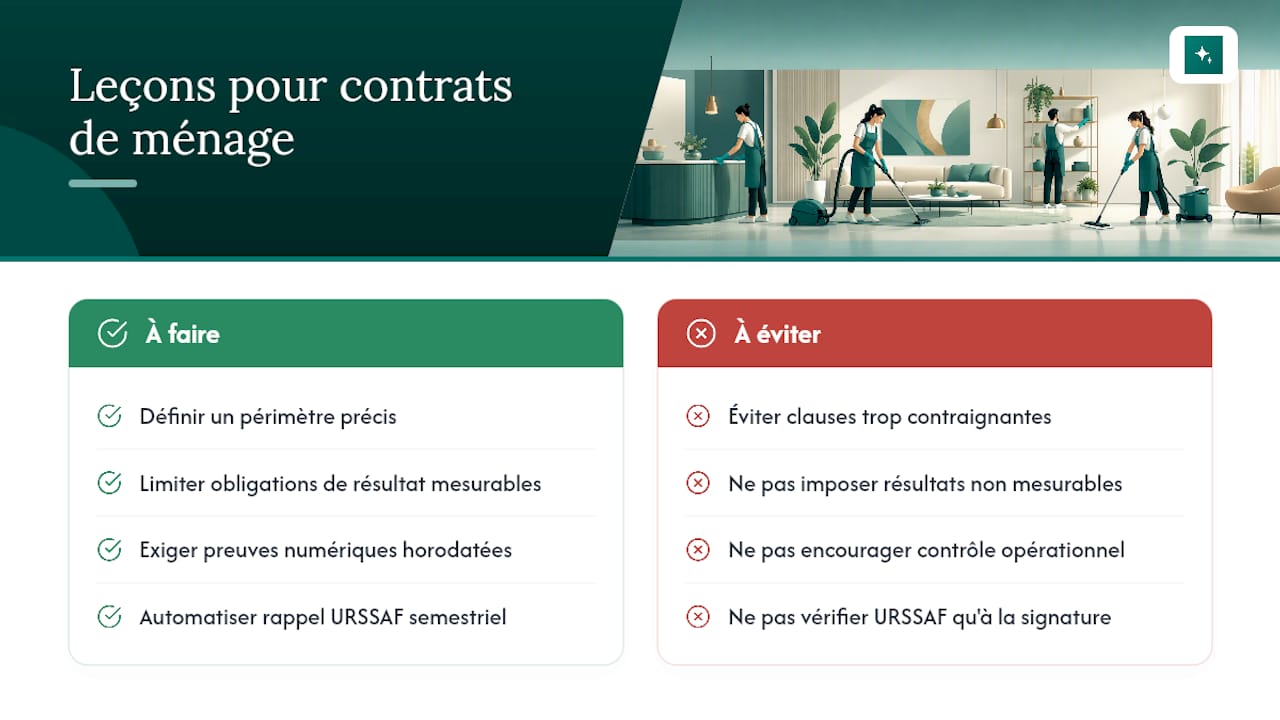
When drafting a cleaning contract, the temptation is to try to cover everything with highly demanding clauses. This often backfires. A contract loaded with results obligations on tasks that are difficult to measure objectively creates more disputes than it prevents. It also increases the risk of reclassification if the client ends up exercising constant operational control to verify those results.
The right balance lies elsewhere: a very precise scope in the spec sheet, results obligations limited to genuinely measurable points (compliance rate on a photo checklist, remediation deadline), and best-efforts obligations for everything else. That structure is more defensible legally and easier to manage day to day.
On audit trails, the most useful development in recent years is not a legal one. It is the adoption of timestamped digital evidence as a standard part of service delivery. A photo report generated automatically after every visit changes the nature of disputes. Instead of arguing about what was or was not done, both parties have an enforceable record. For short-term rentals, where the manager is not on site, this has become a contractual necessity, not a convenience.
Finally, the URSSAF compliance obligation is consistently underestimated. Many clients check the certificate at signing and forget the six-monthly renewal. Yet it is precisely at renewal that fraud is detected. Automating that reminder in your contract management process matters just as much as the clause itself.
Cleanclac: automate execution and proof of service
Drafting a solid contract is the first step. Making sure every clause is honoured at every visit is another matter, especially when you manage several short-term rental properties.
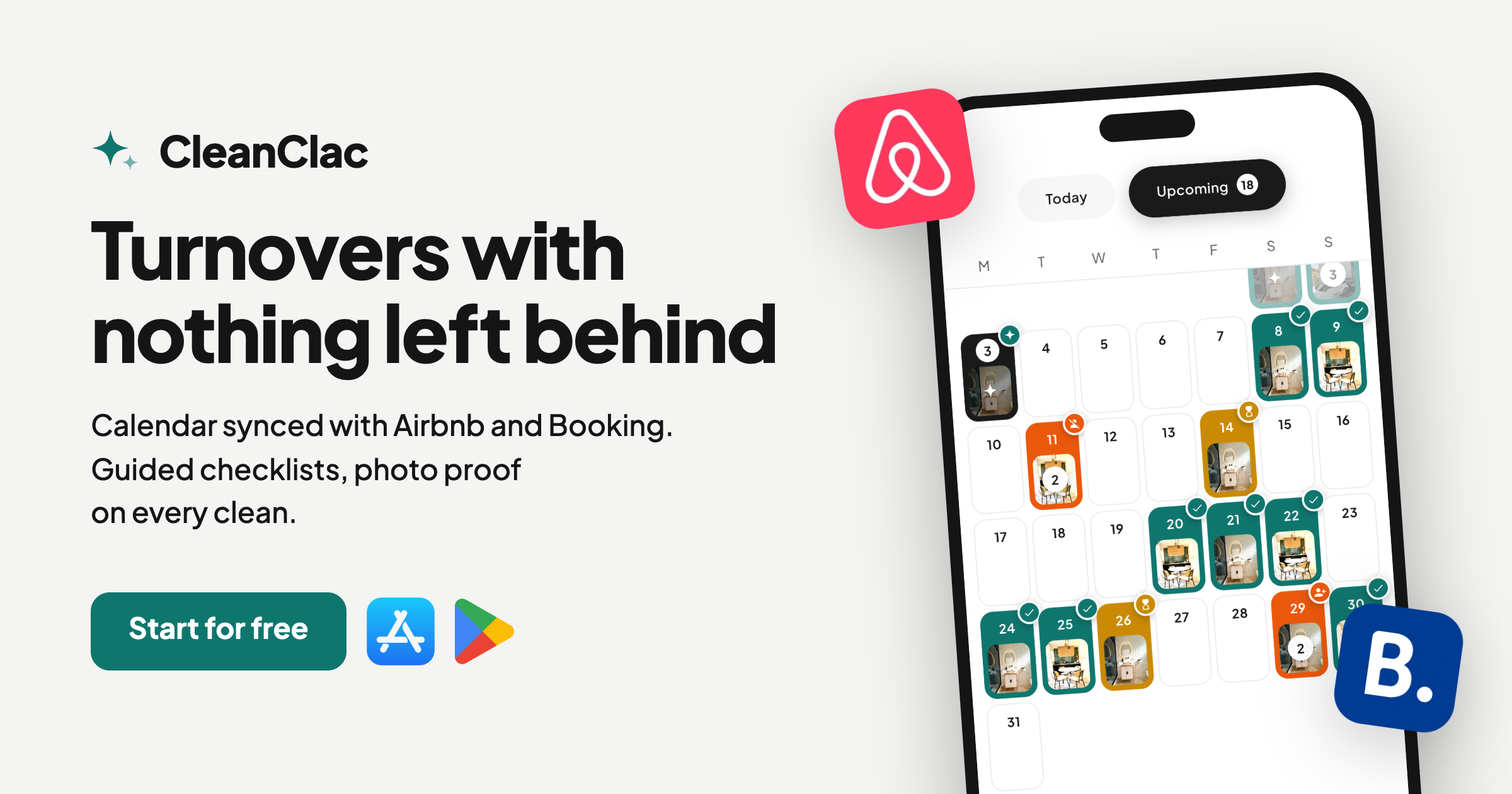
Every report the app produces is a performance record that can be used directly in a dispute with a guest or a contractor.
For managers who want to align their service contract with their operational setup, Cleanclac offers annex templates and use cases tailored to short-term rentals on Airbnb, Booking.com, Abritel and Vrbo. Pricing starts at €2 per property, with no long-term commitment. Try the app free and see how it fits with your existing contracts.
This article provides general information only and does not replace advice from a qualified lawyer. Consult a qualified legal professional about your specific situation before acting on anything in this content.
Sources
The resources below cover the reference texts, downloadable templates and sector guides cited in this article.
- National collective agreement for cleaning businesses: article on staff transfer
- Everything you need to know about contracting cleaning services: PROPRET
- Cleaning service contract: free template (LegalPlace)
- Free premises cleaning contract template (Pactolane)
- Cleaning spec sheet PDF: compliance checklist (Neatikai)
For contracts above €10,000 excl. VAT or covering multiple sites, a review by a specialist employment and commercial lawyer remains the most appropriate precaution, regardless of the quality of the starting template.