Centralise Multi-Platform Cleaning: the 2026 Method
Learn how to centralise cleaning across Airbnb, Booking and Vrbo by automating tasks from every booking, so your turnovers run on time every time.

Jonathan Lalinec
Centralising multi-platform cleaning means automatically linking your Airbnb, Booking and Vrbo reservations to a single app that schedules, assigns and tracks every clean. In practice, that means connecting your PMS or calendars to a tool like CleanClac so that every confirmed booking becomes an automatic cleaning task.
The action to take today: sync your booking calendars with a cleaning management app and set up a default assignment rule before your next check-in.
Two facts make the case for urgency:
- Beyond a handful of properties, manual coordination by messages and spreadsheets is structurally inefficient.
- Automating your cleaning schedules creates the task the moment a booking is confirmed and updates it instantly if the booking is changed or cancelled.
Key takeaways
Centralising your cleaning through an app connected to your reservations reduces scheduling errors and becomes essential once you manage more than 5 to 10 properties.
| Point | Details |
|---|---|
| Automation threshold | Beyond 5 to 10 properties, manual coordination becomes structurally inefficient. |
| Document before you automate | Write your checklists, linen procedures and photo criteria before connecting any tool. |
| Test in real conditions | Validate six functional tests on a pilot of two to five properties before rolling out. |
| Track the right metrics | Measure on-time readiness rate, turnover time, photo completion rate and monthly incidents. |
| A starting option | CleanClac automates task creation, mobile notifications and photo tracking per property. |
Contents
- Why centralising your cleaning changes your operations
- What standards to set before you automate
- How to centralise your multi-platform schedules in practice
- What criteria to use when choosing a SaaS tool
- Checklist and timeline for getting set up
- CleanClac as an operational starting point
- Try CleanClac on your portfolio now
- Sources
- Frequently asked questions
Why centralising your cleaning changes your operations
A manager juggling three platforms and a WhatsApp group will always lose a critical piece of information at the worst moment. Centralisation removes that friction point by bringing reservations from every platform into a single task feed.
The main benefit is not just time saved. It is the reduction in failed turnovers, those situations where a guest arrives before the previous clean is done. Centralising through a PMS or channel manager turns repetitive manual tasks into automated processes and significantly reduces the risk of double-booking.
Three concrete gains emerge once the system is running:
- Far fewer last-minute calls and messages to confirm a clean has been done.
- Systematic photo evidence that replaces on-site checks.
- Reporting that flags problem cleaners or problem properties before guest reviews suffer.
Automation pays off quickly once a portfolio grows beyond a small size. The weekly coordination time drops sharply once the system is bedded in.
What standards to set before you automate
Automating a poorly defined process only accelerates the chaos. Before connecting any tool, you need to write down what a successful clean actually means for your portfolio.
Five documents form the minimum foundation:
- A room-by-room checklist covering non-negotiable checkpoints: linen, bathroom, kitchen, equipment.
- A linen procedure specifying turnaround times and quantities per property type.
- A consumables restocking policy with alert thresholds.
- Photo quality criteria to standardise what each cleaner must document.
- Access and security rules: codes, key lockboxes, permitted hours.
A well-built task template includes a clear title, an estimated duration, a priority level and any necessary attachments (property layout, specific instructions). The property manual plays an underrated role here. Written properly, it lets any replacement cleaner step in without lengthy training, even at short notice.
Pro tip: Write your checklists as if the cleaner reading them has never set foot in the property. That is the best test of whether your SOP is genuinely usable.
How to centralise your multi-platform schedules in practice
Implementation follows a sequential logic, not a big-bang switch. Here is the order that minimises service disruption:
- Connect your Airbnb, Booking and Vrbo calendars to your scheduling tool via API or iCal sync.
- Define your assignment rules: by area, by skill, or by immediate availability.
- Create task templates for each property type, with duration and checklist attached.
- Configure your turnover windows, fixed or flexible depending on your time constraints.
- Test the system on a pilot batch of two to five properties before rolling out fully.
On the technical side, the mechanism relies on automatic task creation at booking confirmation, with immediate updates on modification or cancellation. Photo proof at completion and mobile notifications cut out the back-and-forth calls that eat up a manager's day.
For unexpected situations, a backup pool of cleaners remains essential. A cleaner who calls in sick on the morning of a turnover must never bring the whole schedule to a halt. Automatic reassignment to a second tier of providers, combined with incident tracking, absorbs these situations without constant manual intervention.
Notification timing depends directly on the turnover window available between two bookings.
| Turnover window | Cleaner notification timing | Recommended safety margin |
|---|---|---|
| Several hours or more | Notification the evening before | Flexible, reassignment possible |
| A few hours | Immediate notification | Backup pool activated by default |
| Under 8 hours | Instant notification and escalation | Dedicated priority cleaner mandatory |
Pro tip: Do not limit automation to turnover cleans. Schedule recurring tasks for deep cleans and seasonal maintenance too, and use flexible time slots to optimise your cleaners' rounds.
What criteria to use when choosing a SaaS tool
Choosing a tool rarely comes down to the interface. It comes down to whether it can hold up when your portfolio doubles.
On the technical side, check available PMS and channel manager integrations, the presence of an API or webhooks, native mobile notifications, photo checklist support and multi-account management with differentiated permissions.
On the operational side, look at the assignment modes on offer: rotating pool, first-available routing, or balanced distribution among cleaners. Automatic reassignment on cancellation, KPI-based reporting history and the quality of onboarding matter just as much as the feature list.
On the financial side, compare the per-property pricing model rather than the flat subscription, and anticipate hidden costs: marketplace commissions, training fees and your team's learning curve.
Before you commit, a six-point test is enough to validate a tool in real conditions:
- Automatic task creation from a test booking.
- Task update after a date change.
- Mobile notification received by the assigned cleaner.
- Photo upload as proof of completion.
- Automatic reassignment when a cleaner cancels.
- Export of a performance report for one week.
Checklist and timeline for getting set up
Rolling out centralisation over 90 days avoids service disruptions and leaves time to fine-tune the settings.
- Weeks 1 to 2: audit your current portfolio and identify friction points.
- Weeks 3 to 4: write SOPs and checklists for each property type.
- Weeks 5 to 6: technical configuration and calendar connections.
- Weeks 7 to 8: pilot on two to five representative properties.
- Weeks 9 to 12: refine assignment rules, then scale up progressively.
Once live, a simple monitoring rhythm is all you need:
- Daily: check pending tasks and late alerts.
- Weekly: quality audit on a sample of completed jobs, with photo evidence.
- Monthly: refresh SOPs based on incidents logged.
Four metrics are worth tracking from the first month: on-time readiness rate, average turnover time, percentage of jobs with complete photo evidence, and number of incidents reported.
CleanClac as an operational starting point
CleanClac automates the creation of cleaning jobs from Airbnb, Booking and Vrbo reservations, with individual mobile access for each cleaner. Every cleaner receives their job directly on their smartphone, without going through an intermediary manager.
The features that directly address the criteria above:
- Automatic task creation on booking confirmation, with updates on modification.
- Instant mobile notifications to the assigned cleaner.
- Integrated photo checklists for proof of completion.
- Stock and supplies tracking per property.
- Real-time dashboards showing the status of every property.
For a tight turnover of under eight hours, the system notifies the available cleaner and, if something goes wrong, lets you find a local cleaning provider through the marketplace without breaking the preparation chain. A manager running fifteen properties across three platforms gets full visibility without going back to shared spreadsheets.
What automation really changes on the ground
For a portfolio that grows from six to fourteen properties, switching to a centralised system changes the nature of the work. You stop chasing information and start focusing on quality. The watch points are real: training cleaners on new checklists takes time, and documentation needs updating whenever an incident reveals a grey area. The message for managers still hesitating: the cost of waiting is measured in lost guest reviews, not in the comfort of keeping things as they are.
Try CleanClac on your portfolio now
Compared with managing everything manually through spreadsheets and messaging groups, or using a basic channel manager with no dedicated cleaning module, CleanClac adds a specific layer: full automation of the cleaning cycle, from booking to photo proof, with no technical development on your side.
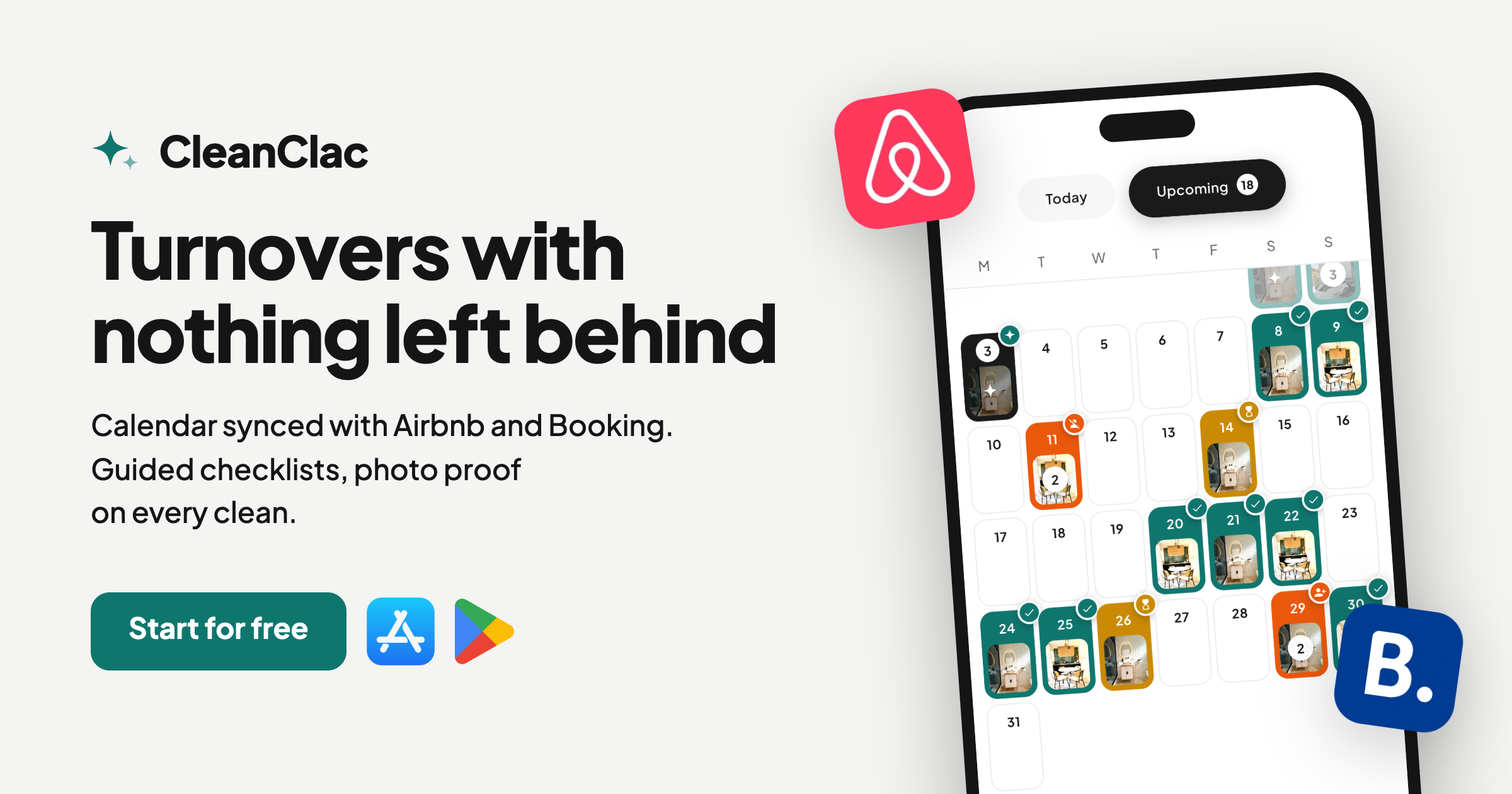
A trial lets you validate the six functional tests described above in one to two weeks: automatic task creation, update on modification, mobile notification, photo proof, reassignment on cancellation and report export. If you already manage several properties on Airbnb and Booking, compare the experience directly on our page dedicated to market alternatives to position the offering. Practical guides on automation and tools support the onboarding process. Connect your first booking calendar on CleanClac today and launch your pilot on two to five properties.
Sources
- Comment automatiser les plannings de nettoyage pour votre location de vacances en 2026 ? - Terra America
Frequently asked questions
What does centralising multi-platform cleaning actually mean?
It means connecting your Airbnb, Booking and Vrbo reservations to a single app that automatically creates and assigns the corresponding cleaning tasks.
From how many properties should you automate?
Manual coordination generally becomes unworkable beyond 5 to 10 properties, the threshold at which a dedicated app pays for itself.
Which integrations should you check before choosing a tool?
Check compatibility with your PMS or channel manager, the availability of mobile notifications, and support for photo checklists as proof of completion.
How long does setup take?
A full rollout, from the initial audit to scaling up, typically spans 90 days, with a pilot on two to five properties starting around week eight.
Does CleanClac handle last-minute emergencies?
Yes, CleanClac lets you find a local cleaning provider through its marketplace when your regular cleaner is unavailable.


