Quality Consistency Across Multiple Cleaners
Learn how to keep cleaning quality consistent across multiple properties and cleaners with unified standards, clear KPIs, and centralized oversight.

Jonathan Lalinec

Quality consistency across multiple cleaners and properties starts with centralized oversight: a unified brief, a small set of standardized KPIs, and neutral governance that resolves disputes quickly. That combination is what stops each property from drifting toward its own standards.
Centralizing oversight does not mean imposing a single cleaner on every site. It means one shared reference framework applies everywhere, even when the on-the-ground teams remain local.
Centralize oversight when:
- the volume of jobs across active properties becomes significant;
- quality gaps between properties start showing up in guest reviews;
- bulk purchasing or logistics savings are meaningful;
- the complexity of scheduling, reporting, and invoicing is multiplying errors.
Keep multiple cleaners operating autonomously when:
- strong local regulations require specialist providers;
- a single supplier would create dangerous dependency if they fail;
- property differences (floor area, type, seasonality) make a single standard unworkable.
Organizations with a formal quality process consistently see a significant average productivity increase, proof that structure delivers more than simply adding extra checks.
Key takeaways
Quality consistency across multiple cleaners rests on a unified brief, a small number of standardized KPIs, and neutral governance that resolves disagreements without delay.
| Point | Details |
|---|---|
| Decide quickly | Centralize oversight once you exceed 15 to 20 jobs per week across multiple properties. |
| Limit your KPIs | Track CSAT, compliance rate, average turnaround time, and anomaly rate rather than a dozen indicators. |
| Neutral governance | Set up a steering committee that keeps business arbitration separate from technical problem-solving. |
| Solid master contract | Include quantified SLAs, KPI-linked penalties, and substitution clauses from the tender stage. |
| Built-in traceability | An app like Cleanclac centralizes photo evidence, schedules, and individual mobile access for each cleaner. |
Contents
- Centralize or keep multiple independent cleaners?
- Risks to anticipate with multiple cleaners
- How to organize quality consistency step by step
- Which KPIs to track when comparing properties
- How to structure the tender and master contract
- Tools that make multi-cleaner coordination easier
- Sources
- Frequently asked questions
Centralize or keep multiple independent cleaners?
Centralizing oversight delivers three measurable benefits: standardized procedures that reduce quality gaps between properties, savings on bulk consumable purchasing, and consolidated reporting that cuts significant time from monthly reviews. A shared brief also eliminates repeated property-by-property negotiations.

There is a downside. A single contract concentrates supplier risk: one failure hits every property at once. Local teams used to their autonomy sometimes resist a framework imposed from above. And excessive standardization can eliminate legitimate adjustments that a specific property actually needed.
Before deciding, check these criteria:
- Job volume: above 15 to 20 jobs per week spread across multiple properties, centralization becomes cost-effective.
- Property diversity: very different properties (city studio versus villa with a pool) need a modular brief, not a rigid single standard.
- Target gains: put a number on what you expect (turnaround time, non-compliance rate, cost) before changing your model.
- Regulatory constraints: some areas require specific certifications or insurance that limit your choice of cleaner.
Risks to anticipate with multiple cleaners
Coordination between multiple cleaners is the number-one risk in a multi-property setup. Without clear governance, schedules slip and local non-compliance goes unnoticed until a negative guest review appears. Information silos are the most common cause: each cleaner reports in their own way, and nobody has an overall picture.
Three actions keep these risks in check:
- Build a RACI matrix that spells out who decides, who acts, who is consulted, and who is informed for each type of incident.
- Keep a dependency log covering access, keys, and shared supplies between cleaners, to avoid cascade blockages.
- Document substitution procedures that can be activated within 24 to 48 hours if a cleaner fails to show.
Also verify, property by property, the professional liability insurance and local certifications required before signing anything.
Pro tip: never let a cleaner discover a local requirement after the contract is signed. Build it into the brief at the tender stage, not as a corrective annex three months later.
How to organize quality consistency step by step
Building quality consistency across multiple cleaners requires a clear sequence, not improvisation. These five phases work regardless of how many properties you manage.
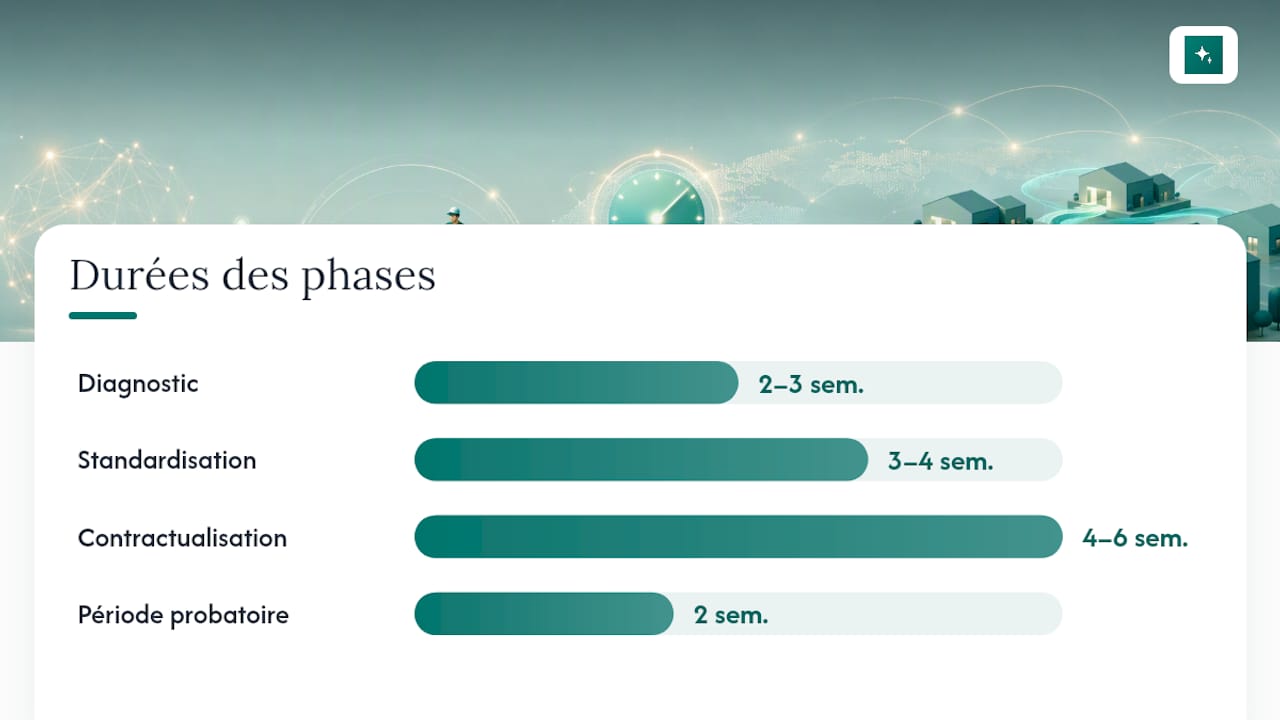
- Diagnosis (2 to 3 weeks): map your current cleaners, identify gaps in their practices, and gather friction points flagged by guests or your team.
- Standardization (3 to 4 weeks): write a single brief with precise acceptance criteria, expected service levels, and required proof of compliance (photos, timestamped reports).
- Contracting (4 to 6 weeks): formalize master agreements with quantified SLAs and substitution clauses.
- Oversight (ongoing): deploy the consolidated dashboard and set review rhythms.
- Audits (quarterly): verify real compliance on the ground, not just what is declared in reports.
At a minimum, the standardized brief must include: acceptance criteria by job type, service levels (turnaround time, availability, photo-proof quality), the escalation process for any deviation, and how proof of compliance is provided.
Every new cleaner goes through the same onboarding:
- Initial training on expected standards, with concrete examples of compliant and non-compliant reports.
- Issue of report templates to be used for every job.
- Access to digital tools, including individual mobile access for each cleaner.
- A probationary period with enhanced auditing during the first two weeks.
The escalation path must be known to everyone before the first incident: who resolves a disagreement between two cleaners, within what timeframe, and at what threshold a neutral steering committee steps in. That neutral governance, which keeps technical resolution separate from business arbitration, prevents the decision ping-pong that paralyzes the most poorly structured multi-property setups.
Pro tip: set a precise monetary or time threshold above which a decision automatically escalates to the steering committee, without waiting for a disagreement to drag on for days.
Which KPIs to track when comparing properties
Tracking too many indicators clouds decision-making. Service quality measurement frameworks recommend sticking to three to five actionable KPIs, combining outcome indicators with process indicators so you can act rather than just report after the fact.
| KPI | What it measures |
|---|---|
| CSAT | Guest satisfaction after each job, collected via a short survey |
| Compliance rate | Share of jobs that fully meet the brief |
| Average turnaround time | Time between notification and job completion |
| First-visit resolution rate | Share of jobs that require no return visit |
| Anomaly rate | Frequency of non-compliance issues found during audits |
Comparing different property types requires normalization. Weight results by job frequency to stop a low-volume property from skewing the overall average, and segment by property type (studio, house, premium listing) rather than aggregating everything into a single figure.
A consolidated dashboard needs, for each data row: the property, the cleaner, the job date, the indicator measured, and an associated proof (photo or report). Without that granularity, tracing the root cause of a deviation is impossible.
How to structure the tender and master contract
A solid master contract protects quality consistency better than any amount of after-the-fact checking. These clauses make the real difference:
- Quantified SLAs: maximum turnaround time, minimum compliance rate, required proof format.
- Penalties and bonuses tied directly to the KPIs you track, not to subjective assessment.
- Documented transition plan in case of cleaner change, including switchover timelines.
- Substitution clauses that can be activated without renegotiating the entire contract.
During the tender, assess each candidate on their real multi-property capacity, their existing reporting tools, their documented compliance track record, and verifiable references covering a comparable scope.
- Write the brief with acceptance criteria already standardized.
- Issue the tender with an objective scoring grid (equal weighting for each criterion).
- Test technical integration (tool access, reporting) before signing.
- Plan a gradual rollout, property by property, rather than a simultaneous switchover that multiplies the risk of incidents.
Consulting a cleaning management software budget template helps you cost out tooling before negotiating cleaner rates.
Tools that make multi-cleaner coordination easier
A consolidated dashboard, mobile notifications for each cleaner, and timestamped proof (photos, videos) significantly reduce disputes between cleaners.
- Check that the tool offers a PMS integration to avoid double entry between booking platforms and the cleaning schedule.
- Require individual mobile access for each cleaner, not a shared account that creates confusion.
- Prioritize a supply management system that flags low stock at each property before it runs out.
A dedicated app like CleanClac becomes essential beyond around ten properties managed simultaneously, when manual tracking becomes unmanageable and every property needs reliable proof of each visit.
Pro tip: always require a timestamped photo as proof for every critical job. It is usually the only piece of evidence that resolves a dispute with a cleaner in minutes rather than days of back-and-forth.
Common mistakes and practical recommendations
The most costly mistake is not a lack of checking; it is the absence of a single source of truth. Each cleaner produces their own numbers, and nobody arbitrates. The second classic mistake is tracking fifteen indicators instead of five, which dilutes attention rather than focusing it.
Standardize three to five KPIs, set up a neutral steering committee from day one, and automate proof collection. Poorly defined governance costs more than a single underperforming cleaner.
A dedicated app to deliver consistency on the ground
Documenting a standardized brief means nothing if there is no way to verify it is being followed every day at every property.

Once you pass around ten properties spread across multiple sites, manual tracking by spreadsheet or scattered messages quickly hits its limits. Supply stock tracking, real-time dashboards, and individual cleaner access give you a consolidated view without spending hours on it each week. Discover how Cleanclac fits into your multi-property management and try the demo to see whether it matches your current job volume.
Sources
- Multi-provider coordination · Noqta
- Quality in services: specifics and challenges · DFCQ
- OECD legal instruments · neutral governance
Frequently asked questions
Do you always need to centralize management when working with multiple cleaners?
Not always. Centralized oversight makes the most sense beyond around fifteen jobs per week, or when quality gaps between properties start showing up in guest reviews. Below that threshold, keeping local teams autonomous is often more agile.
How many KPIs do you need to maintain consistent quality?
Three to five actionable KPIs are enough. CSAT, compliance rate, and average turnaround time are a solid starting point. Combine outcome indicators with process indicators so you can act rather than just report.
How do you prevent conflicts between cleaners across multiple properties?
Neutral governance with a steering committee, a defined escalation chain, and contractually agreed approval thresholds prevents technical disagreements from blocking business decisions.
Which tool helps centralize multi-property tracking?
Which contract clauses protect quality consistency?
A solid master agreement includes quantified SLAs, penalties and bonuses tied to the KPIs you track, a documented transition plan, and substitution clauses that can be activated without renegotiating the whole contract.


