Archive Cleaning Proof and Protect Your Deposit
Learn how to archive timestamped photos, condition reports, and invoices by booking so you can defend every deposit deduction with confidence.

Jonathan Lalinec
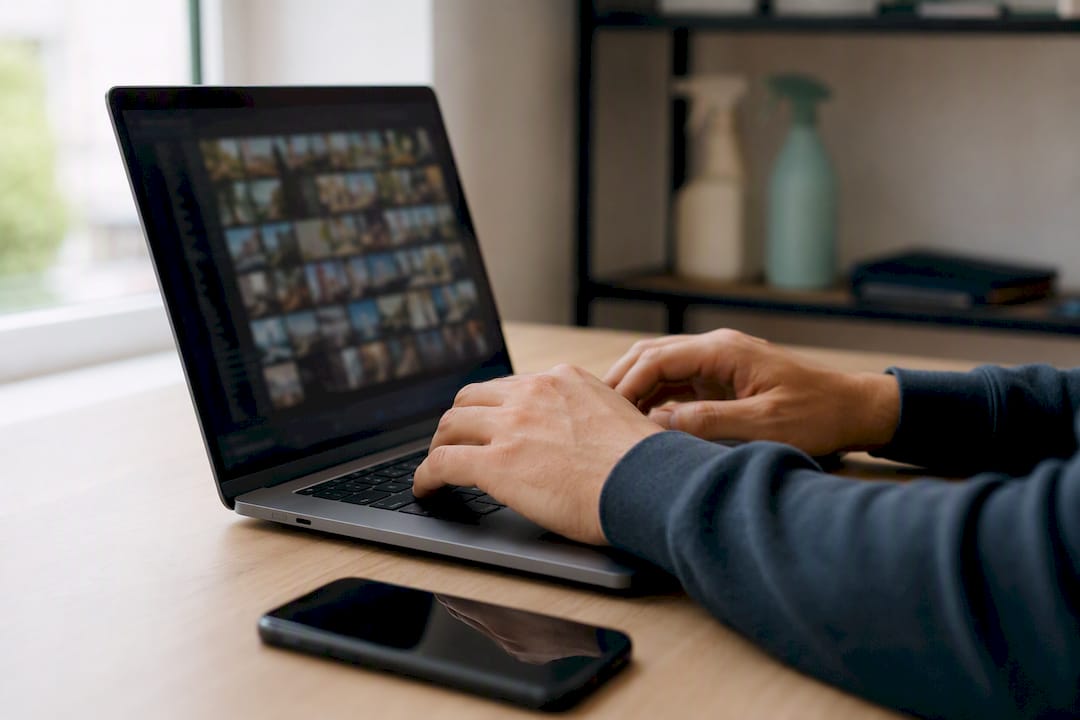
To avoid any dispute, systematically archive timestamped photos, a digital property condition report, and any associated quotes or invoices, all centralized by booking. That is the golden rule: without this three-part file, the burden of proof falls entirely on you when a guest challenges a deduction.
Three elements are non-negotiable:
- Timestamped photos taken immediately after the guest checks out, before anything is moved or cleaned.
- A digital comparative condition report, signed or validated, covering both check-in and checkout.
- Quotes and invoices justifying every amount withheld from the security deposit.
Each document must be linked to the relevant booking, with a clear date and identifier. A file that stands alone, with no connection to the specific stay, loses much of its evidentiary value.
Key takeaways
Archiving reliable cleaning proof requires timestamped photos, a digital comparative condition report, and financial documentation, all linked to the relevant booking.
| Point | Details |
|---|---|
| Three essential proofs | Timestamped photos, a digital comparative condition report, and supporting quotes or invoices. |
| Capture immediately after checkout | Take photos before any tidying or cleaning to preserve their evidentiary value. |
| File naming and centralization | Use a booking identifier and date in every archived file name. |
| Burden of proof on the owner | Without complete documentation, any deposit deduction becomes very hard to defend. |
| Cleanclac centralizes the file | The app generates timestamped photos and real-time reports, exportable when a dispute arises. |
Contents
- What proof to archive and why it matters legally
- How to archive your cleaning proof technically
- The workflow to follow after every guest checkout
- Using your proof when making or defending a deposit deduction
- How Cleanclac simplifies cleaning proof archiving
- What most property managers underestimate about this topic
- Simplify your proof archiving with Cleanclac
- Sources
- Frequently asked questions
What proof to archive and why it matters legally
Each type of proof plays a specific role in defending your position. Here is the detail, from the most fundamental to the most supplementary.
- The check-in and checkout condition report. Without a comparative document covering both moments, justifying a deduction becomes very difficult. Courts require documented proof, not a bare assertion.
- Timestamped photos, wide shots and close-ups. A wide shot of the whole room gives context; a close-up of a stain or broken item provides the concrete proof. Both levels are necessary. One without the other leaves a blind spot.
- The signed cleaning checklist. This document often serves as a first line of defence when cleanliness is disputed, according to field experience compiled by Mes Citations. It must be dated and linked to the booking file.
- Comparative quotes and invoices. They objectively quantify the amount withheld. Without them, any deduction remains arbitrary in the eyes of a judge or mediator, as noted in an analysis by Index-Immo on deposit retention cases.
These four items form a coherent file. In isolation they lose their force; assembled and dated, they become very hard to challenge.
How to archive your cleaning proof technically
A solid archiving system, whether paper-based or digital, rests on three pillars: format, file naming, and backup. Without a clear convention, even a complete file becomes unusable at the moment you need it most.
Recommended formats
- Photos in JPEG or HEIC with EXIF metadata preserved (date, time, and sometimes geolocation).
- Contracts and invoices as PDFs, never as compressed screenshots that lose legibility.
- Condition reports exported as timestamped PDFs rather than editable Word files.
EXIF metadata is your best ally: it proves, without any possibility of manipulation, the exact time a photo was taken. For a photo to be admissible, it must be dated and referenced to the booking file, a point confirmed by Tweelo's documentation on proof traceability.
File naming convention
Use a fixed scheme such as: [BookingID]_[YYYYMMDD]_[doctype]_[number]. For example, RES4521_20260312_photo_checkout_03.jpg. This naming convention lets you find any document in seconds, even six months later.
Organize a central directory by property, then by booking, with automatic backup to a remote storage location. Set a clear retention policy, generally aligned with the statutory limitation periods that apply to your situation, and log access so you know who has viewed or modified a file.
Pro tip: Never store proof solely on the cleaner's phone. A device change or accidental deletion can wipe out your only line of defence.
The workflow to follow after every guest checkout
A paper-based home system rarely works in short-term rental: the pace of turnovers demands a mobile, fast, and systematic process. Here is the sequence that minimizes missed steps.
- Immediate capture. As soon as the cleaner enters the property after checkout, before anything is moved or cleaned, they take the reference photos. This is the most reliable moment, before anything has been disturbed.
- Filling in the digital checklist. The cleaner ticks off each item (kitchen, bathroom, linen, appliances) directly on their phone, with a photo attached to every sensitive line.
- Automatic alert on any issue. If damage or a missing item is flagged, the property manager receives an immediate notification and can confirm or request additional details before the property goes back on the market.
- Linking to the booking file. Every piece of proof is automatically tied to the stay identifier, ready to export in one click if a dispute arises.
Delegating this to on-site teams changes operations: cleaners who are properly briefed and equipped with a mobile tool become the key link in the proof chain, because they are physically present at the right moment, unlike the property manager who is often off-site, as Tweelo notes in its analysis of delegation processes.
Pro tip: Set a firm rule: no checklist is validated without at least one photo per room. A text-only report, with no images, rarely convinces a dissatisfied guest.

Using your proof when making or defending a deposit deduction
The burden of proof falls on the owner or property manager, never on the guest. This is a consistent principle in short-term rental law: without timestamped photos and a comparative condition report, your position weakens considerably, as detailed in LegalPlace's guide to condition reports in short-term rentals.
The deadline for returning the deposit or sending notification varies by platform and contract, but can be up to three months for certain short-term rentals. Once that deadline passes without supporting documentation, any deduction becomes very difficult to defend.
When making a deduction, your notification should include:
- Timestamped before-and-after photos, organized by room.
- The check-in and checkout condition report, signed or digitally validated.
- The quote or invoice corresponding to the amount withheld.
- The dated cleaning checklist, if cleanliness is at issue.
Without these elements together, a digitized condition report and complete photographic record significantly reduce the risk of a drawn-out challenge. This is a conclusion shared by Index-Immo in its analysis of dispute-related documentation.
If a guest disputes the deduction despite a complete file, the recommended approach follows three steps: formal notification with attachments, an attempt at amicable resolution or through a dedicated mediation body, then building a file for potential legal proceedings if no agreement is reached. This process is described by Mamine Batignolles in its piece on abusive deposit deductions. A well-structured file from the outset speeds up every one of these stages.
How Cleanclac simplifies cleaning proof archiving
Cleanclac was designed so that collecting proof no longer depends on anyone's memory or goodwill. The app generates cleaning reports with timestamped photos and videos directly from each cleaner's phone, with no manual file handling.
- Individual login per cleaner, avoiding confusion when several people work on the same property.
- Real-time reports visible to the property manager as soon as the job is done.
- Automatic centralization of documents by booking, ready to export when a challenge arises.
- Cleanliness level and performance tracking, useful for objectively addressing a disagreement.
Centralizing proof by booking does not only make legal defence easier: it also speeds up day-to-day operations, from rescheduling a cleaning to invoicing, according to Index-Immo's analysis of document centralization.
To go deeper on the evidentiary weight of photos, read our article on cleaning photo proof in a dispute.
What most property managers underestimate about this topic
Most short-term rental managers treat proof archiving as an administrative formality to sort out after a dispute has been raised. That is the fundamental mistake. The moment that truly counts is the few minutes immediately after the guest checks out, before anything is moved or cleaned.
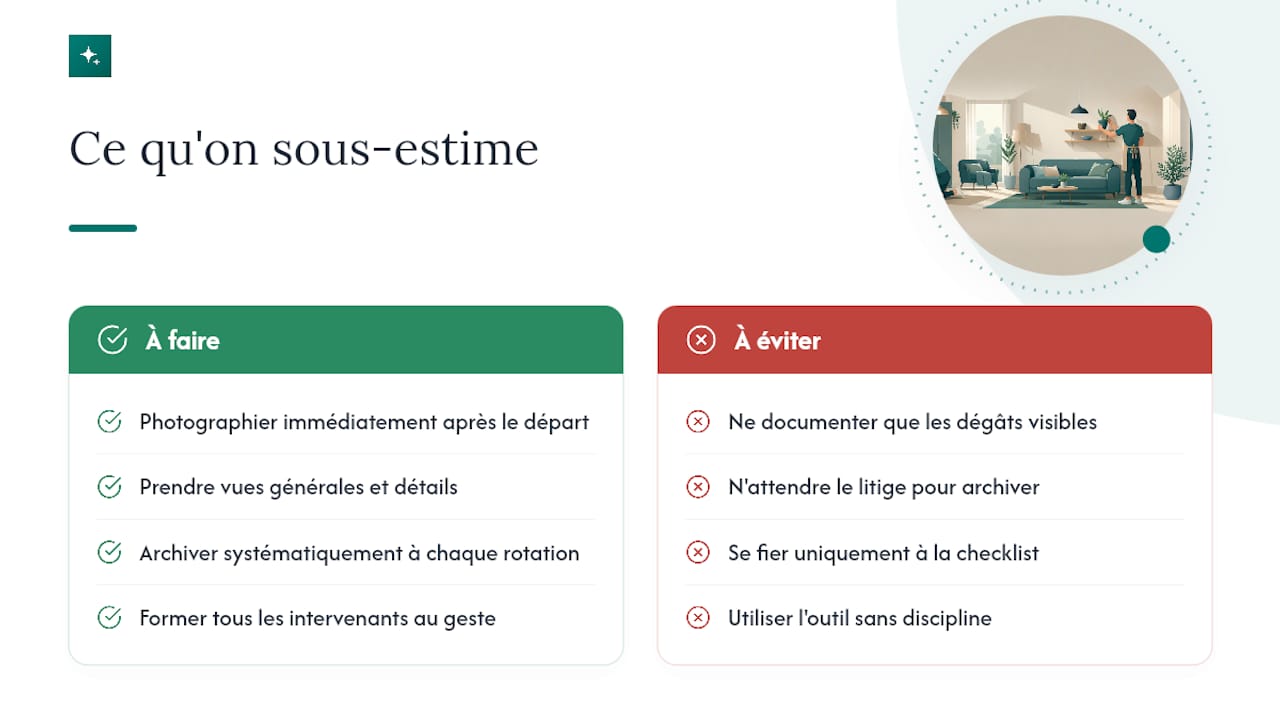
The typical reflex is to photograph only visible damage, while skipping the wide shots that provide context. Yet a judge or mediator cannot assess a situation without a clear point of comparison between check-in and checkout. The checklist alone, without photos, carries little weight either: it proves a task was ticked, not that it was actually carried out.
My conviction, after observing this across many cases: the reliability of proof depends less on how sophisticated the tool is than on the discipline of the habit, repeated at every turnover, by every cleaner, without exception. A simple system applied consistently will always beat a complex one used only half the time.
, Jonathan
Simplify your proof archiving with Cleanclac
When photos are scattered across several phones or files are buried in poorly named folders, Cleanclac offers a direct alternative: every piece of proof is captured, timestamped, and automatically filed by booking, without depending on any individual cleaner's diligence.

The app is particularly suited to multi-property managers and cleaning companies running several teams in parallel: each cleaner has their own mobile login, and the manager follows progress in real time without calls or check-in messages. Pricing starts at a level that is accessible even for a small portfolio, with a fee structure that scales with the number of properties managed.
To see how the tool fits into your daily operations, check the Airbnb cleaning software pricing and try the cleaning management platform on your first property today.
Sources
- LegalPlace · Condition report for short-term rentals
- Tweelo · Short-term rental condition report 2026
- Index-Immo · When can an owner retain a short-term rental deposit
Frequently asked questions
How long should cleaning proof be kept?
The timeframe depends on the statutory limitation periods that apply to your contract, but keeping records for at least several months after the stay covers the vast majority of dispute situations.
Who has to prove the condition of the property in a dispute?
The burden of proof falls on the owner or property manager, which makes timestamped photos and a comparative condition report essential.
Is a cleaning checklist enough as proof?
No. A signed checklist strengthens your file but must be accompanied by photos, because it proves a task was ticked off, not that it was actually carried out correctly.
How does Cleanclac help archive cleaning proof?
Cleanclac automatically timestamps photos and reports for every cleaning, and centralizes those documents by booking for fast export when a dispute arises.
Which file format is best for proof photos?
JPEG or HEIC with EXIF metadata preserved is recommended, because it guarantees an unalterable date and time of capture.


