Managing Multiple Vendors: the Method That Works
Learn how to manage multiple vendors with centralized data, automated assignment, and KPIs. Put the right process in place and take control starting this week.

Jonathan Lalinec

To manage multiple vendors effectively, centralize your data, automate job assignment, and track every relationship with KPIs. That is the only combination that scales, whether you are coordinating five cleaning companies or twenty maintenance technicians across several properties.
Three concrete benefits follow when you apply this method:
- Less time spent on admin, because assignments and reminders no longer depend on a spreadsheet or a chain of messages.
- Stronger compliance, with insurance certificates, certifications and contracts stored centrally and verifiable in one click.
- More consistent service quality, because every job is measured against the same indicators regardless of which vendor carries it out.
The rest of this guide covers which tools to prioritize, the full vendor lifecycle from onboarding to contract end, the governance structure to put in place, and a checklist to get started this week.
Key takeaways
Managing multiple vendors works when data is centralized, assignment is automated, and every relationship is tracked with measurable KPIs.
| Point | Details |
|---|---|
| Centralize data | Group contracts, insurance certificates and history into a single vendor profile. |
| Automate assignment | Let the tool assign jobs based on area, skill set and actual availability. |
| Track five KPIs | Compliance, response time, quality score, cost per job, complaint rate. |
| Formalize the lifecycle | Structure onboarding, ongoing monitoring, quarterly reviews and an escalation plan from the very first contract. |
| CleanClac for short-term rental | Automates scheduling, mobile assignment and photo/video proof for Airbnb and Booking.com turnovers. |
Contents
- Why managing multiple vendors has become a strategic priority
- Which features matter most in a vendor management tool?
- How to structure the vendor lifecycle from onboarding to contract end
- Which roles and indicators to track to stay in control
- Operational checklist: what to launch this week and within 90 days
- How CleanClac puts these principles into practice
- How to handle conflicts and disputes between vendors
- How to train your internal teams in multi-vendor management
- How to analyze costs and optimize your vendor budget
- What most vendor management guides miss
- CleanClac: built for multi-vendor cleaning management in short-term rental
- Sources
- Frequently asked questions
Why managing multiple vendors has become a strategic priority
A property manager coordinating ten vendors across three sites can no longer rely on phone calls and shared spreadsheets. Complexity grows disproportionately with every vendor added, not linearly, because each relationship brings its own contract, its own deadlines and its own contacts.
The risk goes beyond lost time. A missed SLA, an expired insurance policy that nobody noticed, documentation that cannot be found during an audit: these are common incidents in unstructured vendor management. A significant share of operational disruptions does not even come from the primary vendor but from the subcontractors that vendor brings in.
What centralization changes in practice:
- Fewer assignment errors, because scheduling data exists in one place only.
- Faster response to incidents. Digitizing workflows means spotting a delay before it affects the guest.
- Better contractual compliance, with up-to-date documents accessible without chasing anyone.
The challenge is not just efficiency. It is controlling risk as your vendor network grows.
Which features matter most in a vendor management tool?
A tool that claims to manage multiple vendors without covering these five areas is, in practice, nothing more than a digital address book.
Centralized contracts and documents come first. Every vendor needs a single profile holding the contract, insurance certificate, certifications and communication history. This is the foundation of reliable data governance. Without it, any automation runs on outdated information.
Automated scheduling and assignment must account for the vendor's geographic area, skill set and actual availability. A well-designed VMS assigns a job without manual input as soon as a booking or work order is created.
Real-time proof of work changes everything when a dispute arises. Timestamped photos, short videos, digital sign-off: these turn a guest complaint into a resolved case in two minutes.

Supply tracking, invoicing and integrations with existing systems (PMS, shared calendar, ERP) eliminate double data entry and unexpected stock shortages.
Alert workflows and KPI dashboards close the loop. Without them, you learn about a problem when the guest complains, not before.
- Centralized vendor profile (contract, insurance, history)
- Automatic assignment by area, skill set and availability
- Timestamped photo/video proof for every job
- Supply tracking and integrated invoicing
- Automatic alerts and KPI dashboard
Pro tip: Before choosing a tool, list the three integrations that cost you the most time today (calendar, PMS, invoicing). A tool that handles those well is worth more than one that promises everything and connects none of them properly.
How to structure the vendor lifecycle from onboarding to contract end
A standardized vendor lifecycle means you are not reinventing the process with every new relationship. Here are the five stages to formalize.
-
Structured onboarding. Collect all required documents in one go: insurance certificate, certifications, bank details, coverage areas and availability. A single form avoids repeated email exchanges and builds a reliable vendor profile from day one.
-
Formalizing measurable commitments. Set a written, quantified SLA: maximum response time, expected quality level, procedure for no-shows. A vague commitment ("respond quickly") cannot be managed. A specific one ("respond within 2 hours for an emergency") can be measured and enforced.
-
Automating assignment and reminders. Once the SLA is defined, the tool should assign jobs automatically according to the agreed criteria and send reminders without human input. This is the point where admin workload actually drops, not before.
-
Collecting proof and closing the feedback loop. Every job should generate a record: photo, report, satisfaction rating. This loop makes it possible to spot a drop in quality before it becomes a recurring problem.
-
Periodic reviews and an escalation plan. A quarterly review using a standardized scorecard (compliance rate, average response time, quality score) lets you set an improvement plan for any vendor falling below the agreed threshold, as recommended by the Ivalua vendor management guide. If the vendor does not improve after two review cycles, the escalation to a volume reduction or contract end should be written into the contract in advance, not decided under pressure.
This lifecycle turns every vendor relationship into a repeatable process rather than a case-by-case exercise.
Which roles and indicators to track to stay in control
Governance starts with a clear division of responsibilities: a program owner (usually the operations manager), a sponsor who approves budget decisions, and an on-site operational lead who handles day-to-day management. Without this structure, every incident escalates to the same person, who quickly becomes the bottleneck for the entire organization.
Segmenting vendors by strategic value prevents you from applying the same level of scrutiny to a one-off contractor as to a critical partner.
- Strategic vendors: close oversight, monthly review, detailed SLA.
- Operational vendors: regular monitoring, quarterly review, standard KPIs.
- Transactional vendors: lighter oversight, one-off jobs, spot checks.
Five indicators cover most situations: SLA compliance rate, average response time, quality score (from photo/video records or guest feedback), cost per job, and complaint rate. A significant share of disruptions in a vendor chain originates upstream and goes unmonitored, which is why risk mapping should extend beyond your direct contacts.
An automatic alert triggered whenever an indicator breaches its threshold turns this governance into a live management tool rather than a retrospective report.
Operational checklist: what to launch this week and within 90 days
Here is the order of priority to follow so you do not spread yourself too thin.
-
Week 1: inventory your current vendors. List every vendor, their contract, their required documents and the expiry dates. This step often reveals surprising gaps: expired insurance policies, contracts that were never formally signed.
-
Week 2: set three pilot KPIs. Do not aim for completeness. Response time, compliance rate and quality score are enough to build a dashboard your whole team can read.
-
Weeks 3 to 4: test a pilot tool on a limited scope. Choose one property or one team, connect the minimum required integrations (calendar, PMS), and measure the before/after difference on your three KPIs.
-
Months 2 to 3: train and communicate. Walk vendors through the new tools and expectations, with clear guidance on submitting proof of work and meeting deadlines.
-
Day 90: roll out if the pilot delivers. Extend the scope only after confirming that the integrations hold under load and that vendors have adopted the new process.
How CleanClac puts these principles into practice
CleanClac was built for short-term rental, where the constraint is especially tight: a turnover clean must be completed between one guest's checkout and the next guest's arrival, often within a few hours.
- The app generates cleaning jobs automatically from Airbnb, Booking.com or Abritel reservations, with no manual data entry.
- Every cleaner has their own mobile access and receives their job via automatic or manual assignment based on availability.
- Cleaning reports include photos and videos, providing proof of work that can be used immediately in any dispute with a guest.
- Supply tracking prevents the stock shortage discovered at the worst possible moment, just before a check-in.
These features directly address the points raised above: centralization, automated assignment and real-time proof of work.
Pro tip: If you already work with several cleaning companies in parallel, start by centralizing their job reports in a single tool before making any vendor changes. The visibility gain usually arrives before the cost saving.
How to handle conflicts and disputes between vendors
Two vendors working on the same property or in the same supply chain will almost always end up passing blame when something goes wrong. A poor clean attributed to insufficient time left by a late maintenance team, a dispute over shared supplies costs: these situations are routine in multi-vendor management, not exceptions.
The best protection is a timestamped record. When every job generates a report with photos and an exact time, a disagreement is resolved by checking the history rather than listening to two conflicting accounts. This is also why a timestamped photo proof tool quickly becomes essential once you are working with more than two or three vendors.
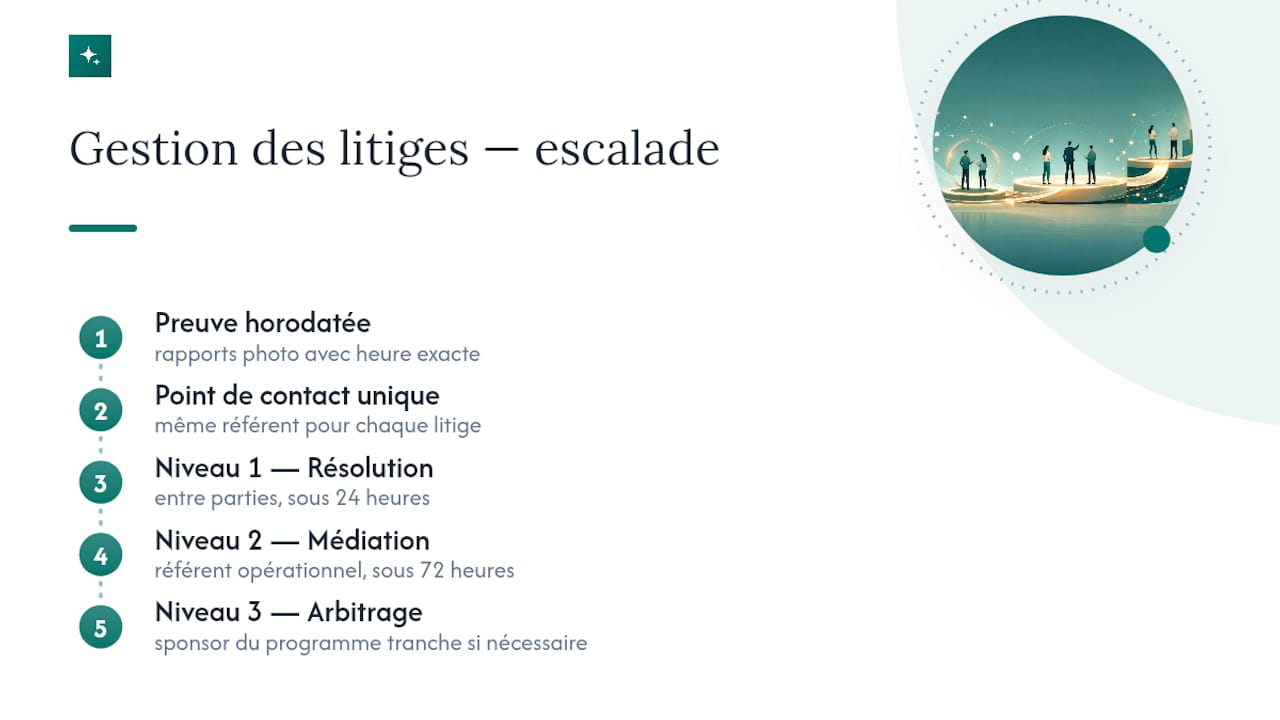
A second lever is formalizing a single point of contact for every dispute. The person who manages escalation should not change from one incident to the next, otherwise each vendor starts their argument from scratch every time. A three-level escalation framework works well in most setups: direct resolution between the parties within 24 hours, mediation by the operational lead within 72 hours, then arbitration by the program sponsor if no agreement is reached.
Finally, include a review clause in every contract that allows for a gradual volume reduction rather than an abrupt termination. This avoids being left without a fallback in peak season if a vendor stops meeting their commitments.
How to train your internal teams in multi-vendor management
A powerful tool left to an untrained team stays underused. The transition to digitized multi-vendor management most often fails because internal teams continue, out of habit, to reach for the phone or email even when the tool is already in place.
Training needs to reach three distinct groups. Operations managers need to understand the KPI dashboard and the escalation logic, not necessarily every technical feature in the tool. Scheduling managers need to master automatic assignment and know how to correct an allocation when something unexpected happens. Vendors themselves only need simple access to their job for the day, with no unnecessary complexity.
Pro tip: Train the person who handles the most incidents day-to-day first, not the decision-maker who approved the budget. That person will determine whether the tool is actually adopted on the ground.
A gradual rollout works better than a full cutover overnight. Run the old process and the new tool side by side for two to three weeks on a limited scope, long enough for habits to change. Document the recurring questions that come up during that period. They become the foundation of an internal guide you can reuse for every new vendor or new hire.
How to analyze costs and optimize your vendor budget
The total cost of multi-vendor management does not stop at the service fees themselves. You also need to account for the hidden cost of admin time spent coordinating, chasing and manually checking every job. This cost is rarely quantified but is often higher than people expect.
Cost per job, one of the five KPIs recommended above, is the starting point for any serious budget optimization. Comparing it across similar vendors often reveals unjustified gaps, not caused only by quality differences but also by poorly optimized travel routes or badly managed supplies.
Comparing available pricing models helps you anticipate the return on investment of a tool before committing. A subscription priced per managed property, for example, stays predictable and scales automatically as your portfolio grows or shrinks.
Three optimization levers come up consistently in organizations that have structured their vendor management:
- Consolidate supply orders across vendors in the same geographic area to reduce delivery costs.
- Renegotiate transactional vendor contracts once a year, based on the cost-per-job data collected.
- Reduce the number of one-off vendors in favor of better-integrated strategic partners, which cuts the repeated admin cost of managing short-term relationships.
A well-managed vendor budget is never a fixed line item. It is a live indicator, revised at every quarterly review cycle.
What most vendor management guides miss
Most content on this topic sells automation as an end in itself. That is a priority mistake. Automation is only as good as the data it processes. An automated schedule built on vendor availability that is never kept up to date produces errors faster than a human would have made them.
The real challenge, the one managers consistently underestimate, is data discipline at the input stage. Organizations that successfully transition to digitized vendor management almost always start by cleaning their base data, not by choosing a tool.
A second blind spot: governance is usually designed after the fact, once the tool is already deployed. The reverse works better. Decide who owns the program and how you segment your vendors before you configure the first automation workflow. No tool, however powerful, compensates for the absence of clear roles.
Prioritize in this order: clean the data, define governance, then automate. The reverse sequence, which is very common, explains why so many vendor management tool deployments disappoint after the first six months.
CleanClac: built for multi-vendor cleaning management in short-term rental
CleanClac is built for property managers, cleaning companies and agencies that coordinate several cleaning teams across multiple properties at once, without wanting to manage that complexity manually. Follow the guide to automate guest check-in and simplify your operations.
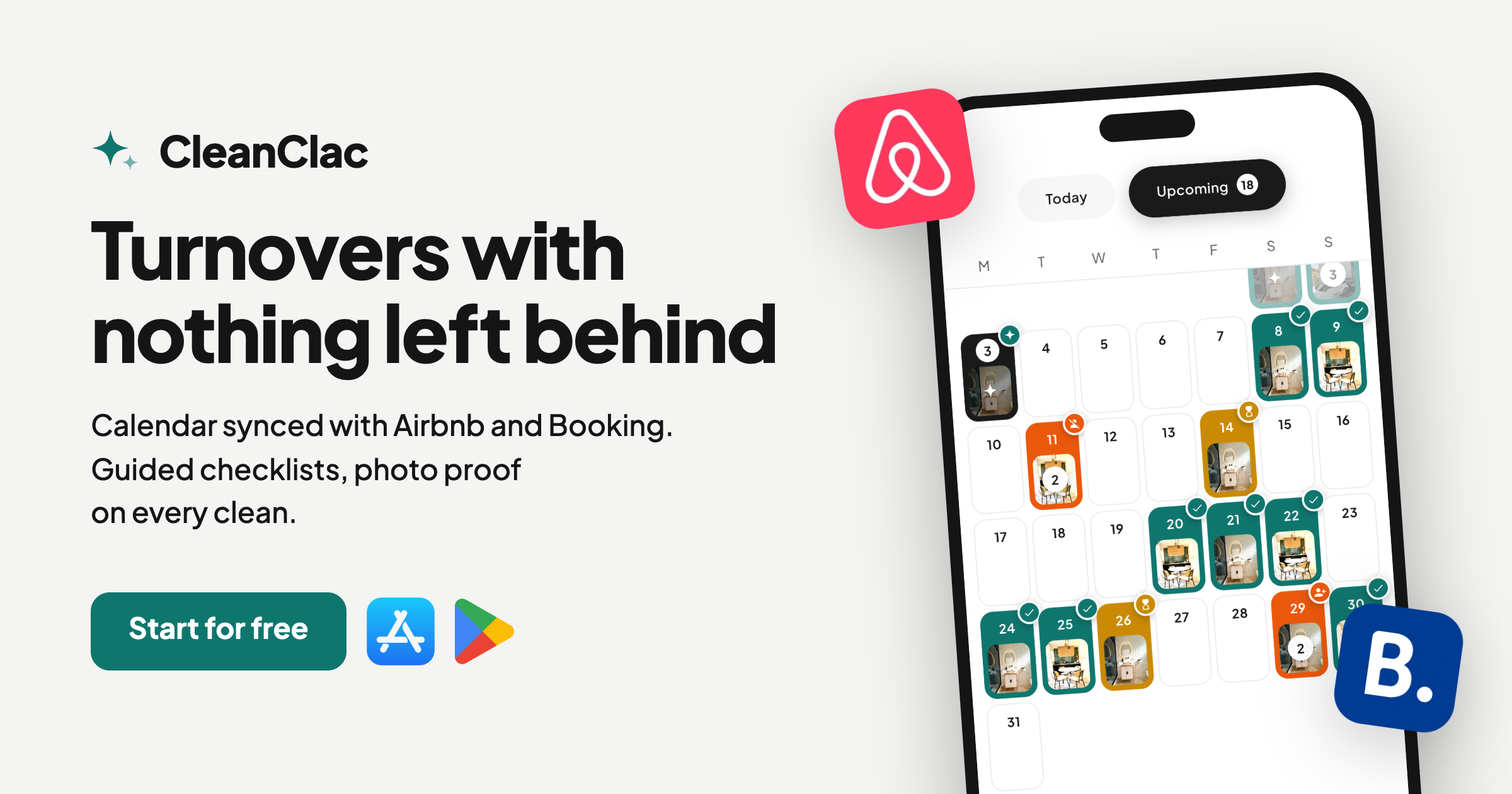
Every cleaner has their own mobile access, which removes manual data entry and eliminates confusion about who is working where. If you already manage several cleaning vendors and want to centralize their tracking without any technical complexity, the CleanClac product page covers the available features and lets you start a trial. To compare pricing options based on the number of properties you manage, the 2026 pricing grid gives a clear view of what to budget.
Sources
For further reading on governance and best practices: IBM, Workday, ServiceNow, Ivalua and SAP. To try a concrete automation, the CleanClac product page includes a live demo.
- What is vendor management? | IBM
- Vendor management: definition and tips for improvement | Workday FR
- Complete 2026 guide to vendor management | Ivalua
- Vendor management | SAP
Frequently asked questions
What is vendor management?
Vendor management covers all the processes that organize the selection, coordination, monitoring and evaluation of external companies or individuals who carry out work on your behalf, from contract signing through to quality tracking.
What are the different types of service provision?
There are generally three categories: strategic services (critical partners managed closely), operational services (regular monitoring, standard KPIs), and transactional services (one-off jobs with lighter oversight). This segmentation is recommended by SAP.
What is a service provider?
A service provider is a company or independent professional who carries out a contractually defined job, such as cleaning, maintenance or concierge services, in exchange for an agreed fee.
Who are the service providers in short-term rental?
They are most often cleaning companies or individual cleaners, maintenance technicians, concierge services and sometimes linen suppliers, all coordinated around the property's booking calendar.
How do you automate the management of multiple cleaning vendors?
A tool like CleanClac connects the booking calendar directly to cleaning job assignment, removing manual scheduling and providing a timestamped photo record for every job completed.


