Airbnb Linen Management: The Operational Guide
Master Airbnb linen management with the three-set rule, hotel-style standardisation, and automation tips that keep every turnover running without a hitch.

Jonathan Lalinec
Airbnb linen management comes down to three non-negotiable principles: apply the three-set rule (one set in place, one being washed, one in reserve), standardise every size and format as hotels do, and automate your scheduling so you never rely on memory alone. Here are the actions to take this week.
Immediate actions:
- Count your linen sets per sleeping place. If you have fewer than three, order the rest before the next turnover.
- Physically separate clean linen from dirty linen in a dedicated space, even a simple labelled basket.
- Write down the date and time of your next guest checkout, then plan the wash or contact your provider today.
This week:
- Draw up a complete inventory per property (see the template in section 9).
- Choose a colour or unique reference code per property to label every linen batch.
- Decide whether you handle washing in-house or outsource it, and get at least one quote from a local laundry service.
Key Takeaways
Reliable linen management rests on three inseparable pillars: a buffer stock of at least three sets per bed, standardised formats to simplify replacements, and automated scheduling to eliminate oversights between turnovers.
| Point | Details |
|---|---|
| Three-set rule | Allow 1 set in place, 1 being washed, and 1 in reserve per bed to avoid any shortfall. |
| Cost per stay | Linen cost ranges from €1.50 to €5.50 per stay depending on the method chosen. |
| Hotel-style standardisation | Use a single reference per item type (sheet, towel, duvet cover) to simplify purchasing and replacements. |
| Outsourcing threshold | From 3 properties upward, a laundry service or scheduling software pays for itself in time and reliability. |
| Cleanclac | Automates cleaning assignment, photo checklists, and linen stock tracking per property. |
Useful Resources to Go Further
- Airbnb Laundry: How to Structure Linen Management · Hosting Academy: a practical guide to standardisation and choosing a laundry provider.
- Linen Management for Short-Term Rentals: The Complete Guide · Naps Immo: the three-set rule, colour-coding tips, and stock organisation.
- Equipping an Airbnb with Linen: Checklist and Budget · Ecolinge: recommended weights, quantities by property type, and indicative budget.
- Airbnb Linen Options and Costs Compared · Le Lavoir du Val d'Europe: cost ranges per method, useful for building your pricing.
- How to Choose and Care for Linen in Holiday Rentals · Faire.fr: inspection checklists, elasticity tests, and care advice.
Table of Contents
- Why linen directly affects your reviews and your booking rate
- What linen to provide and how much, depending on your property
- How to organise linen turnover between guests
- Managing yourself, building a team, or outsourcing: which option suits your volume?
- What linen management costs and how to build it into your pricing
- Which materials to choose and how to care for linen so it lasts
- How to automate linen logistics as you scale up
- Ready-to-use checklists and templates for every turnover
- Which setup to choose based on your profile
- Cleanclac automates what you still do manually
- Sources
Why linen directly affects your reviews and your booking rate
A guest who finds a stained sheet or a scratchy towel will not keep quiet about it. Linen cleanliness consistently ranks among the top causes of negative reviews on Airbnb, and a single bad review can drag down the overall score of a property that was previously well positioned. The link between linen quality and guest satisfaction is direct: clean, well-presented, odour-free linen creates a first impression that shapes how guests perceive their entire stay.
The operational consequences are also financial. A partial refund granted after a complaint, a free night offered as compensation, or simply the loss of a future booking from a guest who never returns: these hidden costs often exceed the price of a properly sized linen stock.
What experienced hosts observe:
- Cleanliness comments feed directly into Airbnb's Cleanliness score, which has a direct impact on search ranking.
- A property rated 4.8 or above on cleanliness benefits from better algorithmic visibility on the platform.
- Standardised, professional-looking linen reinforces the perceived value of a property and justifies a higher nightly rate.
What linen to provide and how much, depending on your property
The basic rule is straightforward: standardise models and sizes as hotels do. Identical formats across all your properties simplify purchasing, replacements, and stock management. One fitted sheet size (140×200 cm) for all your double beds, a single duvet cover reference, a single bath towel size.
Bedding per sleeping place
For each bed, allow at minimum:
- 3 fitted sheets (sized to match the mattress)
- 3 duvet covers
- 6 pillowcases (two per set, three sets)
- 1 waterproof mattress protector per mattress (protects your investment)
Bathroom and kitchen
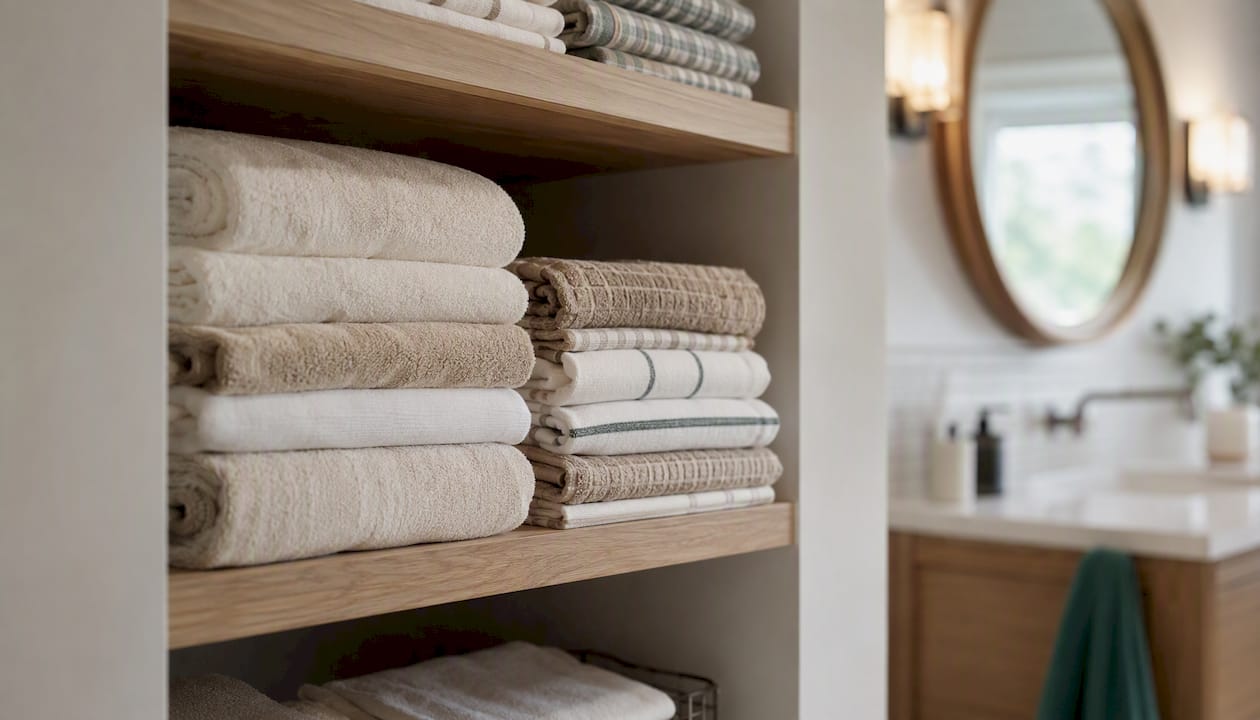
Per bathroom, allow 3 bath towels and 3 hand towels per guest, plus 3 bath mats. For the kitchen, 6 tea towels per property is a reasonable minimum.
Recommended quantities by property type
For properties with high turnover (several stays per week), industry specialists recommend increasing the stock to 4 or 5 sets per bed rather than 3, to absorb laundry delays or a last-minute problem.
How to organise linen turnover between guests
The linen changeover process always follows the same sequence, regardless of property size. The goal is never to block a check-in because no clean linen is available.
Standard process at guest checkout:
- Remove all used linen immediately: bedding, towels, tea towels, bath mats.
- Inspect each item before putting it in the dirty pile: visible stains, tears, condition of the fitted sheet elastic.
- Set aside damaged linen in a separate bag for assessment and replacement.
- Start the wash in-house or drop the bag at the laundry, according to your setup.
- Collect the clean linen, check its condition after washing, fold it, and store it by property.
- Make the beds and lay out the towels before the next guest arrives.
Estimated time per turnover:
- Studio: 30 to 45 minutes for a full changeover, not counting washing time.
- One-bedroom: 45 to 60 minutes.
- Two-bedroom or larger: 60 to 90 minutes, more if duvet covers are ironed.
Two practical levers to cut this time: use exclusively elasticated fitted sheets (90 seconds to fit versus 4 minutes for a flat sheet) and fold clean linen into complete bed kits before storing them.
Pro tip: Prepare "complete bed" kits (fitted sheet, duvet cover, two pillowcases) in a bag or pouch per sleeping place. Your cleaner no longer has to hunt for individual items, which reduces oversights and speeds up the turnover.
Managing yourself, building a team, or outsourcing: which option suits your volume?
The choice between self-management, an in-house team, and outsourcing depends mainly on the number of properties managed and the frequency of turnovers. Linen management is time-consuming: what works for one property quickly becomes unmanageable at five or ten without structured organisation.
Self-management (1 to 2 properties):
- Advantages: minimal cost, full quality control, flexibility.
- Disadvantages: significant personal time, dependence on your own availability, risk of shortfall if something unexpected comes up.
- Works well when turnovers are spread out (fewer than 3 per week per property).
In-house team (3 to 8 properties):
- A dedicated cleaner or small team with a centralised storage space.
- Allows linen to be shared across geographically close properties.
- Requires investment in organisation: scheduling, stock tracking, storage space.
Outsourcing (laundry service, linen hire, concierge service):
- Providers offer a turnkey solution: collection, washing, pressing, delivery. Some also offer linen hire, which eliminates the upfront stock investment.
- Selection criteria: turnaround time (24 h or 48 h?), minimum quantity per order, pricing per kilo or per set, geographic coverage.
- Watch out for minimum quantities imposed by some professional laundry services, which may not suit a single-property owner.
Pro tip: *If you manage more than 5 properties in the same city, negotiate a monthly contract with a local laundry rather than paying per item.
What linen management costs and how to build it into your pricing
The cost ranges from around €1.50 to €5.50 per guest per stay depending on the method chosen. The gap is significant and warrants analysis before settling on an approach.
How to build this cost into your pricing:
- Add the linen cost to the total cleaning cost, then divide by the average number of nights per stay to get a cost per night.
- For an average stay of 3 nights with a linen cost of €4, that works out to roughly €1.33 per night, easily absorbed into the cleaning fee.
- On your Airbnb listing, include this cost in the cleaning fee rather than charging it separately: guests respond better to a single overall cleaning fee than a separate "linen" line item.
Which materials to choose and how to care for linen so it lasts
White cotton remains the reference for short-term rentals. It withstands high-temperature washing (60°C to 90°C), bleaches easily when stains are stubborn, and worn items can be replaced without any colour-matching issues. Many experienced hosts favour white for exactly this reason: a uniform stock simplifies replacements and eliminates sorting problems.
Recommended weights:
- Bath towels: 500 g/m² minimum for a hotel-quality feel. Below that, towels dry poorly and deteriorate quickly.
- Sheets and duvet covers: 150-thread-count cotton as the professional standard; polycotton acceptable for high-turnover properties.
- Bath mats: 700 g/m² for adequate absorbency.
Practical care:
- Wash at 60°C for standard white linen, 90°C for stains or when hygiene is in doubt.
- Use a liquid detergent without a strong fragrance to avoid allergic reactions in guests.
- Pre-treat stains before washing: apply an enzymatic stain remover directly to the stain, leave for 15 minutes, then wash normally.
- Ironing: cotton duvet covers crease. Either iron them, switch to polycotton which creases less, or fold the linen while it is still warm straight from the dryer.
Storage and replacement:
- Label every batch by property or colour code to ensure traceability and quickly identify wear issues.
- Plan systematic replacement: a towel that loses its softness after roughly 50 washes, a fitted sheet whose elastic gives way, a duvet cover that yellows despite washing.
- Keep an emergency replacement stock (2 to 3 items per reference) so a turnover is never blocked.
How to automate linen logistics as you scale up
For a single property, a spreadsheet is enough. From three properties onward, oversights and scheduling conflicts become the norm without a dedicated tool. A cleaning management tool synced with your booking calendar fundamentally changes how you run linen logistics.
What a management tool automates in practice:
- Automatic cleaning assignment as soon as a booking is confirmed or modified on Airbnb, Booking.com, or Vrbo.
- Notifications sent directly to the cleaner's smartphone, with property details and the next guest's arrival time.
- Integrated photo checklists: the cleaner documents the state of the linen (stains, wear, quantities in place) at every turnover.
- Linen and supply stock tracking, with alerts when a minimum threshold is reached.
- Turnover reports viewable in real time by the manager.
Automating notifications and checklists through software significantly reduces oversights between turnovers and improves guest ratings. For multi-property managers, this is the difference between an organisation that holds together at scale and a series of manual workarounds that fail at the worst possible moment.
Criteria for choosing your tool:
- Native integration with your PMS or booking platforms (Airbnb, Booking.com, Vrbo).
- Individual mobile access for each team member, with no complex training required.
- Pricing per active property, scalable to the size of your portfolio.
- A stock and supply management feature, not just scheduling.
Ready-to-use checklists and templates for every turnover
Systematic checklists reduce the risk of sending a guest into a property with damaged or missing linen. The following templates are ready to use: print them or import them into your management tool.
Pre-arrival inspection checklist
- Fitted sheet in place, no stains or tears, elastic intact.
- Duvet cover clean, no tide marks, correctly centred on the duvet.
- Pillowcases: correct number (2 per pillow), clean, no deep creases.
- Bath towels folded and laid out (number matching the number of guests).
- Bath mat clean and dry.
- Kitchen tea towels clean and sufficient in number.
- Mattress protector in place under the fitted sheet.
- No musty or stale smell on any linen.
- Reserve stock accessible (dedicated cupboard or drawer) with at least one spare set.
Property inventory template
To make these checklists operational:
- Import the inventory template into a shared spreadsheet (Google Sheets, for example) accessible to your cleaner.
- If you use management software, create a custom checklist within the tool: the short-term rental cleaning tips published by Cleanclac include templates adapted to different property sizes.
- Print the inspection checklist and laminate it to leave in the property for your cleaner.
Which setup to choose based on your profile
The answer depends less on budget than on volume and available time.
Solo host (1 to 2 properties): handle the linen yourself or delegate to your cleaner, but build your three-set buffer stock before the next season without fail. The classic mistake is underestimating washing time and ending up ironing damp sheets an hour before a check-in. A simple spreadsheet is enough at this stage, as long as you update it after every turnover.
Multi-property manager (3 to 10 properties): this is the threshold where manual management becomes a real operational risk. Outsource washing to a local laundry or a linen hire service, and adopt a scheduling tool that automatically syncs your bookings with your cleaners. The time saving is immediate, and errors involving missing or damaged linen drop significantly.
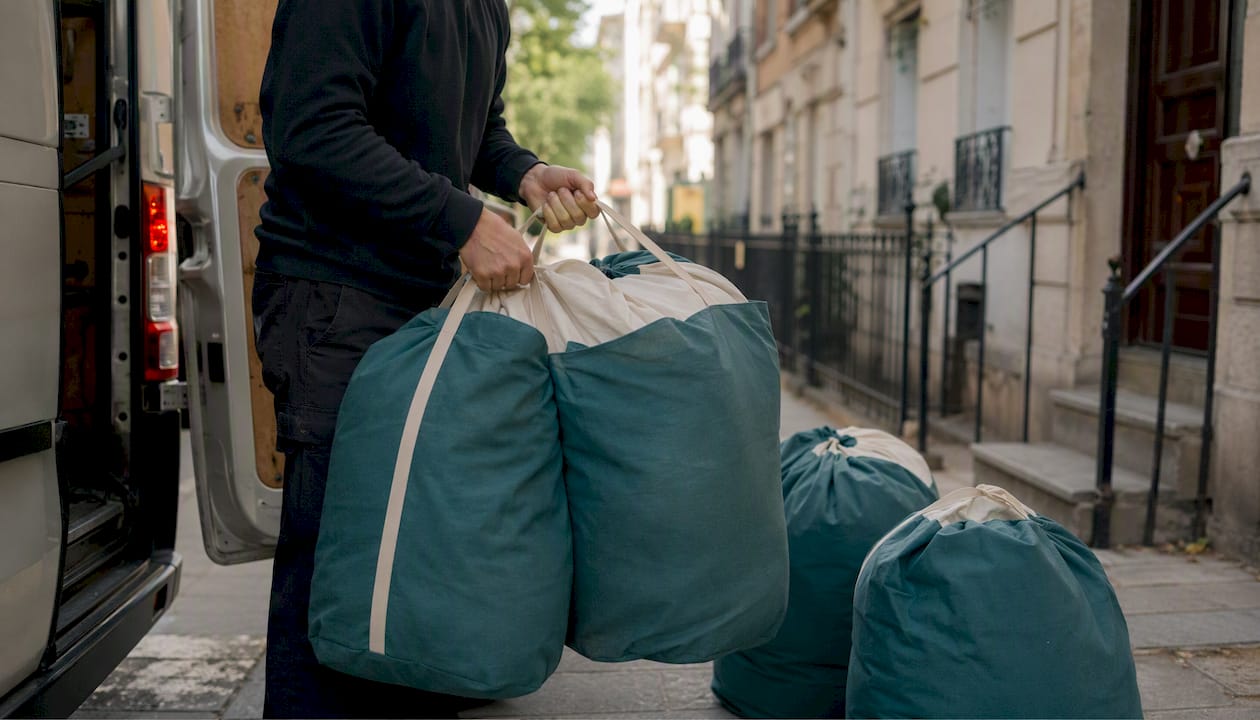
Concierge service or agency (10 properties and more): at this scale, total linen standardisation (a single reference per item type, a single supplier) and full scheduling automation are non-negotiable. Negotiate a framework contract with your laundry service, centralise storage, and monitor quality through the photo checklists in your management software.
Three priorities that apply to every profile: build a sufficient buffer stock, standardise formats to simplify replacements, and automate scheduling to eliminate oversights. The order in which you tackle them depends on your current situation, but none of the three is optional in the long run.
Cleanclac automates what you still do manually
Managing linen across several properties manually means juggling messages, spreadsheets, and last-minute calls. Cleanclac replaces this fragmented organisation with a centralised system: as soon as a booking is confirmed on Airbnb, Booking.com, or Vrbo, the cleaning job is automatically assigned to the available cleaner, who receives a notification on their smartphone with the property details and the next guest's arrival time.
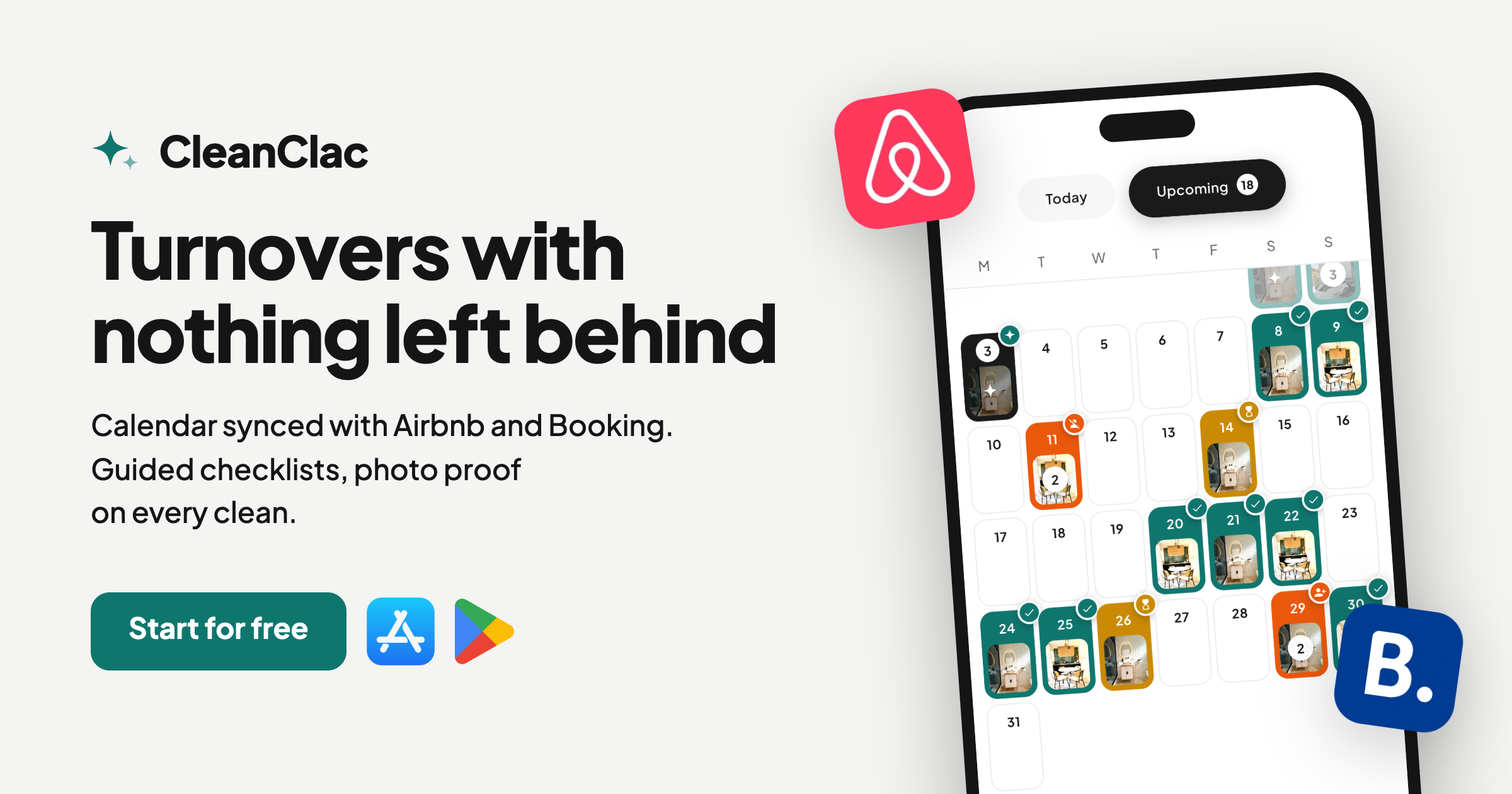
The integrated photo checklists allow each cleaner to document the state of the linen at every turnover, creating a history viewable in real time. Stock tracking alerts you automatically when a minimum threshold is reached, before a shortfall blocks a turnover. For managers who also need to find a local cleaner at short notice, Cleanclac offers an integrated marketplace. The result: fewer errors, less time spent coordinating, and cleanliness scores that improve. Try the app at Cleanclac or check the Airbnb cleaning software comparison to see which solution fits your portfolio.
Sources
- Airbnb Laundry: How to Structure Linen Management
- Faire
- Equipping an Airbnb with Linen: Checklist and Budget – Ecolinge
- Linen Management for Short-Term Rentals: The Complete Guide · Naps Immo
- Airbnb Linen Options and Costs Compared