How to Send Cleaning Instructions via an App
Send checklists, temp access codes, photos and stock alerts to your cleaners through an app to guarantee a flawless turnover every time.

Jonathan Lalinec

Send a standardised checklist, a temporary access code and a hard deadline directly through the app. That is the foundation of every successful turnover. Then ask for verification photos at the end of the clean and a final tick on every task. Set an automatic alert for any stock level that falls below your defined threshold, so you never face a last-minute shortage.
In brief:
- Access codes should be sent through the app as temporary codes to keep things secure and eliminate copy errors.
- A standardised checklist should follow a dirty-to-clean sequence, with clear acceptance criteria for every task.
- Photos should cover the entrance, linen, bathroom and kitchen, plus any anomaly, and be named by date for easy retrieval.
- Supply management should rely on threshold alerts in the app, with a receipt confirmation to prevent stockouts.
- Automating job creation, performance tracking and reminders through the app cuts manual oversights significantly.
Table of contents
- Template checklist to send to cleaners
- Access codes, timing and duration: organising the slot and sign-off
- Photo reporting and quick property checks: what to photograph and when
- Supply management and stock alerts through the app
- Standard messages and short templates to send in the app
- Integrating the process into your management workflow
- The operational benefits of standardised communication
- How CleanClac makes sending instructions and tracking cleans easier
- Frequently asked questions
- Resources and useful guides to go further
Template checklist to send to cleaners
An effective checklist always follows the same logical order, dirty to clean, to avoid unnecessary back-and-forth. Industry guides recommend structured workflows and task-specific templates to reduce oversights and speed up execution.
A basic template for a standard turnover includes:
- Air out the rooms and remove dirty linen.
- Clean the kitchen: hobs, fridge, dishes, bins emptied.
- Bathroom: sanitise fixtures, replace towels, wipe mirrors streak-free.
- Bedrooms: remake beds with no visible stains or lingering odours.
- Final check: restock welcome supplies, take photos, lock the door.
Every line needs a clear acceptance criterion rather than a vague instruction. For linen, for example, the expected standard is "no visible stains, neutral smell", not simply "bed made". Include a free-text field for remarks and a "photos taken" checkbox, which serves as evidence in the event of a guest dispute.
Pro tip: Keep the checklist on a single screen with no scrolling. A cleaner working against the clock will never read a list that runs across several pages.
Access codes, timing and duration: organising the slot and sign-off
The entry code should be sent through the app rather than by text or phone call, so there is a dated record and no risk of transcription errors. A temporary code generated only for the cleaning window also limits the security risk when a cleaner changes from one job to the next.
The process runs in three stages:
- Send the access code and the hard deadline as soon as the next booking is confirmed.
- The cleaner works through the checklist during the slot, typically around one hour to one and a half hours for a standard apartment, adjusted for floor area and number of bedrooms.
- Final sign-off: every item ticked and photos uploaded, which automatically closes the cleaner's job file.
This loop eliminates verification calls and gives the manager a usable record if a guest arrives early.
Photo reporting and quick property checks: what to photograph and when

Documenting the turnover with photos and a quick property check allows you to resolve damage disputes faster and respond to guests more effectively. A minimal set of photos is enough, as long as it covers the high-risk areas.
Photos to request every time:
- Entrance and living area, to show the general condition when the cleaner arrives.
- Remade beds, direct proof of the cleanliness standard.
- Bathroom after cleaning, the area guests contest most often.
- Kitchen, including hobs and fridge.
- Any anomaly spotted: breakage, stain, item left behind.
Photos should be named by date and by property. That simple format makes archiving straightforward and retrieval quick when a claim comes in. When a turnover runs under 90 minutes, a condensed checklist of ten to twelve items and photos focused on high-risk areas is more effective than exhaustive documentation that slows the clean down. Those images then serve as the basis for notifying a guest, triggering a refund or justifying an extra visit.
Supply management and stock alerts through the app
A clear stock management policy, with thresholds defined in advance, reduces shortages and avoids improvised last-minute runs. The inventory to track should stay lean so it does not bloat the checklist.
The items to watch most closely:
- Linen: sheets, towels, pillowcases.
- Welcome supplies: coffee, tea, tea bags, bathroom toiletries.
- Cleaning products: washing-up liquid, sponges, bin bags, toilet paper.
The workflow runs best with clear roles: the cleaner flags a low level in the app, the manager receives the notification and confirms the order, then another person (or the same cleaner) confirms receipt at the next delivery. This split prevents duplicate orders and silent oversights.
Standard messages and short templates to send in the app
Standardising messages reduces the time a cleaner spends reading and interpreting them, especially when the window is tight. Three templates cover the vast majority of situations.
- Assignment message: date, earliest arrival time, full address, access code, estimated job duration, checklist attached as a linked file.
- Incident message: photo of the anomaly, urgency level (blocking or not for the next guest's arrival), expected action from the cleaner (wait for a response, find a workaround, flag without acting).
- Final report message: checklist fully ticked, verification photos uploaded, actual time on the job compared to the estimated time.
These three formats cover the complete turnover cycle, from assignment to closure, without the manager needing to rewrite a message every time.
Integrating the process into your management workflow
Automated workflows, where a cleaning job is created directly from a booking, save time and eliminate the manual oversights that happen when a manager is handling multiple properties at once. Assignment then happens without re-entering data, as soon as a checkout is confirmed on the calendar.
In this type of setup:
- Each cleaner has individual access from their smartphone, with no complex installation required.
- The manager tracks progress from a centralised dashboard, with no verification calls.
- Supplies and each cleaner's performance are tracked over time, making it possible to spot properties at risk of a stockout before it happens.
Pro tip: Always link the checklist to the relevant booking rather than to a fixed date. An early or late checkout shifts everything else down the line.
The operational benefits of standardised communication
Standardised communication mechanically reduces errors and disputes, because the cleaner no longer has to guess what is expected. It also improves responsiveness to guests, since every anomaly comes back with a photo rather than a vague message. Three indicators are enough to measure the impact over time: the rate of incidents reported after a clean, the average actual turnover time compared to the estimated time, and changes in the cleanliness ratings left by guests.
, Jonathan
How CleanClac makes sending instructions and tracking cleans easier
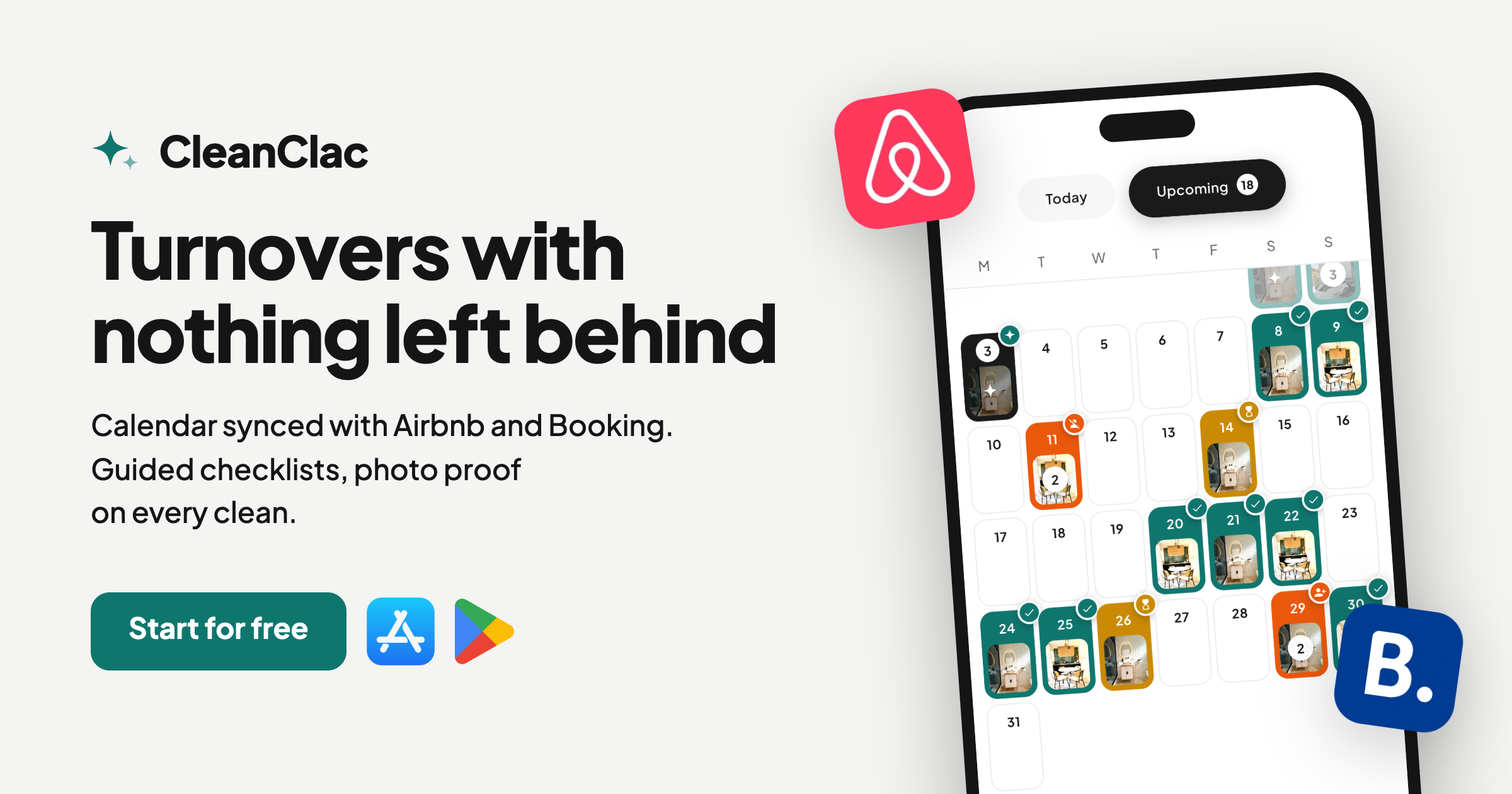
The app can automate job assignment as soon as a booking is confirmed on Airbnb, Booking.com or another platform, with no manual re-entry. Each team member can receive access from their smartphone, with all the necessary information built into the message. Photo reporting and supply tracking are available in a dashboard, which cuts down on verification calls and unexpected stockouts.
The cleaning management app starts with a free plan, then paid plans from 9.99 € per month for two properties, with no commission on cleans. Check the full pricing page to choose the right plan for the number of properties you manage, or explore the experience built for cleaners before onboarding your team.
Frequently asked questions
How do you securely send an access code to a cleaner?
The most reliable method is a temporary code sent through the app at the moment of assignment, tied to the job rather than to the person. This prevents a code from remaining active after you stop working with a contractor.
How long should a standard turnover take?
It depends on floor area and number of bedrooms, but a standard apartment is usually cleaned in about one hour to one and a half hours. A tighter window means focusing the checklist on priority areas rather than documenting everything.
Which photos should you always require from cleaners?
High-risk areas are enough: the entrance, linen, bathroom and kitchen, plus any damage or anomaly spotted. That minimal set speeds up dispute resolution if a guest complains without adding to the cleaner's workload.
How do you avoid running out of supplies between cleans?
A threshold alert set in the app, which notifies the manager as soon as a stock level drops below a defined point, prevents most oversights. Having a designated person confirm receipt closes the loop and avoids duplicate orders.
Does CleanClac track supplies by property?
Yes, CleanClac offers supply tracking and built-in alerts within the app for every managed property. The manager can see the full order history and stock levels directly from the dashboard.
Resources and useful guides to go further
To build a complete workflow, the cleaning workflow template guide from PerfectHost walks through task assignment step by step. On the tools side, the automation guides and the cleaning software comparison help you position a solution like CleanClac within your current setup.


