Automate Cleaning for Short-Term Rentals
Learn how to automate turnover cleaning for your short-term rental: trigger tasks, checklists, and quality checks from your booking calendar with no manual input.

Jonathan Lalinec

Long-term cleaning management for a short-term rental means automating the planning and tracking of every clean between bookings, from the trigger of a confirmed checkout to the validated on-site proof. The action to take right now is to connect a dedicated operational tool to your booking calendar, so that every status change triggers cleaner assignment, checklist creation, and quality control with no manual input.
In brief:
- Automated ongoing cleaning management relies on tasks being triggered automatically by confirmed checkouts, modifications, or cancellations.
- The Airbnb checklist must be followed strictly, with linen and bathrooms prioritised, and timestamped on-site proof is essential to validate quality.
- The sync between your PMS and your operational tool should be limited to booking events, leaving the execution tool to handle assignments, checklists, and proof.
- Linen preparation must be planned ahead, with stripping and an immediate wash start, to avoid delays on the day of the turnaround.
- Photo and video records, combined with regular metrics, ensure continuous oversight of punctuality, cleanliness, and guest satisfaction.
Table of contents
- What automated ongoing cleaning management actually covers
- Checklist and workflow to run at every turnover
- Connecting your PMS and operational tool without duplication
- Organising your team and planning for the unexpected
- Stock tracking and quality proof at every turnover
- What automation really changes for property managers
- CleanClac for automated ongoing cleaning management
- Getting started with CleanClac
- Sources
- Frequently asked questions
What automated ongoing cleaning management actually covers
The scope here is the repeated management of cleans across the full operating life of a property, not a one-off job. The goal is to organise, month after month, a task flow triggered by actual booking activity rather than a fixed schedule drawn up in advance.
Three events must trigger an action in the system:
- A confirmed checkout, which starts the cleaning task before the next arrival.
- A confirmed arrival, which sets the deadline that must not be missed.
- A cancellation or date change, which must automatically recalculate the available window.
The cleanliness standards themselves are non-negotiable: Airbnb requires a full clean between every guest, with a checklist covering surfaces, floors, linen, bathrooms, restocking, and odour removal. Automated scheduling only makes sense if it faithfully reproduces that level of quality at every turnover, without relying on a cleaner's memory or a last-minute exchange of messages.
Checklist and workflow to run at every turnover
A reliable clean depends on a repeatable sequence, not improvisation. Here is the flow to automate between two bookings:
- Trigger: the confirmed checkout automatically creates the task, with the next arrival time set as the deadline.
- Assignment: the nearest available cleaner receives the notification, with a backup identified in case of no response.
- Task priority: linen and bathrooms first, then surfaces and restocking, following the order recommended in the official Airbnb checklist.
- On-site proof: photos or video attached to critical checkpoints, timestamped in the app.
- Final sign-off: the task is closed only after the full checklist has been verified.
Linen rotation deserves its own treatment during a same-day turnaround. An expert cited by Airbnb recommends stripping the linen first and starting the first wash cycle immediately, then using a spare set to make the beds without waiting for the cycle to finish (Airbnb, expert tips). Logging this step as a separate task with a status such as "machine running" or "spare set used" prevents oversights when two turnovers follow each other on the same day.
Delays also call for a set procedure rather than a case-by-case reaction: build in a reasonable buffer between the clean and the next arrival, and trigger an automatic alert to a backup cleaner as soon as a task runs over that window without being signed off.
Pro tip: keep an "open exception" field in the checklist rather than locking everything down automatically. A cleaner who spots an unexpected problem must be able to flag it without blocking the task from being closed.
Connecting your PMS and operational tool without duplication
The most common mistake is trying to have one system do everything. The PMS centralises bookings and sales channels: Airbnb, Booking.com, Vrbo. The operational tool handles tasks, checklists, and on-site proof. These are two different jobs, and the Airbnb software partner page illustrates this separation clearly, distinguishing booking hubs from execution tools.
The data to sync between the two systems is limited but critical:
- Booking status (confirmed, cancelled, modified).
- Arrival and departure times, including late changes.
- Date modifications, which must recalculate the available cleaning window in real time.
Best practice is to let the PMS pass only booking events, and let the operational tool handle assignment and tracking, without duplicating business logic across both platforms. A dedicated booking-sync app shows how this separation works in practice: the calendar feeds the tasks, but the field tool decides who does what and holds the proof.
Organising your team and planning for the unexpected
Reliable automatic assignment rests on simple criteria: the cleaner's proximity to the property, their actual availability in the slot, and the skills required for that property (large square footage, specific equipment, particular instructions). These criteria should be configured once and then applied consistently.
A backup plan is not optional when turnovers are automated:
- A backup cleaner must be identified before the primary cleaner accepts the job.
- An automatic notification goes to that backup as soon as no response has been received within a set time.
- A directory of local service providers lets you find a replacement quickly when none of your regular cleaners are available, via specialist cleaning companies.
Standardised training reduces quality variation between cleaners. A checklist visible directly in the app, rather than memorised or passed on verbally, limits errors during busy periods or last-minute replacements.
Pro tip: train every new cleaner on their first job with the checklist on screen, not on a paper copy they will not be able to find for the next one.
Stock tracking and quality proof at every turnover
Restocking consumables (linen, cleaning products, coffee, toilet paper) should trigger an alert as soon as a minimum threshold is reached, not once the stock has run out. An automatic notification to the property manager allows ordering before the next turnover rather than discovering the shortage on-site.

Photo or video proof attached to critical tasks, recommended by Airbnb inspection best practices, must be archived and retrievable in the event of a dispute with a guest.
Three metrics are worth tracking regularly:
- Turnover punctuality against the set deadline.
- The number of cleanliness issues reported by guests.
- The average cleanliness rating on booking platforms.
The ecosystem of software partners listed by Airbnb shows that automating assignment and notifications does not remove the cleaner's on-the-ground judgement: it frees them to focus on exceptions rather than logistics.
What automation really changes for property managers
Automating ongoing cleaning management is not just about operational convenience. It redefines what is expected of a property manager. Many still believe reliability comes from a trusted, experienced cleaner. In reality, it comes from process repeatability: a checklist followed identically every time, systematic proof, an assignment that does not depend on someone's memory on a tired day.
The real gain is not the time saved on scheduling. It is the reduction in variation between two turnovers of the same property. A manager who checks only occasionally ends up discovering problems through guest reviews, long after those problems have already affected the cleanliness rating. A tool that captures proof at the time of the clean moves that quality control before arrival, not after checkout.
, Jonathan
CleanClac for automated ongoing cleaning management
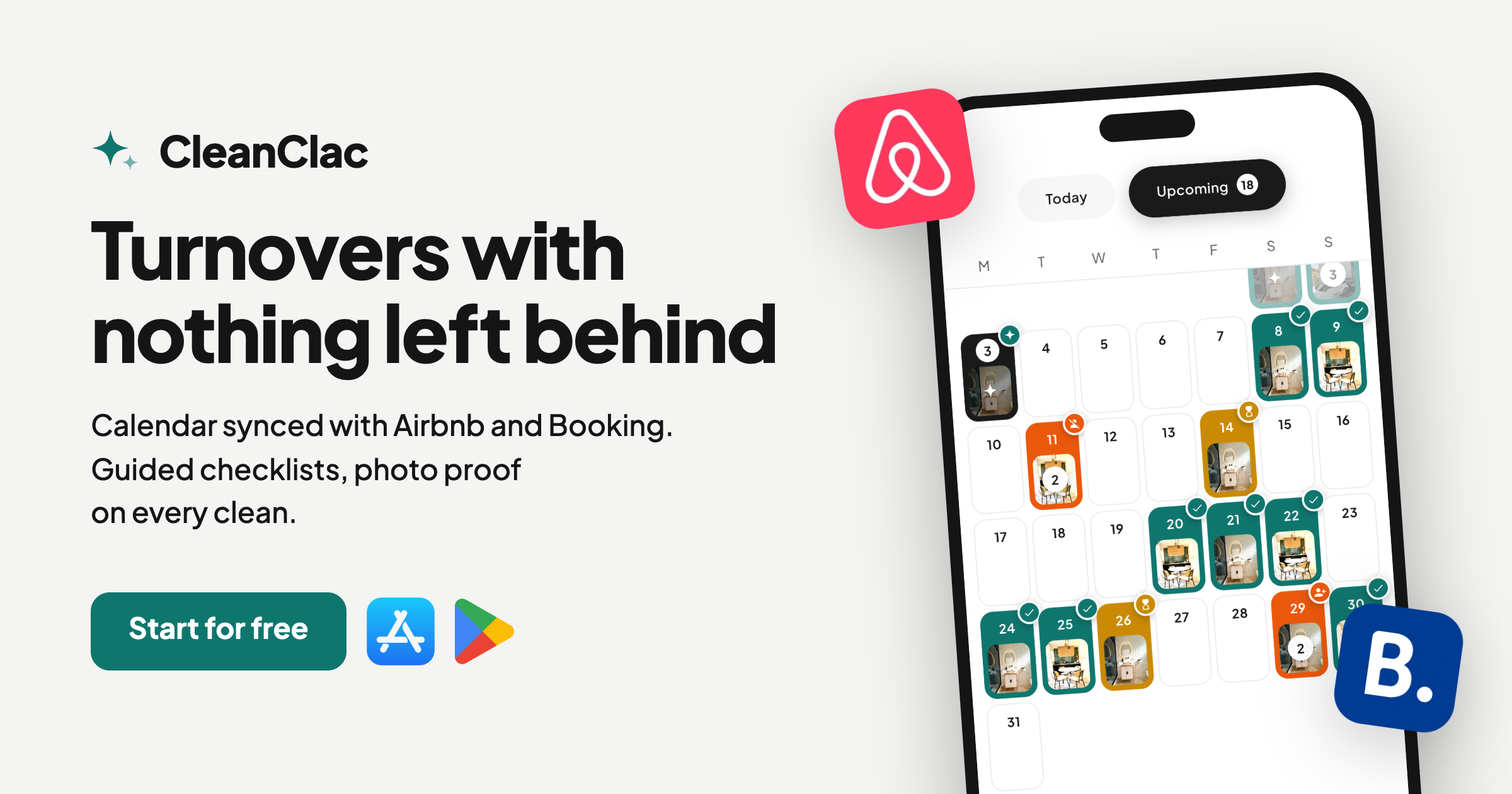
An app can automatically schedule cleaning tasks from Airbnb bookings and other platforms, then provide real-time reports on the status of each property, without the manager having to chase anyone.
Each cleaner can have their own mobile access, which allows the operation to run without complex manual management: they receive their job, follow their checklist, and submit their proof directly from their phone. Stock levels and cleaning performance can remain visible at all times, so every property is ready to welcome guests with no unpleasant surprises at check-in.
Getting started with CleanClac
CleanClac offers several plans based on the number of properties managed, from a free plan to options for larger portfolios, with pricing that scales as your portfolio grows. Visit the pricing page for a full breakdown of plans and to choose the one that fits your volume.
For cleaning teams themselves, a dedicated page presents the mobile access designed to simplify their day-to-day work, with no commission taken from their earnings.
Here is where to start:
- Test automated scheduling on one property with the free plan before rolling it out across your portfolio.
- Invite your regular cleaners to create their own individual mobile access.
- Compare the available plans on the pricing page to choose the billing frequency that suits you.
For properties rented over longer periods, such as those listed by Blue View Cannes, the same logic of linen rotation and stock tracking applies, with intervals that are simply less frequent.
Frequently asked questions
What does ongoing cleaning management mean for a short-term rental?
It is the repeated management of cleans across the full operating life of a property, organised around an automatic trigger at each confirmed checkout rather than a fixed schedule. The goal is to reproduce the same cleaning standards described in the official Airbnb checklist at every turnover, without exception.
How do you automate cleaning scheduling between two bookings?
By connecting an operational tool to the booking calendar, so that a confirmed checkout automatically triggers cleaner assignment and checklist creation. CleanClac schedules these tasks directly from Airbnb bookings and any other platforms you use.
Do you need a PMS or a dedicated cleaning tool to manage turnovers?
Both play different but complementary roles: the PMS centralises bookings and sales channels, while the operational tool handles tasks, checklists, and on-site proof. The Airbnb software partner page illustrates this separation between booking hub and execution tool.
How do you handle linen for a same-day turnaround?
The recommended approach is to strip the linen first and start the wash cycle immediately, then use a spare set to make the beds without waiting for the cycle to finish, following expert advice shared by Airbnb. Logging this step as a separate task in the app prevents oversights on high-turnover days.
Which metrics should you track to monitor cleaning quality over time?
Property managers typically track turnover punctuality against the set deadline, the number of cleanliness issues reported by guests, and the average cleanliness rating on booking platforms. Photo or video proof attached to each critical task lets you document these results consistently over time.


