Cleaning Schedule Conflicts: How to Avoid Them Between Stays
Avoid cleaning schedule conflicts between bookings: standardize turnovers, automate cleaner assignment on confirmation, and always have a backup ready.

Jonathan Lalinec

To eliminate scheduling conflicts between bookings, you need to standardize the turnover process, automate cleaner assignment on confirmation, and always name a backup who is available. A cleaning schedule conflict happens the moment a mismatch between one guest's checkout and the next guest's check-in puts pressure on the cleaning team. These three levers, a fixed procedure, automatic notification, and an identified backup, are enough to remove the majority of the tensions seen on same-day turnovers.
In brief:
- Turnover time ranges from one hour for a studio to up to three hours for a large, well-equipped property, at a cost of between 150 and 300 euros.
- Keeping the gap between checkout and check-in to at least four hours significantly reduces scheduling conflicts, especially on same-day bookings.
- Automating cleaner assignment as soon as a booking is confirmed, via a dedicated app, cuts delays and the risk of errors or missed assignments.
- Pre-stocking linen and supplies on site and identifying a backup cleaner in advance are key practices for handling same-day surprises effectively.
- The choice between an in-house team and external contractors depends on weekly turnover volume and how spread out your properties are.
Table of contents
- Why scheduling conflicts happen
- Operational processes to prevent conflicts and make every turnover reliable
- Managing same-day turnovers and automating the booking-to-cleaning handoff
- Condensed operational checklist to copy into your workflow
- How a dedicated app actually reduces scheduling conflicts
- In-house team or outsourcing: what impact on scheduling conflicts?
- Try CleanClac to automate cleaning schedules
- Further reading and useful resources
- Sources
- Frequently asked questions
Why scheduling conflicts happen
Most of the tension comes from a time calculation that is too tight between checkout and the next check-in. If a departure is scheduled for 11 a.m. and the next guest arrives at 3 p.m., the team theoretically has four hours, but a twenty-minute late checkout, a laundry cycle that runs long, or a broken washing machine can shrink that window to almost nothing.
Several factors come up repeatedly in short-term rental properties:
- a late checkout from the departing guest that eats into the available window
- a linen wash cycle that runs over, especially when several sets of sheets need processing
- unexpected maintenance discovered during the turnover, such as a leak, a broken appliance, or damage
- the sudden unavailability of the assigned cleaner, with no backup plan in place
The size of the property and its level of amenities directly affect how long the turnover takes and what it costs. A studio generally takes one hour, while a three-bedroom apartment with a jacuzzi can require up to three hours, at a cost ranging from 150 to 300 euros depending on floor area and amenities, according to operational benchmarks observed across the industry.
Operational processes to prevent conflicts and make every turnover reliable
A repeatable procedure removes most of the disagreement about who does what and in which order. The method that works best follows a top-to-bottom sequence through each room, so you never dirty a surface you have already cleaned.
- Strip: remove dirty linen, empty bins, air out the rooms
- Surfaces: dust and disinfect worktops, furniture, and appliances
- Bathroom: clean the bathroom and toilet with dedicated products
- Floors: vacuum then mop last, once all surfaces are done
- Staging: make the beds, arrange the towels, check the visual details
Each task is best linked to a clear, verifiable acceptance criterion for the final photo inspection: bed made with crisp folds, bathroom without marks, surfaces free of visible dust. This photo inspection, used by operators who handle same-day turnovers most effectively, also serves as evidence in the event of a dispute with a guest or a contractor.
Turnover should not be confused with a deep clean. The first is a quick reset of one to three hours between stays, while the second, carried out every three to six months, tackles the build-up of dirt not visible day to day, such as curtains, grout, and the inside of appliances.
Pro tip: assign a fixed role to each team member on multi-room properties: one cleaner for the bathroom and floors, another for the kitchen and staging, so you can work in parallel without getting in each other's way.

Managing same-day turnovers and automating the booking-to-cleaning handoff
Same-day turnovers, where a checkout and a check-in fall on the same day, concentrate most of the conflict risk. The rule that limits incidents most effectively is to aim for a minimum four-hour gap between checkout and the next check-in, whenever the booking calendar allows it.
A common practice among operators who handle same-day turnovers well is to remove friction points before they arise, in line with operational best practices across the industry: that means pre-stocking linen sets and supplies directly on site, without depending on an extra trip from the cleaner.
Three actions concretely reduce the risk on these tight slots:
- pre-position clean linen sets and supplies in a dedicated space within the property
- automate cleaner assignment as soon as the booking is confirmed, with no waiting and no manual re-entry
- flag same-day jobs visually in the cleaner's interface so they can prioritize their rounds accordingly
When a job is identified as same-day and the assigned cleaner reports they are unavailable, the backup procedure must activate immediately. A named backup, notified by automatic alert, avoids the last-minute improvisation that causes the majority of unmanaged cancellations.
Condensed operational checklist to copy into your workflow
Before the cleaner arrives on site, a few simple steps prevent half of all blockages:
- Check that clean linen sets are available in the property's restocking station
- Confirm the actual checkout time of the departing guest via message or door sensor
- Send the assignment notification to the cleaner with the deadline for completing the job
- Prepare supplies (cleaning products, bin bags, toilet paper) in sufficient quantities
On site, the sequence stays the same for every turnover, and three photos must be taken systematically for the final inspection: the living room or main bedroom once staging is complete, the cleaned bathroom, and the tidied kitchen. If something goes wrong, a simple escalation procedure limits the damage: contact the assigned cleaner, then, if there is no response within fifteen minutes, send a standard message to the identified backup ("Urgent job, [address], check-in at [time]") and trigger their visit without waiting for further confirmation.
How a dedicated app actually reduces scheduling conflicts
Adding a cleaning management app to your workflow primarily changes the speed at which information travels between a booking and the cleaner on the ground. CleanClac automates cleaning scheduling from Airbnb and other platform bookings, with individual mobile access for each cleaner and real-time tracking of each property's status.
In practice, this type of tool provides:
- automatic cleaner assignment as soon as the booking is confirmed, with no manual re-entry
- linen and supply stock tracking to anticipate shortages before a same-day turnover
- photo reporting directly from the cleaner's phone, kept as evidence in case of dispute
- real-time visibility of each property's status for the coordination team
Systematically documenting the process and automating assignment on booking confirmation are among the practices that set apart operators who handle same-day turnovers most effectively.
This approach ties directly into the recommended practices for making same-day turnovers reliable: less manual re-entry, less delay between a booking being made and the information reaching the team on the ground.
In-house team or outsourcing: what impact on scheduling conflicts?

The choice between an in-house team and external contractors is not settled by general principles, but by weekly turnover volume and the diversity of your property portfolio. An in-house team gives more control over quality and responsiveness, at the cost of a fixed payroll that weighs heavily during quiet periods. Outsourcing to specialist cleaning companies gives flexibility at peak times, but requires stricter documentation to maintain a consistent standard from one contractor to the next.
The criteria that should drive the decision are the number of turnovers per week, how spread out the properties are geographically, and the budget available for coordination.
, Jonathan
Try CleanClac to automate cleaning schedules
Once the procedure is standardized, the next step is to remove the manual re-entry between a booking and cleaner assignment. CleanClac is designed for exactly this: automatic notification on confirmation, a real-time tracking dashboard, dedicated mobile access for each cleaner, and integrated photo reporting.
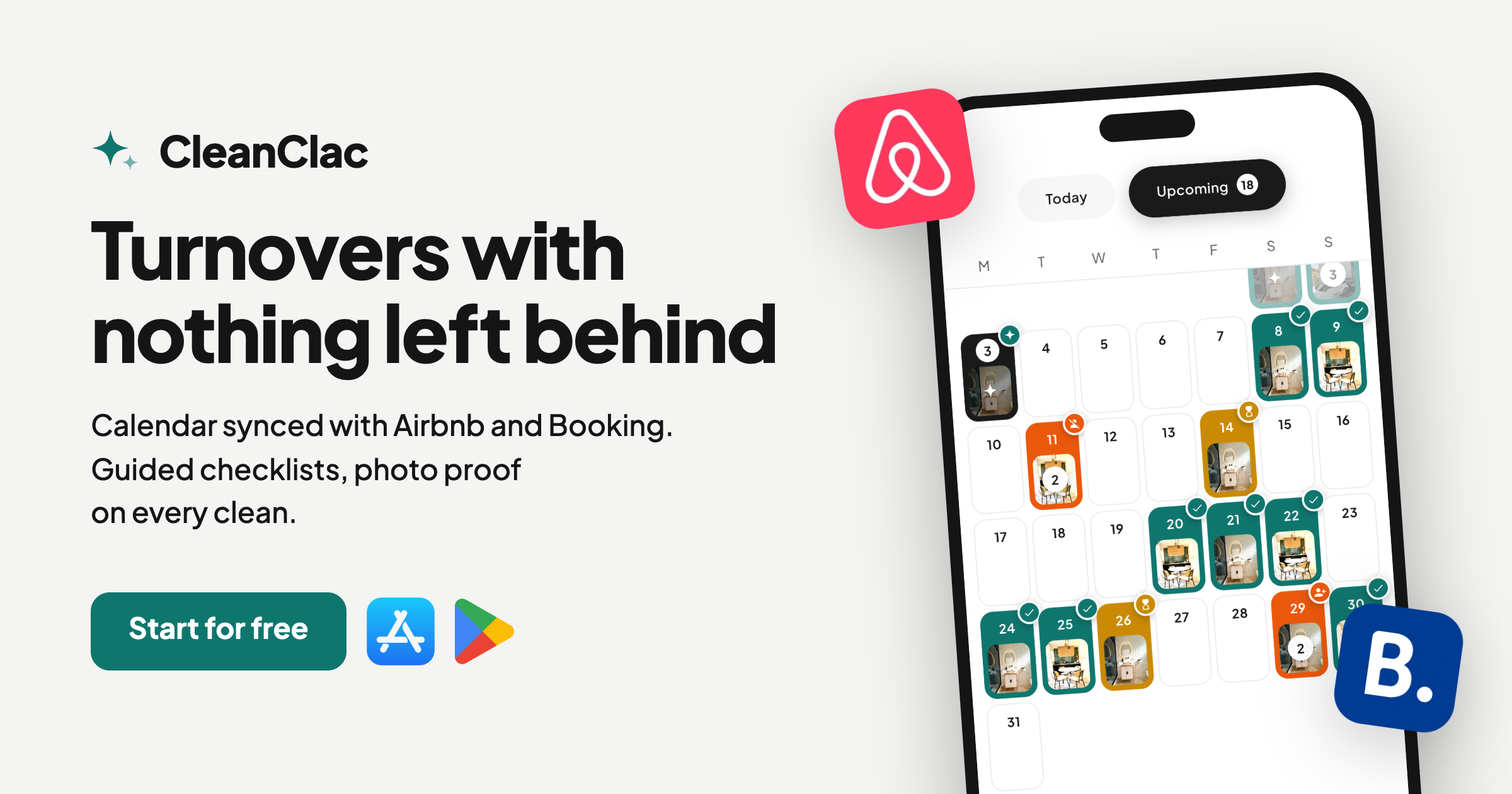
The features that make the biggest difference for reducing scheduling conflicts:
- automatic assignment with no manual step required for each booking
- linen and supply stock tracking to anticipate shortages
- individual mobile access for each cleaner, with no shared account
- compatibility with the main existing PMS tools, with no need to change your booking platform
The 2 properties plan is available at 9.99 euros per month, and a free plan lets you test how it works before committing to a subscription. To compare the plans available for two properties or more, CleanClac's pricing page sets out each tier in detail.
Further reading and useful resources
To go deeper on duration and cost benchmarks, Hostfully's guide on same-day turnovers sets out practices observed across the industry. The PerfectHost guide on organizing cleaning between bookings offers complementary checklist templates, and the CleanClac product page presents the features available to automate this workflow.
Frequently asked questions
What is a cleaning schedule conflict between two bookings?
It is a mismatch between one guest's checkout and the next guest's check-in that prevents the cleaner from finishing on time. This risk rises sharply on same-day turnovers, when the available window drops below the recommended four hours.
How long does a standard turnover take?
A turnover generally takes between one and three hours depending on the size of the property and its level of equipment, as shown by benchmarks observed across the industry. A studio takes roughly one hour, while a large apartment with specific amenities can require up to three hours.
What budget should I allow for a turnover clean?
The indicative cost of a turnover sits between 150 and 300 euros, with variability depending on the property's floor area and amenities, according to the same industry benchmarks. This amount covers a standard clean, excluding periodic deep cleans.
How do you avoid conflicts on same-day bookings?
The most reliable approach combines a gap of at least four hours between checkout and check-in, pre-stocking linen on site, and a backup cleaner identified in advance for unexpected situations. Flagging these jobs as priority in the scheduling tool also helps the cleaner plan their rounds accordingly.
Can CleanClac automate cleaner assignment?
Yes, CleanClac triggers automatic cleaner assignment as soon as a booking is confirmed, with individual mobile access for each cleaner. The app also includes stock tracking and photo reporting, available from the pricing page to test on two properties.


