Rentals United Cleaning Integration: From Booking to Work Order
Connect Rentals United to your cleaning software and automate every work order. Learn to map XmlApartmentID, read RLNM webhooks, and validate with three tests.

Jonathan Lalinec

Use the XmlApartmentID paired with RLNM subscriptions to trigger cleaning work orders automatically. This technical pairing identifies each property without ambiguity and notifies your system of every booking creation, modification, or cancellation. Cleaning software that can read these feeds, such as CleanClac, converts each event into a scheduled task complete with timestamped photo proof. Before going live, three tests are enough to validate the chain: a creation, a modification, and a cancellation.
In brief:
- Confirm that every listing has a valid XmlApartmentID and that contact details, checkout times, and PMS fields are consistent before connecting.
- Process RLNM notifications as soon as they arrive, adapt rules to the booking source, and schedule cleaning from the actual checkout time.
- Test against historical bookings, then simulate a creation, a modification, and a cancellation before monitoring for gaps between the calendar and the cleaning schedule for at least two weeks.
- Every listing must have complete contact details, photos, a stated guest capacity, and 365 days of availability before it can be connected.
- Secure your notification endpoint and limit each cleaner's access to the information they need for their task, with no visibility into rates or guest contact details.
Table of contents
- Technical requirements and data quality checks
- Data feed: what to read in webhooks and how to map to work orders
- Step-by-step checklist for implementing the integration
- Essential tests and success indicators
- Practical tips for day-to-day operations
- PMS settings and sync scope: what data is imported
- Minimum inventory requirements and metadata to provide
- Managing cleaning statuses for accurate tracking
- Syncing cleaning-driven availability back to Rentals United
- Cleaner smartphone access and data security
- Automating alerts for incidents and delays
- Cleaner performance reports integrated with Rentals United
- Supply management linked to the integration for automated tracking
- Why automating cleaning from Rentals United changes operations
- A concrete solution for automating cleaning from Rentals United
- Frequently asked questions
- Sources
Technical requirements and data quality checks
Before connecting a cleaning tool to Rentals United, it is worth making sure the technical foundations are solid. Three elements determine the reliability of the entire automation chain.
- Have access to the API documentation and the integration credentials provided by Rentals United.
- Confirm that the XmlApartmentID is filled in for every property and that contact details, check-in and checkout times, and rates are consistent between your PMS and Rentals United.
- Make sure the PMS exposes the fields needed for sync, or prepare a manual mapping where it does not.
A property identifier entered incorrectly, or a time discrepancy between two systems, is enough to shift a cleaning assignment by several hours. This preliminary check takes little time but prevents the majority of errors that appear in the first weeks of an integration.
Data feed: what to read in webhooks and how to map to work orders
Every booking sent by Rentals United contains a set of fields that, correctly interpreted, are sufficient to generate a cleaning work order without manual input. The reservations management documentation details the available methods for retrieving this data, including List reservations, Get reservation by ID, and Push_ModifyStay_RQ.
- Identify the property using the XmlApartmentID, the only field that guarantees an exact match between the booking and the property concerned.
- Extract the stay dates, the booking status, and the creator field, which indicates the source channel and lets you adjust mapping rules by platform.
- Parse the RLNM webhook as soon as it arrives and convert the payload into a structured work order, rather than waiting for a periodic import.
- Apply your property's business rules: the minimum gap between checkout and the start of the clean, the estimated duration based on property size, and assignment to an available cleaner.
Pro tip: Always base the trigger delay on the actual checkout time rather than the contracted time. A late checkout automatically shrinks the cleaning window.
RLNM webhooks notify your system in real time whenever a booking is created, modified, or cancelled, letting your cleaning software react immediately rather than waiting for a sync cycle. A system that relies only on periodic imports accumulates a lag that eventually ripples through cleaners' schedules.
Step-by-step checklist for implementing the integration
Putting a reliable integration into production follows a precise order, where each step conditions the next.
- Validate the XmlApartmentID format for every property and build the mapping between the Rentals United identifier and the corresponding record in your cleaning system.
- Configure a secure endpoint to receive RLNM notifications, following the API documentation's recommendations on authentication and queue management.
- Send test payloads to verify that every expected field arrives correctly formatted before going live.
- Define the rules for converting a booking into a work order, drawing on a standardised checklist such as the 166-task Airbnb cleaning checklist to ensure consistency across properties.
- Plan modification and cancellation handling so that an already-scheduled work order is automatically updated or removed without manual intervention.
A few points deserve particular attention during setup:
- Document every transformation rule so the operations team understands why a work order was generated, updated, or cancelled.
- Keep a log of received webhooks during the first few weeks so you can quickly diagnose any gap between Rentals United and the cleaning schedule.
A resilient endpoint that retries on temporary failure prevents the loss of critical events such as a last-minute cancellation.
Essential tests and success indicators
Before rolling automation out across your entire portfolio, a few targeted tests let you de-risk the switchover.
- Import a batch of historical bookings to check that the mapping between XmlApartmentID and cleaning records works on real data, not just dummy entries.
- Simulate a booking creation, a modification, and a cancellation, then verify that the corresponding work order is correctly created, updated, or removed.
- Track the delay between webhook receipt and work order generation, the mapping error rate, and the presence of timestamped photo confirmations at the close of each job.
A correctly configured RLNM endpoint converts a simple booking event into an automatically generated work order, according to the reservations management documentation. This removes the manual verification step that usually slows teams down.
A successful test shows no gap between the Rentals United calendar and the cleaners' schedule over an observation period of at least two weeks, ideally covering a full cycle of short and long bookings.
Practical tips for day-to-day operations
Once the technical integration is in place, day-to-day execution quality depends mostly on operational discipline.
- Ask each cleaner to confirm job completion on their smartphone, with timestamped photos as evidence.
- Standardise the cleaning checklist across your entire portfolio to ensure a consistent quality level from one property to the next.
- Enable stock alerts for supplies so replenishment is triggered before a shortage rather than after.
- Share cleaner performance indicators with the teams concerned so everyone can see their contribution to overall quality.
Pro tip: A standardised checklist, like the one used to structure automatic cleaning schedules, reduces guest complaints caused by the same items being missed repeatedly from one turnover to the next.
PMS settings and sync scope: what data is imported
Rentals United does not replace your PMS. It acts as a distribution layer that connects to your existing management system, which remains the source of record for property data, as described on the vacation rental services page. This distinction matters when configuring a cleaning integration, because it determines where to correct bad data.
The sync scope depends on which PMS settings are enabled at connection. Some managers choose to import only bookings and availability, leaving property metadata managed exclusively in the PMS. Others also sync rates and stay restrictions, which requires more frequent consistency checks between the two systems.
The Rentals United connection guide details how to configure PMS settings and import all relevant properties. For a cleaning tool, the choice of scope directly affects mapping reliability. The broader the sync, the greater the risk of divergence between the two sources if one platform is not updated in real time.
One simple principle works well in practice: treat Rentals United as the source of truth for real-time booking events, while validating static metadata directly in the PMS. This clear division of responsibility prevents data conflicts during booking peaks.

Minimum inventory requirements and metadata to provide
Rentals United requires a minimum data set before connecting a property: complete contact details, photos, guest capacity, and 365 days of availability. These requirements, set out in the integration and certification guide, are a prerequisite for onboarding a listing on the platform.
For a cleaning tool, this baseline is also a useful working foundation. Reference photos allow a visual comparison of property condition before and after a clean, while guest capacity often determines the scope of the clean and the estimated job duration.
An incomplete inventory becomes apparent quickly once the integration is live. Properties without reference photos produce less useful cleaning reports, and an incorrect guest capacity distorts time estimates. A quick audit of property records before launching automation across the portfolio avoids this kind of friction.
Consistency between Rentals United metadata and PMS data also deserves regular checking, particularly after adding a new property or changing a guest capacity, as this type of update can easily go unnoticed if it is not synced immediately.
Managing cleaning statuses for accurate tracking
An automatically generated work order is not enough on its own. You also need to track its progress in real time. Three statuses typically structure this tracking: scheduled, in progress, and complete.
Scheduled applies to a work order created automatically on receipt of a booking webhook, before any cleaner has picked it up. In progress is set when the cleaner confirms arrival on site, usually via their smartphone. Complete is triggered at the close of the job, ideally accompanied by timestamped photo evidence of the work done.
This level of tracking lets a manager spot a delay immediately. A work order still showing as scheduled when check-in is approaching signals a problem that needs urgent attention. It also makes coordination easier when several cleaners are working on nearby properties on the same day, since each person can see the real-time progress of their assigned tasks.
Status tracking also feeds availability. A property whose clean moves to complete can be marked available for the next check-in, reducing the risk of error when bookings are back to back. This sync between cleaning status and availability is one of the concrete benefits of a well-built integration between Rentals United and a cleaning management tool.
Syncing cleaning-driven availability back to Rentals United
Once a clean reaches complete status, the property's availability must be pushed back to Rentals United to prevent a booking being accepted before the property is actually ready. This reverse sync, from the cleaning system to the channel manager, completes the loop that starts with the booking event.

In practice, this feedback loop prevents two problematic scenarios: a check-in accepted while the previous clean is still unfinished, or a property unnecessarily blocked when the clean was completed ahead of schedule. The reliability of this loop depends directly on how quickly the cleaner records the complete status on site.
For managers who run back-to-back short stays, this mechanism noticeably reduces logistical friction, especially during high-occupancy periods when several checkouts and check-ins follow one another on the same property within a single day.
Cleaner smartphone access and data security
Each cleaner must be able to view their schedule and confirm tasks without depending on centralised manual management. Individual smartphone access, such as that provided by the dedicated cleaner app, meets this need while cutting down on informal messages by phone or chat that tend to get lost.
Data security deserves particular attention in this context. Each cleaner should only have access to the information strictly necessary for their task: the property address, access instructions, and the task checklist, with no visibility into rates or guest contact details. This separation of access reduces risk in the event of a device being lost or inadvertently shared.
Securing technical entry points also matters. A poorly secured RLNM endpoint exposes the entire booking feed to unauthorised access. The API documentation's recommendations on authentication and queue management are designed to prevent exactly this kind of vulnerability.
Well-managed individual access also simplifies day-to-day team management, particularly when several cleaners work across the same portfolio of properties and need to be assigned dynamically based on their availability.
Automating alerts for incidents and delays
A work order stuck at scheduled status for too long before a check-in is one of the most critical signals to automate. Without proactive notification, this kind of delay is often only discovered when a guest arrives at a property that is not ready.
Automated alerts can be triggered on several criteria: no arrival confirmation from the cleaner within a set time, a job running over its estimated duration, or an incident flagged directly from the mobile app. These notifications must reach the manager immediately, ideally with enough lead time to reassign the task to another available cleaner.
The value of this kind of automation lies mainly in how quickly it fires. A system that waits for an end-of-day report to flag a delay arrives too late to fix the situation before the next guest. By coupling RLNM webhooks with real-time cleaning status tracking, a manager can act within the useful window, before the problem affects the guest experience.
Cleaner performance reports integrated with Rentals United
Measuring cleaner performance makes it easy to spot quality gaps from one team to another and adjust assignments accordingly. These reports are typically built from data collected during each job: actual duration compared to estimated duration, rate of tasks confirmed with a photo, and frequency of incident reports.
When these metrics are cross-referenced with booking data from Rentals United, it becomes possible to compare cleaner performance against the actual occupancy rhythm of properties. A cleaner regularly assigned to back-to-back turnovers in tight windows will naturally show a different performance profile from one working with more time between cleans.
Cleaning reports with timestamped photos provide a concrete basis for assessing this performance. They document property condition at the end of each job and serve as a reference in the event of a guest dispute or a question about the quality of a particular clean. This traceability builds trust between managers and cleaners, while making reassignment decisions easier when they are needed.
Supply management linked to the integration for automated tracking
Every clean uses supplies: linen, cleaning products, welcome consumables. Manual tracking of these items is a frequent cause of unexpected stockouts. Linking the booking feed from Rentals United to automated stock tracking lets you anticipate needs rather than discover shortfalls after the fact.
In practice, each automatically generated work order can trigger a stock decrement for the property concerned. When a critical threshold is reached, a replenishment alert fires before the next cleaner arrives on site without the supplies they need.
This link between booking volume and supply consumption becomes especially useful during high-occupancy periods, when the pace of cleans accelerates and stock runs out faster than usual. Automated tracking built directly into the booking feed avoids emergency runs to restock a property just before a guest arrives.
Why automating cleaning from Rentals United changes operations
Automating cleaning triggers is not just a marginal time saving. It removes a manual step where most scheduling errors concentrate. Fewer mapping mistakes, faster turnover between bookings, and guest satisfaction that rises naturally when every property is ready on time.
, Jonathan
A concrete solution for automating cleaning from Rentals United
Converting a booking feed into an operational work order requires a tool that can read these events and translate them into assigned tasks without manual re-entry. That is exactly what we offer with CleanClac. Cleaning schedules are built directly from bookings, each cleaner has their own mobile access to confirm tasks, and real-time reports document every job with photo evidence.
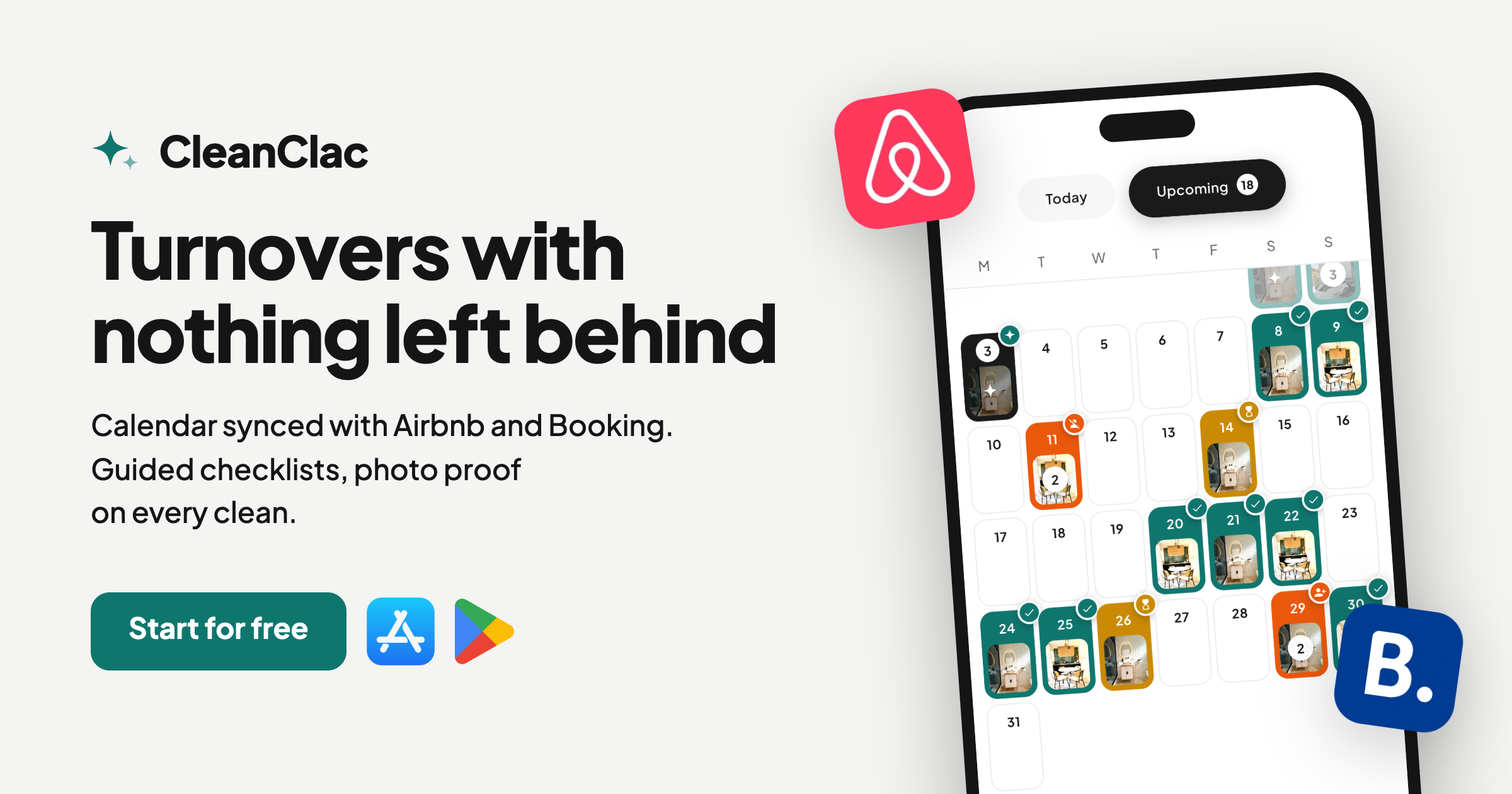
- Automatic cleaning scheduling as soon as a booking is received, with no manual schedule management.
- Individual mobile app for each cleaner, with task confirmation and report submission.
- Standardised checklist of 166 illustrated tasks to guarantee consistent quality across every property.
Our plans start from the pricing page, with a subscription scaled to the number of properties you manage. Visit our detailed pricing page to choose the plan that fits your portfolio and get started with the Rentals United integration.
Frequently asked questions
What is the XmlApartmentID in the Rentals United integration?
The XmlApartmentID is the unique identifier assigned to each property in Rentals United. It is used to match a booking to the correct record in an external system such as a cleaning tool. It guarantees an exact match, which is essential for automatically triggering the right cleaning work order.
How do RLNM webhooks trigger a cleaning work order?
RLNM webhooks notify your system in real time whenever a booking is created, modified, or cancelled in Rentals United. Cleaning software that consumes these notifications automatically converts each event into a scheduled task, updating or deleting it as required.
What minimum data does Rentals United require for a property?
Rentals United requires complete contact details, photos, guest capacity, and 365 days of availability before connecting a property, as set out in the integration and certification guide. This baseline also serves as a reference for documenting property condition before and after a clean.
How much does a solution like CleanClac cost to automate cleaning?
Our plans are listed on our pricing page, where you will find options suited to the number of properties you manage.
How do you test an integration before rolling it out?
Simulate a booking creation, a modification, and a cancellation, then check that the corresponding work order is created, updated, or removed correctly. Testing against imported historical bookings also lets you validate the mapping before going fully live.


