Airbnb Cleaning Workflow: Run Every Turnover Smoothly
Set up auto-created cleaning jobs at checkout, a room-by-room checklist, and timestamped photos so every Airbnb turnover runs without a hitch.

Jonathan Lalinec

Automate job creation at every checkout, standardise a room-by-room checklist, and require a timestamped final photo before handing over the keys. These three steps are enough to secure any turnover, no matter how many properties you manage. The rest of this article walks through the operational sequence, scheduling tools, and quality checkpoints that turn this foundation into a reliable system.
In brief:
- A studio often takes under two hours; a house with a garden can take half a day. Build in 30 to 60 minutes of buffer.
- iCal works fine for one or two properties on a single platform. Once bookings come from several sites, property management software reduces errors.
- A shared operating procedure sets cleanliness standards and property-specific exceptions. An on-site walkthrough speeds up onboarding for new cleaners.
- Keep spare sets of linen and start the laundry the moment the cleaner arrives: linen is the most common bottleneck in back-to-back turnovers.
- Set a maximum of 15 minutes between spotting a problem and alerting the manager so that a delay does not compromise the next check-in.
Table of contents
- The workflow step by step: from booking to property ready
- Room-by-room checklist: what to hand to your cleaners
- SOPs and standards: defining what "done" actually means
- Scheduling and tools: iCal, PMS and automations to set up
- Linen, laundry and supplies: avoiding the logistics bottleneck
- Assignment, tracking and quality control: statuses and proof before opening
- Practical application: how a dedicated app runs this workflow
- Perspective: priorities and common pitfalls
- Simplifying this workflow with CleanClac
- Frequently asked questions
- Sources
The workflow step by step: from booking to property ready
A successful turnover always follows the same logic: cut the number of on-the-spot decisions to eliminate oversights. The sequence starts before the cleaner even arrives, the moment the previous booking ends.
- A job is created automatically as soon as checkout is recorded, with no manual input from the manager.
- An initial walkthrough flags any damage or items left behind before work begins.
- Strip the beds first so the linen goes straight into the wash without delay.
- Clear the dishes and empty the bins to free up the workspace.
- Clean from top to bottom: dust, then surfaces, then floors, so no area needs a second pass.
- In the bathroom, work from wet to dry: shower walls first, mirror last.
- Floors are done last, once every other surface is finished.
- Restocking supplies (coffee, toilet paper, toiletries) closes out the physical cleaning.
- A timestamped final photo, room by room where possible, documents the property's condition before the keys are handed over.
- An automatic notification confirms to the manager that the property is ready.
Each step deserves a rough time estimate. A studio can often be cleaned in under two hours; a house with a garden may take half a day. Scheduling a 30-to-60-minute buffer between jobs absorbs the unexpected without pushing back the next check-in. When something goes wrong (a stubborn stain, broken equipment), the escalation path should be agreed in advance: who is notified, within what timeframe, and what the fallback plan is if the deadline is not met.
Pro tip: Set a maximum escalation window of 15 minutes between spotting a problem and alerting the manager. Beyond that, the delay flows straight through to the check-in.
Room-by-room checklist: what to hand to your cleaners
A well-thought-out sequence is not enough without a written checklist that every team member can follow without personal interpretation. It must cover every area of the property with specific tasks, not vague intentions.
- Entrance: floor mopped, mirror streak-free, shoes or personal items left by previous guests removed.
- Living room: cushions repositioned, remote controls disinfected, dust removed from high and low surfaces.
- Kitchen: hob and oven degreased, fridge emptied and wiped, dishes put away, bin liner changed.
- Bedrooms: linen changed completely, under the bed checked, wardrobes inspected.
- Bathroom: grout and shower walls free of limescale, fresh towels folded, toilet paper stock replenished.
- Outdoor areas: balcony or terrace swept, outdoor furniture wiped down, ashtrays and rubbish removed.
Some points are zero-tolerance: visible hair in the shower, bin odour, stained bedding. These defects warrant a quick check before the cleaner leaves, as they weigh heavily on reviews. Natural ventilation and pH-neutral cleaning products handle odours better than room fragrances, which can actually put some guests off, according to Airbnb's expert cleaning tips.
For a multilingual team, an illustrated version with reference photos reduces misinterpretation, especially around folding or storage standards. Our illustrated Airbnb cleaning checklist in six languages addresses exactly this need.

SOPs and standards: defining what "done" actually means
The checklist says what to do. The SOP (standard operating procedure) says how to do it and to what quality level. That makes it indispensable as soon as you work with several cleaners or several properties. A well-written SOP transfers knowledge from the owner into an executable, auditable document, making it possible to scale without losing consistency, as Welco explains in its guide to writing a cleaning SOP.
A useful SOP typically covers six points:
- Access to the property (code, key box, security instructions).
- Expected cleanliness standards by area.
- Rules for restocking supplies.
- How to spot defects before leaving.
- The final sign-off process.
- Property-specific exceptions (fragile equipment, pets, unusual layout).
The best way to test it is an on-site onboarding session: walk through the property with the new cleaner, SOP in hand. This accelerates competence from the very first job. A layered structure works well: a common baseline for all properties, then a short list of exceptions specific to each one.
Scheduling and tools: iCal, PMS and automations to set up
A basic iCal feed is enough when you manage one or two properties on a single platform. Once volume grows or bookings come in from Airbnb, Booking.com and Vrbo at the same time, sync errors become frequent and a PMS or channel manager becomes necessary.
- Job creation and cancellation should trigger automatically with every booking change.
- Cleaner notifications go out without manual input the moment a job is assigned.
- A time buffer between bookings prevents overlaps during back-to-back check-ins.
- Estimated duration per property should be configured so delays can be anticipated.
Pro tip: Always schedule a safety margin of at least 30 minutes between checkout and the next check-in, even when the calendar appears to allow none.
Integrations between a PMS and a cleaning tool eliminate double entry, but they need regular checking. A sync that fails silently can leave a property with no job assigned.
Linen, laundry and supplies: avoiding the logistics bottleneck
Linen is the number-one bottleneck in back-to-back turnovers. Stripping the beds the moment the cleaner arrives and starting the machine straight away conditions everything else in the day's schedule.
- Keeping a buffer stock of complete linen sets means you never have to wait for a wash cycle to finish between bookings.
- Rotating stock (last in, last out) spreads wear evenly across all sets.
- Documenting stains or incidents with a photo and a cost note simplifies tracking and any potential charge to the guest.
- Restocking supplies (toiletries, paper, coffee) on a fixed schedule rather than reactively reduces on-site stockouts. Our page on Airbnb stock management explains this per-clean tracking approach in detail.
Assignment, tracking and quality control: statuses and proof before opening
Three statuses are enough to manage a job without unnecessary complexity: to do, in progress, complete. This simple system gives the manager instant visibility on progress without back-and-forth messages.
- To do: the job is created and assigned, waiting for work to begin.
- In progress: the cleaner has started and the status updates in real time.
- Complete: the checklist is fully ticked and proof has been submitted.
The evidence expected at the end of a job includes a fully completed checklist and timestamped photos of key areas, particularly the bathroom and the bedding.
A cleaning report with timestamped photos is the most direct proof that a property is ready, far more reliable than a verbal confirmation. When a critical incident occurs (damage found, item missing), immediate escalation to the manager prevents a guest from discovering the problem on arrival. Our Airbnb cleaning report with timestamped photos structures this step so it stays quick to produce.
Practical application: how a dedicated app runs this workflow
This kind of workflow, described step by step, is hard to maintain manually once several properties and several cleaners are involved. A dedicated app automates job creation from each booking and gives every cleaner their own mobile access, with no shared spreadsheet and no scattered messages.
- Illustrated, translated checklists appear directly on the cleaner's phone, room by room.
- Cleaning reports with timestamped photos feed automatically into the manager's dashboard.
- Supply tracking flags restocking needs before a stockout occurs.
- A consolidated multi-property view lets you monitor several rentals without switching tools.
At CleanClac, this logic is exactly how we work every day: every job starts from a booking, every cleaner follows their own checklist, and every clean closes with proof that can be checked remotely.
Perspective: priorities and common pitfalls
If I had to sum up what separates a workflow that holds from one that collapses at the first hiccup, it comes down to three things: automate job creation, write at least a minimal SOP, and always require a photo as proof. Most hosts skip the SOP, assuming a checklist is enough, and then discover that every cleaner interprets "clean" differently. The second classic trap is leaving no time buffer between bookings, which turns a simple delay into a check-in crisis. My advice: test this workflow on a single property before rolling it out everywhere. Adjustments are always easier at small scale.
, Jonathan
Simplifying this workflow with CleanClac
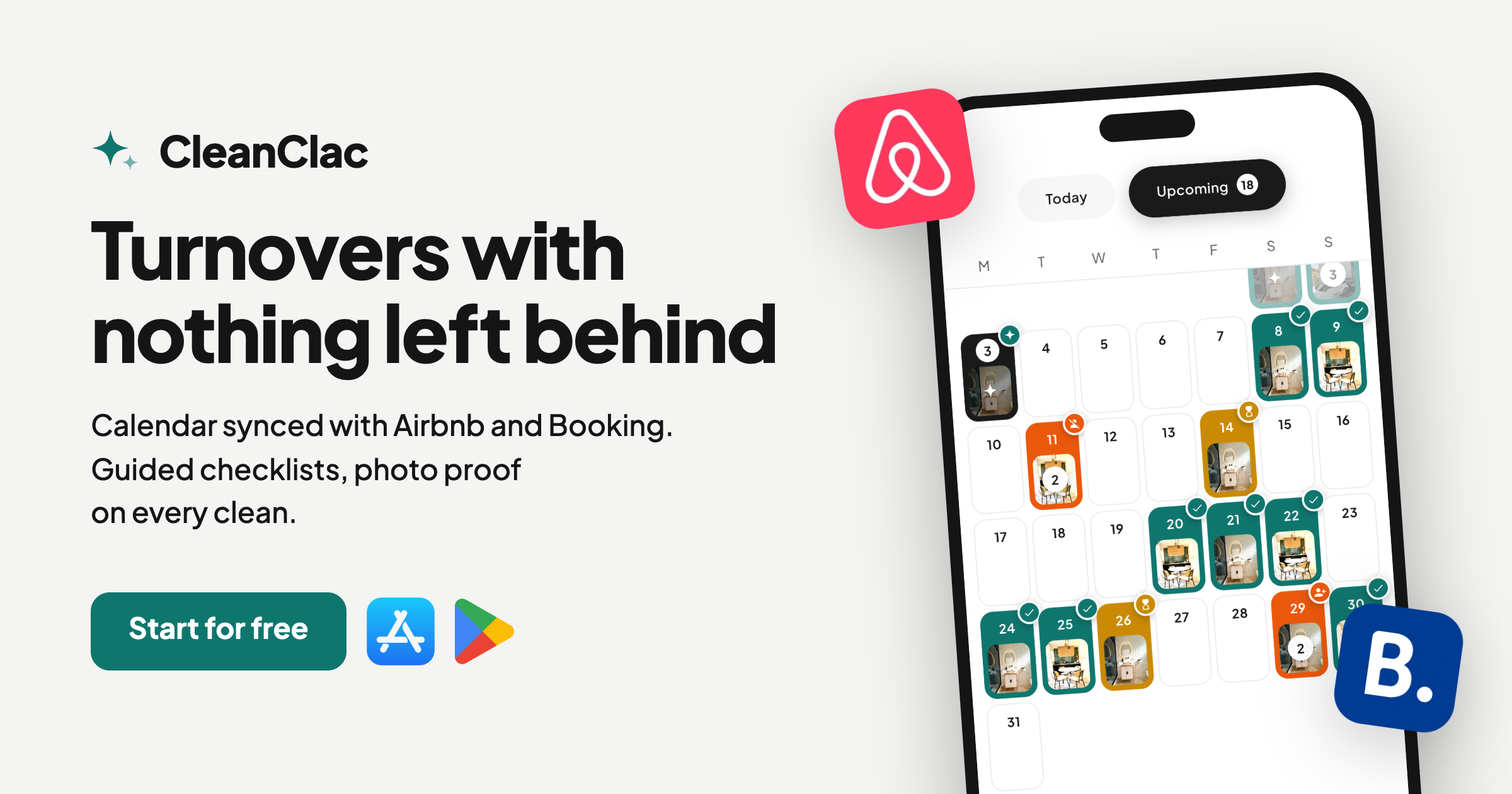
Automating every step of this workflow without spending your evenings on it is exactly what we make possible. Our app creates the job at checkout, sends the illustrated checklist to the cleaner's phone, then collects the timestamped photos that prove the property is ready.
- Automatic cleaning scheduling from your bookings, with no manual re-entry.
- Multilingual illustrated checklists to prevent misinterpretation across teams.
- Supply tracking and restocking alerts before stock runs out.
- Individual mobile access for each cleaner, with no complex setup on the manager's side.
Our pricing starts with plans scaled to the number of properties you manage. See the full details on our pricing page and start your trial today.
Frequently asked questions
Does an Airbnb need to be cleaned between stays?
Yes, a full clean between every stay is a basic guest expectation and directly affects the reviews left after checkout. The precise rules on responsibility between host and platform are set out in the official resources for hosts.
How much does an Airbnb cleaner earn per job?
Pay is most often agreed per job rather than per hour, and varies with the size of the property.
What does an hour of Airbnb cleaning cost?
The rate depends on the local market, the type of property and the level of service required, so no universal figure applies. This cost is usually built into the cleaning fee charged to guests, a strategic choice that helps recover costs without putting off bookings as long as the amount stays reasonable.
Do guests need to clean before checking out of an Airbnb?
Guests are generally expected to carry out a few basic tasks before leaving, such as taking out the bins or washing the dishes they used, but a full clean remains the host's or contractor's responsibility. The exact instructions appear in the house rules shared at the time of booking.
Sources
- Clean like a pro with these expert tips - Airbnb Resource Center
- Everything you need to know about cleaning fees - Airbnb Resource Centre
- How to Write a Vacation Rental Cleaning SOP | Welco


