Cleaning Quality Audit: Secure Every Turnover
A cleaning quality audit keeps every turnover on track. Use a checklist and timestamped photos to protect your property and reduce negative guest reviews.

Jonathan Lalinec

A cleaning quality audit ensures a property is guest-ready: verified checklist and timestamped evidence included. In practice, it is a systematic check carried out between two bookings to verify the actual condition of the property before the next guest arrives. The expected verdict is binary: "ready" or "non-compliant", documented with dated photos. Done well, this audit reduces negative reviews and limits refund requests.
In brief:
- Check the bathroom, linen, kitchen, high-touch surfaces, bins, odours and pests, then tailor the checklist to the size of the property.
- Keep timestamped photos of sensitive areas and notes on any issues found. Guests have 72 hours to report a cleanliness problem to Airbnb, and supporting evidence will be required.
- Automate task assignment from the booking calendar, but keep a human check in place. The app guides the cleaner and documents the work; it does not replace the person doing it.
- Track compliance rate, lead time before arrival, photos with no issues flagged, and recurring incidents. When the rate falls below your threshold, schedule a deep clean, retrain the cleaner, or switch to a different one.
- Build in a buffer between bookings and have a second cleaner on standby. Without a backup plan, a delay or no-show can put the next check-in at risk.
Table of contents
- Why this audit directly affects reviews and occupancy
- Essential checklist and quick control points to run at every turnover
- Automating the audit and collecting evidence: recommended workflows and mobile tools
- KPIs, report format and operational decisions after the audit
- Practical perspective: lessons learned and mistakes to avoid
- Automating the cleaning quality audit with CleanClac
- Frequently asked questions
- Sources
Why this audit directly affects reviews and occupancy
Cleanliness remains the leading factor in guest satisfaction for short-term rentals, according to Airbnb's hosting resources, which recommend specific actions between every stay. A poorly cleaned property does not just produce a one-off bad rating. It often triggers a chain of consequences that plays out over several months.
- A low cleanliness score pushes a listing down in the platform's algorithm.
- Repeated complaints increase the risk of partial or full refunds.
- A track record of negative reviews puts off the most discerning guests, who often filter by cleanliness rating.
To manage this risk, best practice is to build in enough time between bookings and to identify a backup cleaner in advance for when something goes wrong. The same hosting resources make this point clearly: a turnover with no buffer and no plan B turns any delay into a guest incident.
Essential checklist and quick control points to run at every turnover
An effective audit relies on a short checklist, completable in a few minutes depending on the size of the property, focused on high-risk areas rather than an exhaustive list that is impossible to follow in the field.
- Bathroom: check for residue, confirm clean towels are in place, and restock consumables (soap, toilet paper).
- Linen: confirm a full change of sheets and pillowcases, with no stains or lingering odours.
- Kitchen: check dishes, inside the fridge, and that appliances are working.
- Floors and high-touch surfaces: handles, light switches, remotes, worktops.
- Bins: emptied and fitted with a fresh liner.
- Odours and pests: no unusual smell, quick check of areas prone to insects.
The concrete actions recommended by Airbnb closely follow this structure: clean surfaces, change linen, empty bins, check appliances, and replenish consumables between every stay.
Photo evidence completes the checklist: a timestamped photo for each critical area, a brief note for any issue, and a digital sign-off from the cleaner to close out the job. This combination, rather than a verbal confirmation alone, protects both the property manager and the cleaner in the event of a dispute.
Pro tip: adjust the length of the checklist to the actual size of the property. A studio does not need the same control points as a six-bedroom house, and a list that is too long always ends up being ticked without being checked.
Automating the audit and collecting evidence: recommended workflows and mobile tools
The most reliable operational workflow follows a simple logic: a booking triggers automatic scheduling, which creates a task for the assigned cleaner, who follows a mobile checklist and produces a timestamped photo report at the end of the job. This sequence eliminates most of the oversights that come with manual coordination by message or shared spreadsheet.
A dedicated mobile app for cleaning teams brings several concrete advantages to this workflow:
- individual access via smartphone, with no dependence on a paper schedule or shared file;
- full traceability of every visit, timestamped and viewable remotely;
- task assignment based on cleaner availability.
The features most worth looking for to structure a reliable audit include illustrated checklists rather than text-only ones, direct integration with property management systems (PMS), and timestamped photo reports generated automatically at the end of each job. On that last point, we offer an illustrated checklist of 166 tasks and cleaning reports with timestamped photos, accessible from the dedicated mobile app for cleaners.
Individual smartphone access for each cleaner simplifies team coordination, particularly when several properties are being managed in parallel by different cleaners.
KPIs, report format and operational decisions after the audit
An audit is only useful if it leads to a decision. A handful of indicators is enough to manage quality without overwhelming the property manager with data:
- checklist compliance rate per job;
- average turnover time between the end of the clean and the next arrival;
- proportion of photos validated with no issue flagged;
- frequency of recurring incidents on the same type of point (linen, odours, appliances).
When the compliance rate falls below a threshold set by the property manager, the logical response is to schedule a one-off deep clean, retrain the cleaner concerned, or replace them if the issue keeps recurring. A good audit report stays short: a summary of the property's condition, the supporting evidence, the list of actions still open, and a named person with a clear deadline for each one.
Pro tip: always have a second cleaner identified and on standby for high-turnover slots. The time buffer between bookings is often the only real safety net when someone is absent.
Practical perspective: lessons learned and mistakes to avoid

Property managers with the best cleanliness scores share one thing in common: a single, simple standard that every cleaner can apply without having to re-read instructions. A Booking.com host rated 10 out of 10 credits their consistency to rigorous protocols rather than endless checklists.
The most common mistake is trying to manage everything on paper, with no usable evidence if a dispute arises. The second is making the whole system depend on one person, who becomes a single point of failure the moment something unexpected happens. Automating repetitive tasks and logging every incident, even minor ones, avoids both traps.
, Jonathan
Automating the cleaning quality audit with CleanClac
We built CleanClac to turn this audit into an automatic process rather than an additional mental load for the property manager. Scheduling triggers directly from Airbnb, Booking.com or Vrbo bookings, the illustrated checklist guides each cleaner from their smartphone, and the timestamped photo report arrives without any manual action on your part.
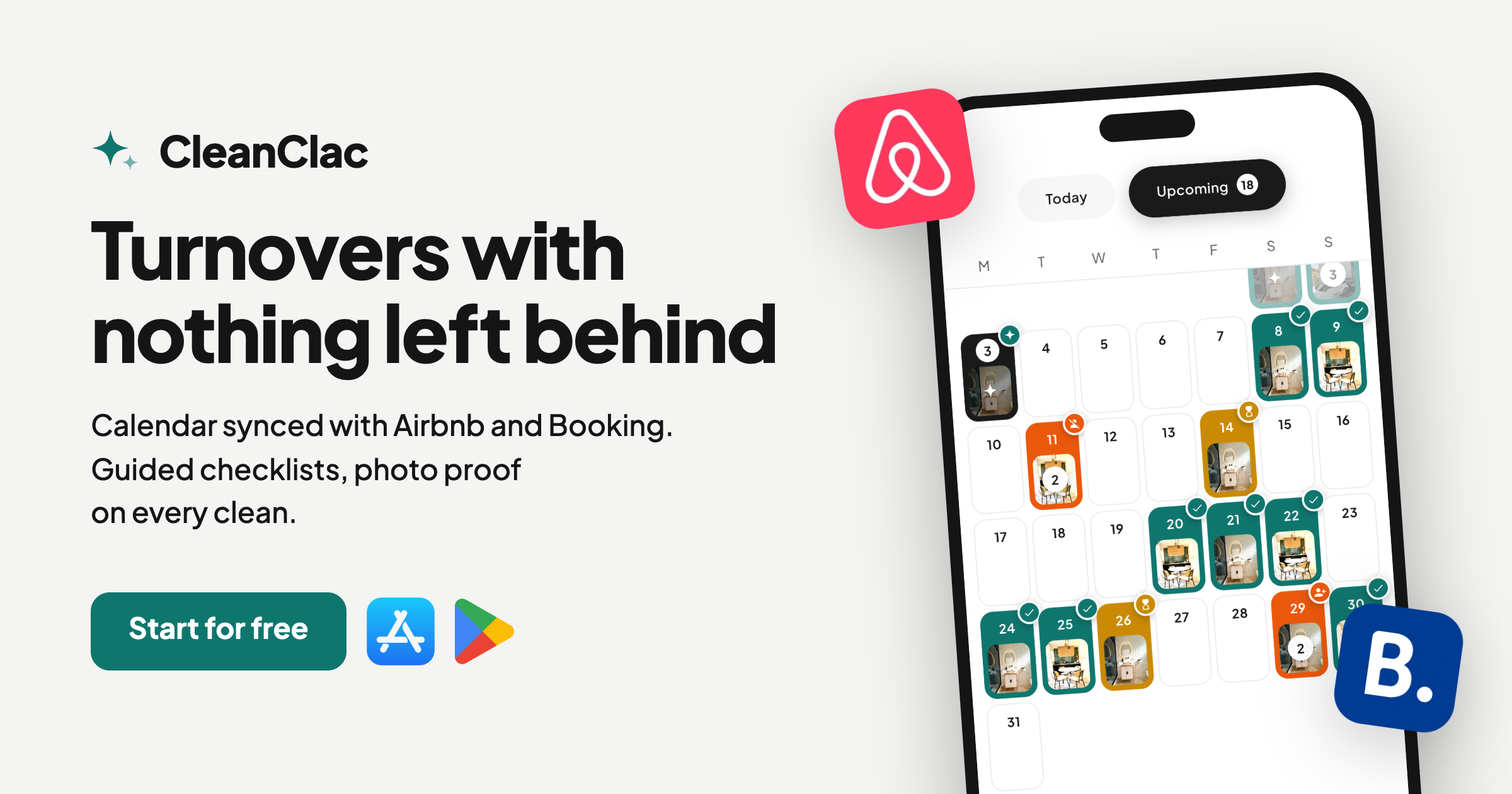
- Automatic scheduling of cleans based on the booking calendar.
- Illustrated checklists accessible from each cleaner's mobile app.
- Real-time reports with timestamped photos for every job.
- Stock and supplies tracking built into the same dashboard.
A free plan lets you test the workflow on a few properties before moving to a paid option. See the CleanClac pricing to choose the plan that fits the number of properties you manage.
Frequently asked questions
What is a cleaning quality audit in short-term rental?
It is a check carried out between two bookings to verify that the property meets a standardised checklist before the next guest arrives. It concludes with a ready or non-compliant status, supported by timestamped photo evidence.
How long should a quality check between two bookings take?
Studios and small apartments sit at the lower end of that range, family properties at the upper end.
What evidence should be kept after a clean?
Timestamped photos of critical areas, a note for any issue found, and a sign-off at the end of the job are enough in most cases. This documentation also makes it easier to handle complaints, since Airbnb gives guests 72 hours to report a cleanliness problem and asks for supporting evidence.
What should you do if a clean is judged non-compliant?
The first step is to arrange a corrective clean before the guest arrives, if time allows, or to call in a backup cleaner. The issue must then be logged in the report so its recurrence can be tracked and training adjusted if needed.
Can an app like CleanClac replace a human check?
No, it structures and documents the check carried out by the cleaner rather than replacing it. The CleanClac app guides the cleaner through an illustrated checklist and automatically generates the timestamped photo report that serves as evidence for the property manager.
Sources
- Ensuring your place is sparkling clean - Resource Center - Airbnb
- Meet the Booking.com host behind Heiligenblut's top-rated property | Click. Magazine


