4 Priority Cleaning Tasks for Property Managers
Focus your turnovers on four tasks: bathroom, kitchen, linen, and restocking. Learn how to standardize your checklist and photo inspection every time.

Jonathan Lalinec
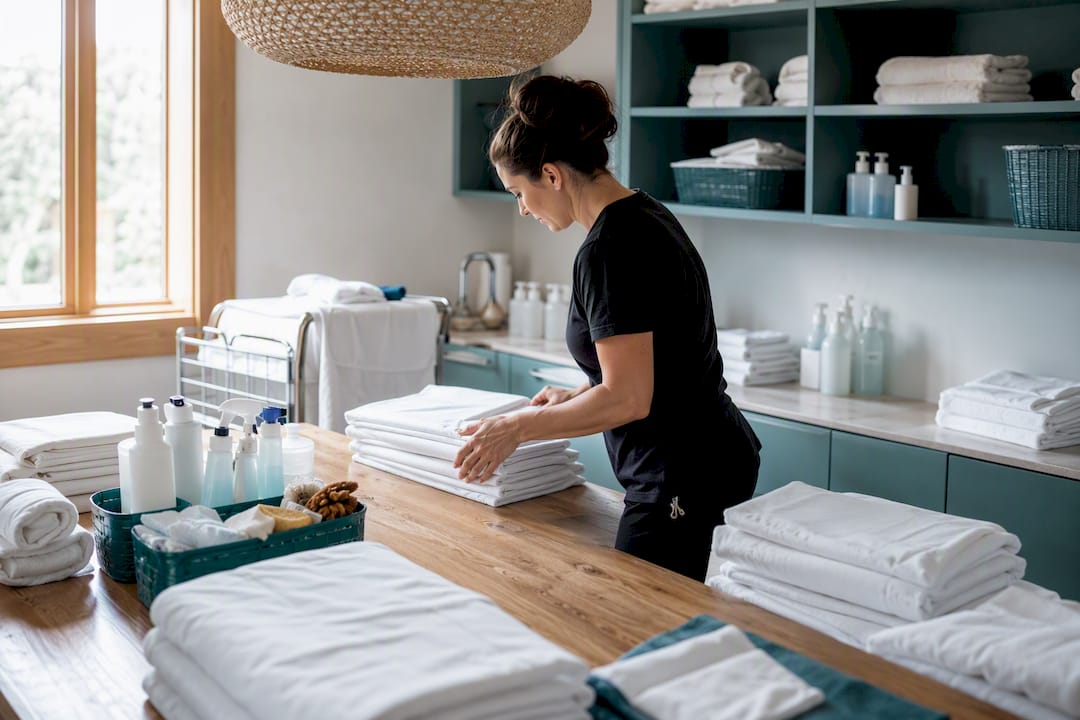
Bathroom, kitchen, linen, and consumable restocking: these are the four areas that determine whether a rental is truly guest-ready. Everything else, from descaling to interior windows, belongs in scheduled deep-clean sessions outside the turnover window. This hierarchy only works if it is backed by a written SOP and a systematic photo inspection. That is precisely what automation through an app like Cleanclac makes possible, without overloading the cleaner.
In brief:
- Cleaning priorities are: disinfect the bathroom, clean the kitchen, change all linen, and complete the photo inspection. These come first, every time.
- A standard turnover generally takes between one and three hours, at an average cost of $150 to $300 depending on the size of the property.
- Three sets of linen per bed keep turnovers flowing without depending on laundry cycle timing.
- If a major issue is found during the inspection, report it immediately, create a ticket, and block check-in if necessary.
- Scheduling a minimum four-hour window between checkout and check-in, with automatic notifications and a backup team, limits delays on same-day turns.
Table of contents
- Room-by-room priority checklist: critical, standard, time permitting
- How long to allow and how to staff a tight turnover
- How to organize linen and supplies so they never hold up a turn
- Quality control: the photo inspection that closes a turnover properly
- Standardizing operations: SOPs, automation, and what a tool like Cleanclac adds
- The one-page printable checklist and seven time-saving tips
- What operational experience really reveals about cleaning priorities
- Sources
- Frequently asked questions
Room-by-room priority checklist: critical, standard, time permitting
A successful turnover follows a logical order, not a randomly ticked list. RapidEye recommends structuring tasks into three levels: critical, standard, and time permitting. This hierarchy stops a rushed cleaner from skipping a high-impact surface to polish a secondary detail.
Critical tasks, non-negotiable:
- Bathroom: disinfect high-contact surfaces (taps, handles, light switches), replace all towels, clean the shower and toilet, wipe down all surfaces.
- Kitchen: remove any food left by the previous guests, wipe countertops, empty bins, clean visible appliance surfaces, do a quick inventory check on dishes and utensils.
- Bedrooms: strip and completely replace all bed linen, dust visible surfaces quickly, make beds with square corners, confirm that bedding and pillows are intact.
Standard tasks, to complete right after:
- Living room and entrance: quick vacuum and mop of high-traffic areas.
- Functional check: remotes present, Wi-Fi working, no visible faults.
- Minimal reset of décor to restore the original staging.
Time-permitting tasks, never to be done at the expense of the three blocks above: cleaning the oven, interior windows, dusting under furniture, descaling taps. These are sound maintenance practices, but none of them has ever caused a guest to cancel a stay. A poorly disinfected bathroom has. The logic of cleaning priorities is simple: what the guest sees and touches in the first five minutes comes before what they will never notice.
How long to allow and how to staff a tight turnover
Hostfully puts a standard turnover at between one and three hours, at an average cost of $150 to $300 depending on the market and the services included. In practice, these are the benchmarks that come up most often in the field:
- Studio: a short window is generally enough, and one cleaner covers it in most cases.
- One to two bedrooms: a moderate window with one or two cleaners depending on the time available.
- Three bedrooms and above: a longer window, requiring at least two people to avoid running over.
Key point on same-day turns: a minimum four-hour buffer between checkout and check-in, when the calendar allows, dramatically reduces the risk of delays. The moment a booking is confirmed, the automatic notification to the cleaner must go out without any manual step. That is the only way to recover the minutes that matter on a compressed window. Every schedule must also name a backup cleaner who can be reached at short notice. If a major issue appears (a leak, an electrical fault, water damage), escalating to maintenance takes priority over any cosmetic task. A clean property with an open ticket is better than a spotless one with a broken boiler.
How to organize linen and supplies so they never hold up a turn
Laundry is often the real bottleneck in a turnover, not the cleaning itself. The most reliable solution is the par level system: three sets of linen per bed, one in use with the current guest, one clean and ready in reserve, and a third in the wash. This rotation handles same-day turns without depending on the exact timing of the laundry cycle.
Two options exist for washing linen:
- On-site laundry: easier to organize, often lower cost per unit, but limited capacity depending on the number of machines and a risk of bottlenecks in peak season.
- External laundry service: near-unlimited capacity and consistent quality, but a longer turnaround time and generally a higher cost per kilogram.
Pre-packing supply kits (toiletry items, coffee pods, toilet paper, welcome products) has a real impact on execution speed. A cleaner who arrives to find a ready kit saves several minutes per turnover. Across dozens of monthly turns, that adds up quickly.
Pro tip: Assemble your restock kits the evening before a heavy rotation day, not the morning of. A missing item discovered mid-clean turns a two-minute job into a twenty-minute round trip.
The consumable stock check must be built into the final inspection, not handled separately. The cleaner verifies and flags stock levels at the same moment they sign off on the cleanliness of the property.
Quality control: the photo inspection that closes a turnover properly
A turnover does not end when the cleaning is finished. It ends when proof exists that the cleaning meets the standard. Both Hostfully and RapidEye recommend photos as a closing proof, not as an administrative formality.
The photo checklist covers at least four areas:
- Bathroom, to confirm disinfection and the absence of hair or residue.
- Made bed, wide-angle shot showing linen and pillows in place.
- Clean kitchen, with countertops and appliance surfaces visibly clear.
- Living area, to verify staging and confirm no items have been left behind.
Before leaving the property, the cleaner does a final walk-through: lighting working, electronics operational, locks closing correctly, no suspicious odors, linen condition matching the expected inventory.
When an issue is found (broken equipment, a stubborn stain, a lingering smell), the escalation workflow follows three steps: immediate report, creation of a maintenance ticket, notification to the manager with a check-in block if the issue is critical. The combination of a sequenced workflow and a named backup cleaner is one of the most reliable ways to hold a tight turnover window without sacrificing quality. The photo record also protects the host in the event of a guest dispute, and it puts direct accountability on the cleaner for the result they deliver. That accountability consistently translates into better cleanliness scores.
Standardizing operations: SOPs, automation, and what a tool like Cleanclac adds
A cleaning SOP is simply a written contract between the property manager and the cleaner: the expected result, the precise sequence of steps, and the proof required at the end. This principle sits at the heart of end-of-tenancy cleaning in Lausanne. Smoobu emphasizes the need for visual aids and formalized checklists to keep results consistent across team members, especially when multiple cleaners rotate across the same portfolio of properties.
Automation turns that SOP into a process that runs itself:
- Instant notification the moment a booking confirms a cleaning slot.
- Automatic assignment to the available cleaner, with a visual flag on same-day turns.
- A photo log the manager can consult at any time, without a phone call.
- Real-time reports on the status of each property, accessible from a single dashboard.
Cleanclac is built around this logic. Each cleaner has individual access from their smartphone, consumable stock tracking prevents mid-season shortages, and real-time reports reach the manager directly without any manual data entry.
A checklist that lives in a mobile app, with a mandatory photo before the task can be closed, turns a fragile verbal instruction into verifiable proof at every turnover.
For a practical guide to building a cleaning SOP, the guides on organizing cleaning operations explain how to sequence a checklist and a photo inspection within a single workflow.
The one-page printable checklist and seven time-saving tips
Recommended execution order for the wall checklist: bathroom, kitchen, linen, bedrooms, living area, restocking, photo inspection. The first three items stay in bold. They are the ones that determine how the next guest rates their stay.
Seven operational tips to make your turnovers more reliable:
- Pre-stage restock kits the evening before busy days.
- Photograph the four key areas every time, without exception, before leaving the property.
- Build a roster of several backup cleaners, not just one.
- Consider a quality bonus tied to the absence of guest complaints.
- Keep a check-in buffer whenever the booking calendar allows it.
- Communicate same-day turns as soon as the booking is confirmed, never at the last minute.
- Integrate the checklist into a mobile workflow where the cleaner ticks tasks and submits photos directly from their phone.
Pro tip: Post a laminated copy of the checklist in each property alongside the digital version. If the network goes down, the cleaner still has a reliable physical reference.
What operational experience really reveals about cleaning priorities
Most guides list tasks without ever making the real trade-off explicit: what do you cut when time runs short? That is the only question that matters for a manager stuck with 90 minutes between two bookings. The honest answer is that descaling, windows, and cleaning under furniture should never appear on the same list as bathroom disinfection. Mixing them into a single checklist without priority levels is the most common mistake, and the most costly one when the window is tight.
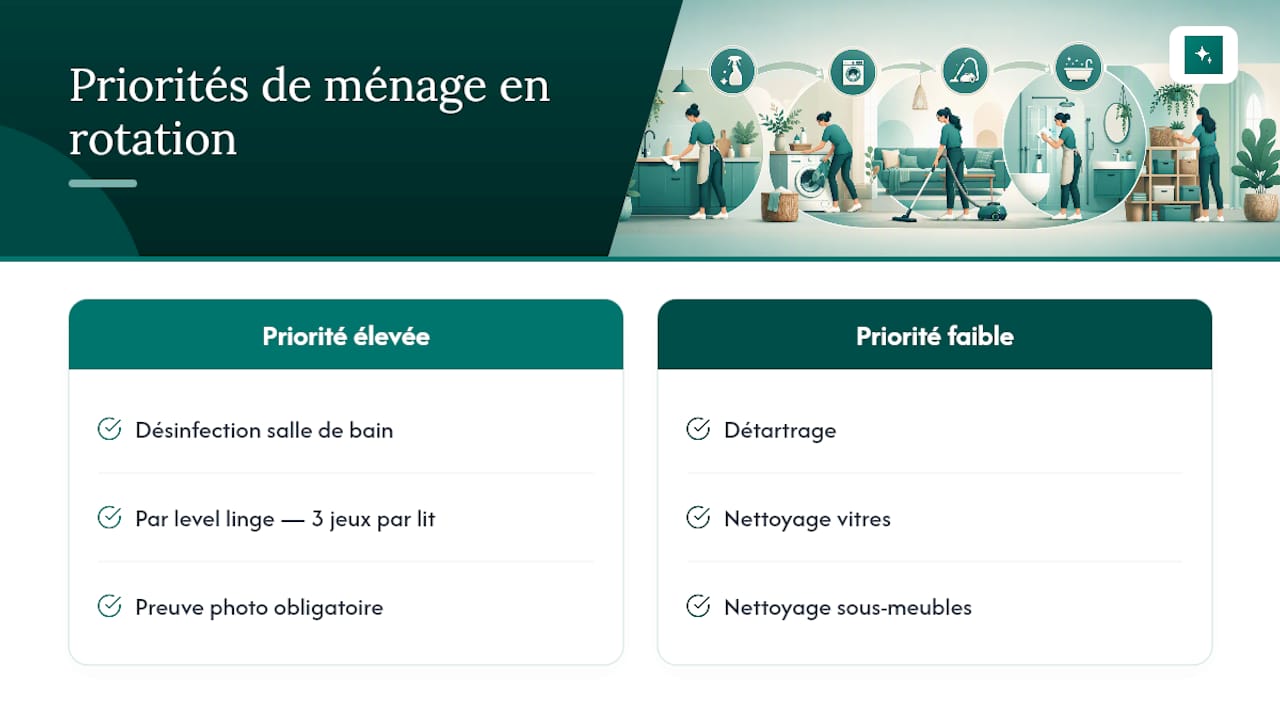
The other classic blind spot is linen. Many managers underestimate the par level they need and only discover the problem on a high-occupancy day. Three sets per bed is not a luxury. It is the minimum insurance against a laundry delay.
Finally, photo documentation is not one more administrative burden. It is the only mechanism that holds a cleaner genuinely accountable without a manager having to follow up behind them. Teams that adopt it typically see fewer guest disputes, not more workload.
, Jonathan
Sources
- Vacation Rental Turnover Cleaning: How to Nail Same-Day Turns (2026) | Hostfully
- Vacation Rental Turnover Cleaning Checklist (2026) | RapidEye
- Vacation Rental Turnover Cleaning: The 4-Hour System
Frequently asked questions
What are the highest-priority cleaning tasks during a turnover?
Disinfecting the bathroom, cleaning the kitchen, changing all linen, and restocking consumables come before anything else, with a photo inspection to close out the process.
How long does a standard turnover take?
A standard turnover generally takes between one and three hours, depending on the size of the property and the services included, at an average cost of $150 to $300.
How many sets of linen should you have per bed?
Three sets per bed are recommended: one in use with the guest, one clean and ready in reserve, and a third in the wash. This rotation handles same-day turns without depending on the laundry cycle timing.
What should you do if a major issue is found during the inspection?
The cleaner reports the problem immediately, a maintenance ticket is created, the manager is notified, and the next check-in is blocked if the issue would affect the incoming guest's stay.
How do you manage a same-day turn without risking delays?
A minimum four-hour buffer between checkout and check-in, an automatic notification sent as soon as a booking is confirmed, and a named backup cleaner all significantly reduce the risk of running over, as shown by the four-hour system described by AllBetter.


