Minimum Equipment for Short-Term Rental Turnover Cleaning
Avoid delays between guests: get the minimum equipment list for rental turnovers, set your PAR levels, and track supplies before a shortage hits.

Jonathan Lalinec

Equipment alone is not enough. Without defined PAR levels and stock tracking, shortages and turnover delays become inevitable. You can automate that tracking rather than managing it by hand.
In brief:
- A PAR of 3 is the recommended starting point, then adjusted after four to six weeks of operation based on occupancy rate and laundry turnaround time.
- Real-time stock management through automated tracking prevents shortages and keeps equipment and linen available when you need them.
- Training teams to use safety data sheets (SDS) and providing them with basic personal protective equipment is essential for their safety.
- Careful cart setup by property type, with photo checklists, speeds up cleaning and keeps it traceable.
- Working with a backup supplier or keeping emergency stock prevents PAR shortages from affecting check-in.
Table of contents
- Which checklist to follow by equipment category
- How to calculate and maintain PAR levels for linen and consumables
- How to organise the cleaner's kit to save time
- What safety and SDS requirements to meet
- How to manage linen rotation and laundry cycles
- Which quality-control checklist to complete before guests arrive
- What property managers' experience reveals about equipment and PAR levels
- How to try CleanClac to track equipment and schedules
- Frequently asked questions
- Sources
Which checklist to follow by equipment category
A prioritised checklist prevents the oversights that delay a turnover or undermine the cleanliness guests perceive on arrival. Here are the categories every team should cover before leaving a property.
- Major equipment: a compact professional vacuum cleaner, manoeuvrable enough for stairs and tight spaces, and a utility hair dryer to speed up drying of certain textiles.
- Manual tools: microfibre mop with wringer bucket, broom, duster, window scraper and toilet brushes.
- Cleaning products: multi-surface cleaner, approved disinfectant, bathroom cleaner, glass cleaner and odour neutraliser.
- Linen: complete sheet sets, mattress protectors and pillowcase covers, sized to the PAR level chosen for each property type.
- Consumables: toilet paper, hand soap, bin bags and laundry pods or capsules.
- Safety: disposable gloves, masks and safety glasses, in line with the protocol set for each product.
Organisation matters as much as the contents. One cart per job, a quality-control pouch tucked into the kit and a dedicated bag for soiled linen cut unnecessary back-and-forth and reduce time on site.
Pro tip: Number your carts and match each number to a property type (studio, one-bed, house) so any cleaner can see at a glance what to bring.
How to calculate and maintain PAR levels for linen and consumables
PAR (Periodic Automatic Replacement) refers to the number of complete linen sets you need to hold in stock so a property stays operational without waiting for a laundry return. A studio can run on a lower PAR than a house hosting families, where bedding is bulkier and wash times are longer.
- Assess your turnover frequency: a high occupancy rate calls for a higher PAR, because linen moves faster between washing and being put back in place.
- Factor in laundry turnaround time: the longer the wash-and-delivery cycle, the more buffer stock you need to avoid a shortage.
- Account for real storage capacity: a high theoretical PAR is useless if your storage space does not allow it to be kept properly.
- Start with a PAR of 3 for most properties, a common practice in the hospitality industry, then adjust after four to six weeks of operation according to sector recommendations.
- Audit stock regularly and formalise a relationship with a preferred supplier: this often unlocks wholesale pricing and faster delivery in an emergency, as the VRHP guide notes.
Always have a contingency plan: a backup supplier or an emergency stock prevents a PAR shortage from blocking a check-in.
How to organise the cleaner's kit to save time
A standard cart holds the essential manual tools, products and consumables listed above, but its contents vary by property size. A studio needs less linen and fewer consumables than a multi-bedroom house.
- Pre-assemble carts by property type and store them labelled, ready to pick up without any additional checking.
- Assign each job with a photo checklist at arrival and checkout to document the property's condition objectively, without dispute.
- Trigger a reorder as soon as a stock threshold is reached, rather than waiting for a complete shortage.
Starting a wash cycle at the beginning of the turnover frees up active time, with the machine running while the team works through the rest of the property. It is one of the simplest ways to reduce the total length of a job.
Pro tip: Link each cart to a digital record in your tracking tool. As soon as a product is flagged as missing, the alert goes straight to the property manager automatically.

What safety and SDS requirements to meet
Protecting cleaning teams starts with a minimum set of personal protective equipment and accessible documentation on the products being used.
- Always provide gloves, masks and safety glasses, with additional protection for concentrated or nebulised products.
- Keep safety data sheets (SDS) within reach and train teams to read them correctly, as the VRHP guide recommends.
- Document employer responsibilities for chemical safety and keep a written record of every training session delivered.
- Put a clear chemical incident procedure in place, with systematic logging of every event, even a minor one.
Institutional housekeeping procedures stress that safe storage and regular tool maintenance prevent equipment deterioration and the hygiene risks that come with it.
How to manage linen rotation and laundry cycles
Linen management directly determines property availability and the cleanliness guests perceive on arrival.
- Choose cycles suited to hygiene standards: use the temperatures and durations recommended for hospitality linen rather than a minimal wash.
- Compare in-house laundry with an external provider on cost, turnaround, finish quality and capacity to absorb peak demand.
- Start the wash at the beginning of the turnover and label clean and soiled linen to keep a clear chain of custody between jobs.
- Have a contingency plan for a PAR shortage: temporary outsourcing or a short-term adjustment to the rotation rather than pushing back a check-in.
Working with a preferred janitorial supplier often makes it easier to scale up during high-occupancy periods, a point the New York housekeeping procedures directive links directly to PAR level availability.
Which quality-control checklist to complete before guests arrive
Before every check-in, a quick final check prevents the majority of cleanliness complaints.
- Check the bathrooms, bedding, kitchen, absence of residual odours, emptied bins and the operation of the main appliances.
- Take photos systematically and send a brief report to the property manager, with clear rejection criteria and an immediate remediation procedure if a point fails.
- Track these checks in a dashboard to spot non-conformance trends by property or by team.
Written procedures and staff training durably reduce turnover errors, according to VRHP recommendations for professional property managers. Documenting every step makes audits faster and deviations easier to correct.
What property managers' experience reveals about equipment and PAR levels

Property managers who structure their PAR levels and standardised kits gain predictability: fewer shortages, fewer unnecessary trips, fewer undocumented incidents. What often makes the difference is not the quantity of equipment held, but real-time visibility into what is missing. Mobile access for every cleaner, instant reports and stock tracking let you adjust PAR levels before a shortage blocks a check-in rather than after.
The most practical advice is to set up your PAR levels and carts in a dedicated tool, then watch a month of real data before adjusting quantities.
, Jonathan
How to try CleanClac to track equipment and schedules
We offer an app designed for the operational management of turnover cleans, with mobile access for every cleaner and real-time tracking of stock and performance. Unlike a paper list or a shared spreadsheet, our tool triggers an alert as soon as a reorder threshold is reached, preventing PAR shortages mid-turnover.
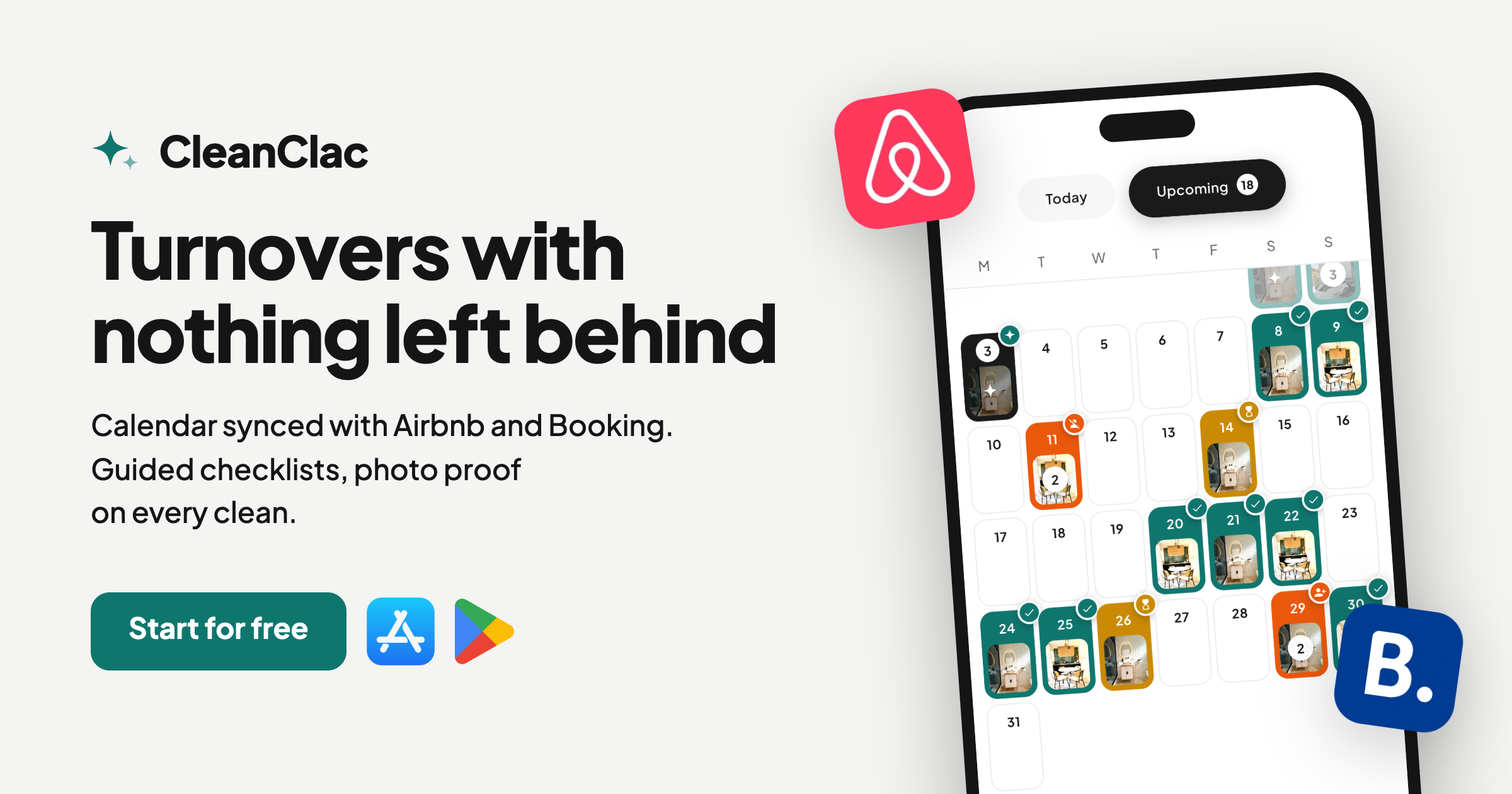
- Create an account and set up one or two properties to test how the cleaning management app works in practice.
- Define your PAR levels for linen and consumables, then assemble a first standard cart for each property type.
- Assign a first job to a cleaner and check the photo report you receive in return.
Our tool supports tracking, photo evidence and job reports, but it does not replace team training or the written safety procedures described above. Check our pricing by number of properties managed to choose the right plan for your portfolio, or explore the app for cleaners if you manage a team in the field.
Frequently asked questions
What is the minimum recommended PAR to start with?
A PAR of 3 is a widely used starting point in the hospitality industry for most properties, according to sector best practice. Adjust that level after four to six weeks of real operation, based on your occupancy rate and laundry turnaround time.
Do you need a single supplier for all cleaning products?
Working with a preferred janitorial supplier often makes it easier to get wholesale pricing and product training, as the VRHP guide notes. Even so, keep a backup option to avoid being left exposed if that supplier runs out of stock.
What safety equipment is essential for the cleaning team?
Disposable gloves, masks and safety glasses form the minimum baseline, with extra protection required for concentrated or nebulised products. Safety data sheets must be kept accessible and explained to every cleaner before they use any product.
How do you avoid a stock shortage during a turnover?
Real-time PAR level tracking and automatic reorder alerts greatly reduce that risk. Having a contingency plan, such as a backup supplier or an on-demand partner found through a cleaning company directory, covers unexpected situations.
Does CleanClac let you track equipment and linen stock?
Yes, our app includes stock and supply tracking with automatic reorder alerts. Pricing varies by the number of properties managed, from €9.99 per month for two properties to larger plans detailed on our pricing page.
Sources
- VRHP Cleaning Guidelines for Professional Vacation Rental Managers
- Directive 3901R-B - Housekeeping Procedures
- Keeping your PAR levels up to par


