Automate Turnover Cleaning Without Scheduling Errors
Learn how to connect your bookings to a cleaning app that creates and assigns tasks automatically, so every turnover runs on time without manual coordination.

Jonathan Lalinec

Automate your turnover cleaning schedules through an app connected to your bookings. Eliminate calendar mistakes and cut the time you spend on coordination. Every confirmed or updated reservation on Airbnb or Booking triggers a cleaning task and notifies the right cleaner automatically. That is the principle we apply at CleanClac, and it concretely changes the way you manage a short-term rental portfolio.
In brief:
- Automatically syncing reservations with Airbnb or Booking.com cuts errors and the time spent on manual coordination considerably.
- Validating a clean with visual proof and automatically reassigning tasks when something goes wrong increases process reliability and guest satisfaction.
- Turnover duration varies with property size, but consistent timing and precise time-stamping help you optimise quality and handle unexpected issues.
- Checking digital evidence in the event of a dispute allows an objective assessment of cleaning quality, which is essential for avoiding conflict with guests.
Table of contents
- When and why to automate turnover cleaning
- Practical criteria for choosing an automation solution
- Recommended workflow for managing cleans between bookings
- Handling unexpected issues and improving reliability
- Costs and pricing models to plan for
- Average duration of a full property turnover clean
- Measuring the effectiveness and quality of turnover cleaning
- Key questions to ask cleaning providers before you commit
- Handling disputes and service guarantees
- Comparing SaaS solutions and customer feedback
- A practical perspective on adopting automation
- Our solution: how it meets automation needs
- Frequently asked questions
- Useful resources to go further
- Sources
When and why to automate turnover cleaning
Beyond two or three properties, coordinating cleans manually quickly becomes unmanageable. A spreadsheet or message thread is enough for a single listing, but as bookings overlap across multiple properties, missed tasks and double-booked cleaning slots start to pile up.
Three signals tell you it is time to move to an automated solution: a turnover volume that exceeds your capacity to track manually, recurring scheduling errors that cause failed checkouts, or an outsourced cleaning team whose availability changes frequently. In these situations, every minute spent confirming a slot by phone is a minute taken away from actually managing the rental.
The benefits are concrete: less time spent on coordination, fewer delayed check-ins because a property is not ready, and more consistent cleaning quality, which feeds directly into the reviews guests leave.
The typical use cases are multi-property managers, teams working with external providers rather than a single dedicated cleaner, and operators subject to strong seasonality where booking volume can double in just a few weeks. In all three cases, automatic sync between bookings and the cleaning schedule becomes a genuine operational lever rather than a nice-to-have.
Practical criteria for choosing an automation solution
Before committing to a tool, it is worth checking that it covers the points that actually make a difference day to day. A solution that falls short on even one of these will always generate extra manual work and cancel out part of the expected gain.
- Real-time sync with Airbnb, Booking.com and the main property management systems must create the cleaning task without any human input.
- A mobile interface for cleaners must let them confirm the assignment and submit proof of completion, photo or report, directly from the property.
- Automatic assignment based on priority rules, with the option of manual reassignment, avoids depending on a single point of contact.
- Supply tracking and stock alerts prevent linen or product shortages before they become a problem.
- A full audit trail and data export make it possible to document every clean in the event of a dispute or quality review.
Pro tip: Test the reliability of the notifications sent to cleaners before judging a solution on its secondary features. A task that does not arrive at the right time makes everything else pointless.
We go into detail on these models in our page on the cost of Airbnb cleaning software.
Recommended workflow for managing cleans between bookings
A well-designed workflow relies on a precise sequence of steps that run without manual intervention, from the moment a booking is made to the moment the next guest arrives.
- The booking is recorded on the platform (Airbnb, Booking.com, Vrbo) and automatically triggers the creation of a cleaning task with the date and time of the slot.
- The available cleaner receives a notification on their phone, confirms they are taking the job, and gets access to the property-specific checklist built into the app.
- Once the clean is done, the cleaner submits visual proof, a photo or short video, which is validated in the manager's dashboard before the property is opened for the next check-in.
- If something goes wrong, whether a delay or an absence, the system allows quick reassignment to another available cleaner without going back to manual coordination.
This structure eliminates grey areas where nobody is sure who is supposed to act. It gives the manager a constant, accurate view of every property's status without having to call anyone to confirm.
Handling unexpected issues and improving reliability
An automated system reduces errors, but it does not eliminate unexpected problems: a cleaner running late, a last-minute cancellation, a late checkout overlapping with an early check-in. The goal is to limit their impact rather than hope to avoid them entirely.
- Build buffer windows between bookings where the calendar allows, to absorb minor delays without affecting the check-in.
- Set up automatic reassignment rules that switch the task to a backup cleaner if confirmation does not arrive within a set time.
- Keep a directory of local cleaning companies on hand to find a replacement quickly when a cleaner is unexpectedly unavailable.
- Track simple metrics, such as the on-time confirmation rate or the number of reassignments per month, to identify recurring friction points.
Pro tip: Always send each cleaner a written, standardised brief rather than a verbal instruction. It significantly reduces misunderstandings about the expected state of the property.
Costs and pricing models to plan for
Two main pricing approaches coexist in the cleaning management software market: a subscription per active property and a per-job fee. The first suits a manager with a stable portfolio better. The second may seem more flexible but becomes expensive as turnover volume grows.
Integration costs are generally limited for this type of tool. Most of the time involved goes into training cleaners on the mobile app and configuring the initial checklists for each property.
Estimating the return on investment is straightforward: multiply the number of coordination hours saved each month by your management hourly rate, then compare that figure to the subscription cost. Across a portfolio of five properties where manual coordination takes several hours a week, the balance tips quickly in favour of automation.
Our practical advice: start with a small scope, one to three properties, before rolling the tool out across your full portfolio. This lets you refine checklist settings and assignment rules without risking disruption to the whole operation.
Average duration of a full property turnover clean
The duration of a turnover clean depends mainly on the size of the property and the standard the manager sets, but the process generally follows the same steps: a quick condition check, changing the linen, cleaning the wet rooms, tidying throughout, and a final walkthrough with the checklist.

A studio or small flat takes less time than a multi-bedroom house, and features such as a pool or garden add to the job. What matters most to the manager is not the exact duration but its consistency: the same property should take roughly the same time at each turnover. A significant variation usually signals a problem with the method or an incomplete checklist rather than cleaner negligence.
This is where the automatic start and end time-stamping available in the cleaner's app becomes useful. It lets you spot abnormal duration gaps and adjust the checklist or training accordingly, rather than defaulting to suspicion.
Measuring the effectiveness and quality of turnover cleaning
Assessing the quality of a clean goes beyond a general impression at the next check-in. Three concrete elements allow a reliable evaluation: compliance with the property-specific checklist, the photo or video proof submitted by the cleaner, and the guest's actual feedback once they have settled in.
A dashboard that brings these three sources together gives an objective view of each cleaner's performance, without relying solely on the manager's memory or a phone call after the fact. Real-time property status reports, accessible from the app, confirm that a property is genuinely ready before the next guest arrives, rather than depending on a verbal confirmation.
Tracking these indicators over time also reveals useful trends: a cleaner whose job duration is gradually increasing, or a property where proof photos regularly lack sharpness on specific points such as the kitchen or bathroom. This structured monitoring is far more reliable than gut feeling, especially when several cleaners work across the same portfolio.
Key questions to ask cleaning providers before you commit
Before handing cleans over to an external provider, a few questions will help you avoid the most common pitfalls. Start by asking how they handle peak periods. A provider who cannot manage several turnovers on the same day quickly becomes a bottleneck in high season.
Ask also about their substitution policy when a cleaner is absent. Do they have a pool of backup staff, or does the service grind to a halt whenever one person is unavailable? This question reveals a provider's real reliability far more clearly than any sales pitch.
Check what proof of completion they can provide: systematic photos, a written report, or just a verbal confirmation. A provider who documents every job makes it much easier to resolve a potential dispute with an unhappy guest.
Finally, clarify the billing terms for late booking cancellations. Some providers charge for a blocked slot even when no clean takes place; others do not. This clause, often buried at the bottom of a contract, has a real impact on your annual budget.
Handling disputes and service guarantees
A poor clean or a missed slot almost always leads to a tense exchange with the next guest and sometimes a partial refund. The best protection is a clear audit trail: a precise timestamp and a photo of the property before check-in allow you to document objectively what was done and by whom.
When a fault is reported, the first step is to compare the checklist the cleaner signed off against the guest's complaint, rather than ruling on the basis of one account alone. This documentation also serves as a foundation for any discussion with an external provider about compensation or a free redo.
Contractual guarantees vary considerably between providers. Some offer a free redo within 24 hours; others limit themselves to a one-off goodwill gesture. It is better to clarify this before the first job rather than at the moment of a dispute, when the relationship is already under strain.
For managers working with several cleaners, keeping a structured log of incidents by cleaner helps you quickly identify who is reliable and who is accumulating problems, without waiting for a negative guest review to surface the issue too late.

Comparing SaaS solutions and customer feedback
Some solutions offer a very complete dashboard but require more initial configuration; others prioritise quick onboarding at the cost of more limited supply tracking features.
Our 2026 comparisons page details these positioning differences to help a manager identify their priorities before choosing. User feedback generally converges on one point: the reliability of notifications sent to cleaners matters more to day-to-day satisfaction than the number of features listed on a spec sheet.
The pricing model also strongly influences the final choice. A per-active-property subscription suits a stable portfolio better, while per-job billing can seem flexible at first but becomes costly as turnover volume climbs. We break down these pricing models in our page on Airbnb cleaning marketplaces, which is useful for comparing approaches before committing.
A practical perspective on adopting automation
The temptation is often to automate everything in the first month. It is better to start with booking sync and cleaner notifications, the core operational gain, before adding detailed stock management or advanced reporting.
Involve your cleaners from the pilot phase rather than after the fact. They are the ones who surface real friction in a checklist or a poorly timed notification. Then track two or three simple metrics during the first few weeks and adjust before rolling out to your full portfolio.
, Jonathan
Our solution: how it meets automation needs
We have built our app around the criteria detailed above: automatic sync with bookings, individual mobile access for each cleaner, real-time property status reports, and supply tracking with stock alerts.
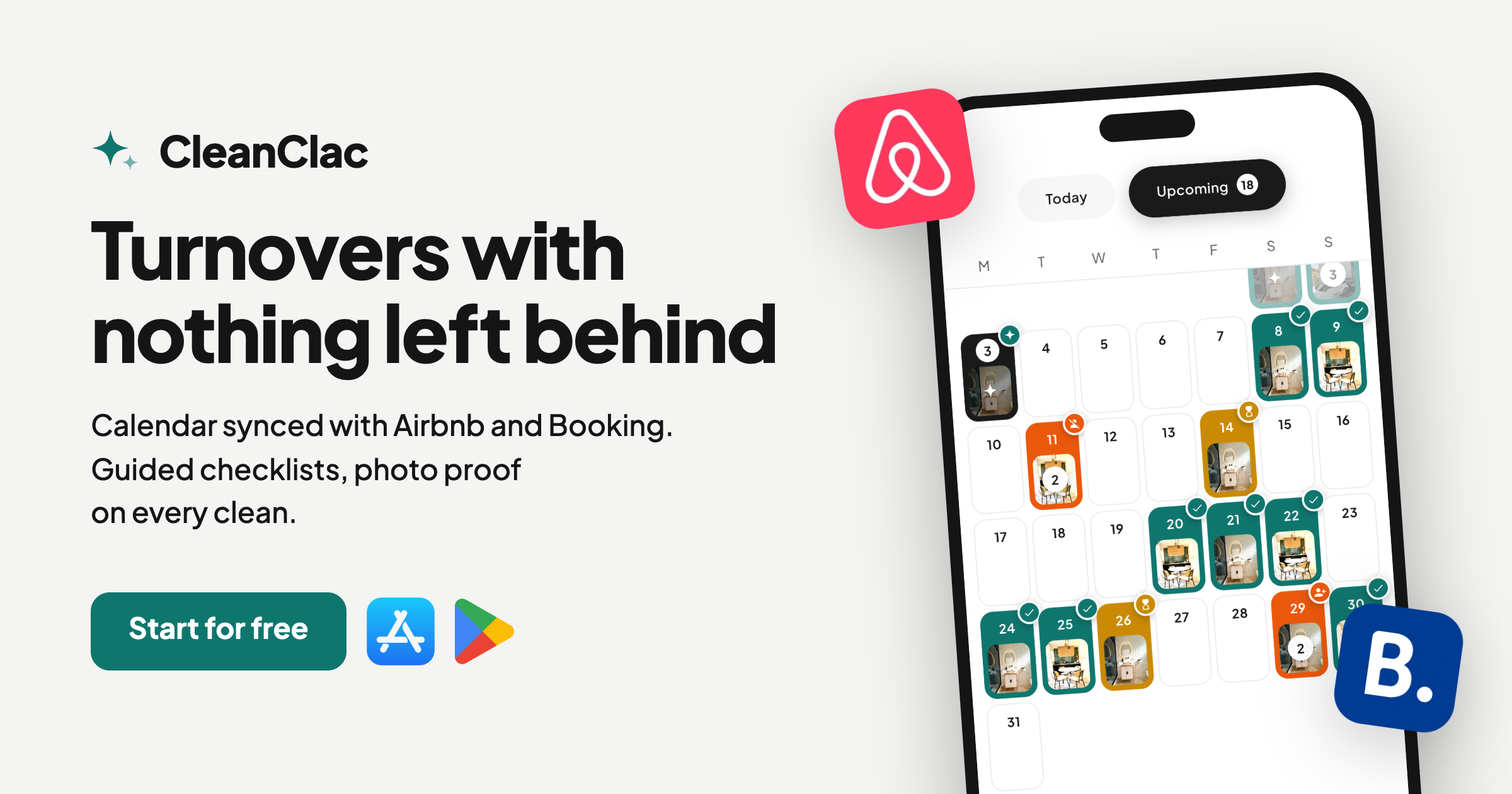
- Dedicated mobile access for each cleaner lets them submit proof of completion without going through a third party.
- Per-property linen and product stock tracking helps you anticipate shortages before they become a problem.
- We offer several plans based on the number of properties managed, available on our pricing page.
- We provide a dedicated app for cleaners to streamline their daily use on the ground.
To assess these benefits in practice, we recommend trying our cleaning management app on one to three properties before rolling it out across your full portfolio.
Frequently asked questions
How do you automate cleaning scheduling between two bookings?
Connect your booking calendar, Airbnb or Booking.com for example, to an app that automatically creates a cleaning task for every new reservation. The available cleaner then receives a direct notification on their phone with no manual input from you.
What is the average duration of a full turnover clean?
What matters most is consistency from one visit to the next, tracked through the automatic time-stamping of assignments in the cleaner's app.
What should you do if a cleaner is unexpectedly unavailable?
The most effective approach is to have an automatic reassignment rule that switches the task to a backup cleaner, combined with a directory of local cleaning companies to contact as a last resort. This two-layer safety net prevents an isolated problem from delaying a check-in.
How much does a cleaning management app like CleanClac cost?
Our plans start at 9.99 € per month for two properties, with tiers at 14.99 € per month for three or four properties and 19.99 € per month for five properties, with each additional property charged at 4 € per month. An annual subscription is also available, starting at 59.99 € per year for two properties.
How do you prove the quality of a clean if a guest raises a dispute?
The strongest evidence is a time-stamped photo or short video sent by the cleaner immediately after the job and stored in the manager's dashboard. Cross-referenced with the validated checklist, it allows you to settle a disagreement objectively rather than relying on one side of the story.
Useful resources to go further
Visit our pricing page to try a plan, our provider directory for backup cleaners, or our practical guides on automation.
Sources
- Cost of Airbnb cleaning software in 2026
- Airbnb cleaning marketplaces: the 2026 comparison
- 2026 comparisons: which cleaning software to choose
- Cleaning management app for Airbnb and Booking.com
- The app for cleaners
- Tools and automation: our guides for short-term rentals
- Free, 2 properties, 3 or 4 properties and 2 more plans
- 2 properties, 5 properties, Additional property


