Lost Items in Short-Term Rentals: the Protocol to Follow
Handle lost items in your short-term rental the right way: secure, photograph with timestamps, assign a contact person, and organise the return.

Jonathan Lalinec

Assign a reachable contact person, secure the item, and photograph it with a timestamp. That is the rule to follow from the moment something is found. That contact then reaches out to the guest via the platform's messaging system to arrange the return, temporary storage, or, for sensitive items, handover to the relevant authorities.
In brief:
- Taking timestamped photos and logging the item in a specific category straight away prevents disputes and makes lost property management easier.
- Systematic documentation with a unique identifier, a factual description, and the precise location reduces the risk of mix-ups or lost evidence.
- Contact through the platform's messaging system should always come first, with a response deadline set and every exchange kept on record to protect the return process.
- Sensitive or high-value items must be reported to the authorities or handled with extra care, unlike everyday objects.
- Retention periods for personal data and photos must be limited in line with data protection principles, then deleted or anonymised.
Table of contents
- Immediate checklist (0 to 24 hours): actions to take the moment something is found
- Inventory and chain of custody: documenting without overcomplicating the work
- How to contact the guest and organise the return
- Item categorisation, escalation and personal data compliance
- Message templates and integration with your management tools
- What a simple protocol really changes for a host
- CleanClac simplifies lost item tracking after the clean
- Frequently asked questions
- Sources
Immediate checklist (0 to 24 hours): actions to take the moment something is found
As soon as a cleaner or host reports a forgotten item, the following sequence prevents loss of evidence and later disputes.
- Secure the item in a labelled bag or box showing the date and booking number.
- Take three timestamped photos: the item itself, its original location in the property, and the inventory label placed on it.
- Fill in a quick record with three minimum pieces of information: who found it, at what time, and in which exact room.
- Avoid posting an unmasked image on a public network or a host group, as this can expose the guest's personal information.
- Categorise the item immediately as A, B or C to guide the next steps.
Pro tip: ask your cleaning team to take the photos before moving the item. The original angle often serves as evidence if there is a disagreement about exactly where it was found.
The short-term rental accommodation industry code of conduct for New South Wales reflects this logic: it recommends that a host or their representative remain contactable and document every incident, which requires an identified contact person and a written procedure rather than informal, case-by-case handling.
Inventory and chain of custody: documenting without overcomplicating the work
A useful inventory does not require complex software, but it must cover six fixed fields for every found item.
- A unique identifier, ideally the booking number followed by a sequential digit.
- A short, factual description with no assumptions about the item's value or intended use.
- The associated timestamped photos, stored in a dedicated folder for that booking.
- The name of the person who found the item and the name of the person currently holding it.
- The exact date and time of discovery.
- The precise location: bedroom, living room, terrace, not simply "the property".
Every subsequent handling of the item, whether it is passed to another team member or taken out for shipping, deserves a line in that same log. Locked storage, a closed cupboard or a sealed bag, limits untracked access.
VisitBritain recommends a written procedure and a register for holding and returning guests' belongings, rather than a simple lost property tray with no tracking. That is the difference between a protocol that protects the host and an anonymous pile of items in a cupboard. Keep all evidence related to the return, postal tracking number, shipping invoice, until the file is closed.
How to contact the guest and organise the return
The booking platform's built-in messaging system is the channel to use first. It keeps a dated history that can be consulted in the event of a dispute. A phone call can supplement written exchanges when a reply is slow, but it never replaces them as evidence.
- Use the platform's messaging system for the first contact and keep a screenshot of every exchange.
- Offer three concrete options: postal delivery with tracking, collection from the property by the guest or someone they send, or temporary storage until their next visit.
- Require proof of the shipping cost before dispatching, via an invoice from the postal provider, or use the platform's resolution tool to secure reimbursement.
- Set a reasonable response deadline, often around one month, before moving to a default decision: donation to a charity or disposal, depending on the item category.
Host feedback published on the Airbnb community describes the same logic in practice: an immediate message backed by photos, then charging the actual shipping cost or holding the item for 30 to 90 days before donating or discarding it if the guest does not respond.
Item categorisation, escalation and personal data compliance
Not every forgotten belonging requires the same treatment. Three categories are enough to guide the decision without adding weight to the protocol.
- Category A, sensitive items: passport, bank card, medication. Contact the platform and, depending on the country, the local authorities rather than handling the item yourself.
- Category B, high-value items: jewellery, laptop, camera. If the guest does not respond within the set deadline, consider filing a report with the local police before any disposal.
- Category C, everyday items: clothing, chargers, common accessories. Limited storage followed by donation or disposal is generally sufficient.
Pro tip: note the category directly on the inventory record at the moment of discovery. That avoids reclassifying the item later under pressure.
On the data side, the ICO's data protection principles set a clear rule: personal information, including photos, cannot be kept indefinitely without justification. Set a standard retention period for your photos and records, review them periodically, and delete or anonymise anything that is no longer needed once an item has been returned or disposed of.

Message templates and integration with your management tools
A standard message follows a simple structure: notification of the find, photo attached, options offered, response deadline, and estimated cost if shipping is being considered. This structure covers everything needed without putting the guest off replying.
- Write a short, reusable template: item found, photo attached, choice between shipping, collection or storage, response deadline, estimated shipping cost.
- Keep a copy of all exchanges and the postal tracking proof in the same folder as the timestamped photos.
- Use a management tool to assign a "found item" task to the cleaning team, centralise timestamped photos, and generate a return report that can be consulted at any time.
To explore the question of timestamped evidence further, our review of tools that hold up in a dispute details the criteria to check. If your local team is stretched and shipping or storage needs to be delegated, our directory of cleaning companies can help you find an available provider. For the retention policy itself, our privacy policy provides a sample structure you can adapt internally. Community exchanges on Airbnb confirm that requiring proof of payment before dispatch, or using the platform's resolution tool, significantly limits abuse.
What a simple protocol really changes for a host
Systematically documenting every found item reduces disputes and speeds up returns. Those two benefits matter more than any argument of principle. A host who photographs and dates every find never needs to rely on memory: the evidence already exists. Automating that documentation frees up time for the team and makes the process more transparent for the guest, who can see that their request is being handled methodically rather than with rough goodwill.
, Jonathan
CleanClac simplifies lost item tracking after the clean
We built CleanClac so that spotting a forgotten item no longer depends on the memory of a cleaner rushing between two checkouts. Every cleaner has their own mobile access, which means a photo taken on site during the clean feeds directly into the property report, with no extra manual step.
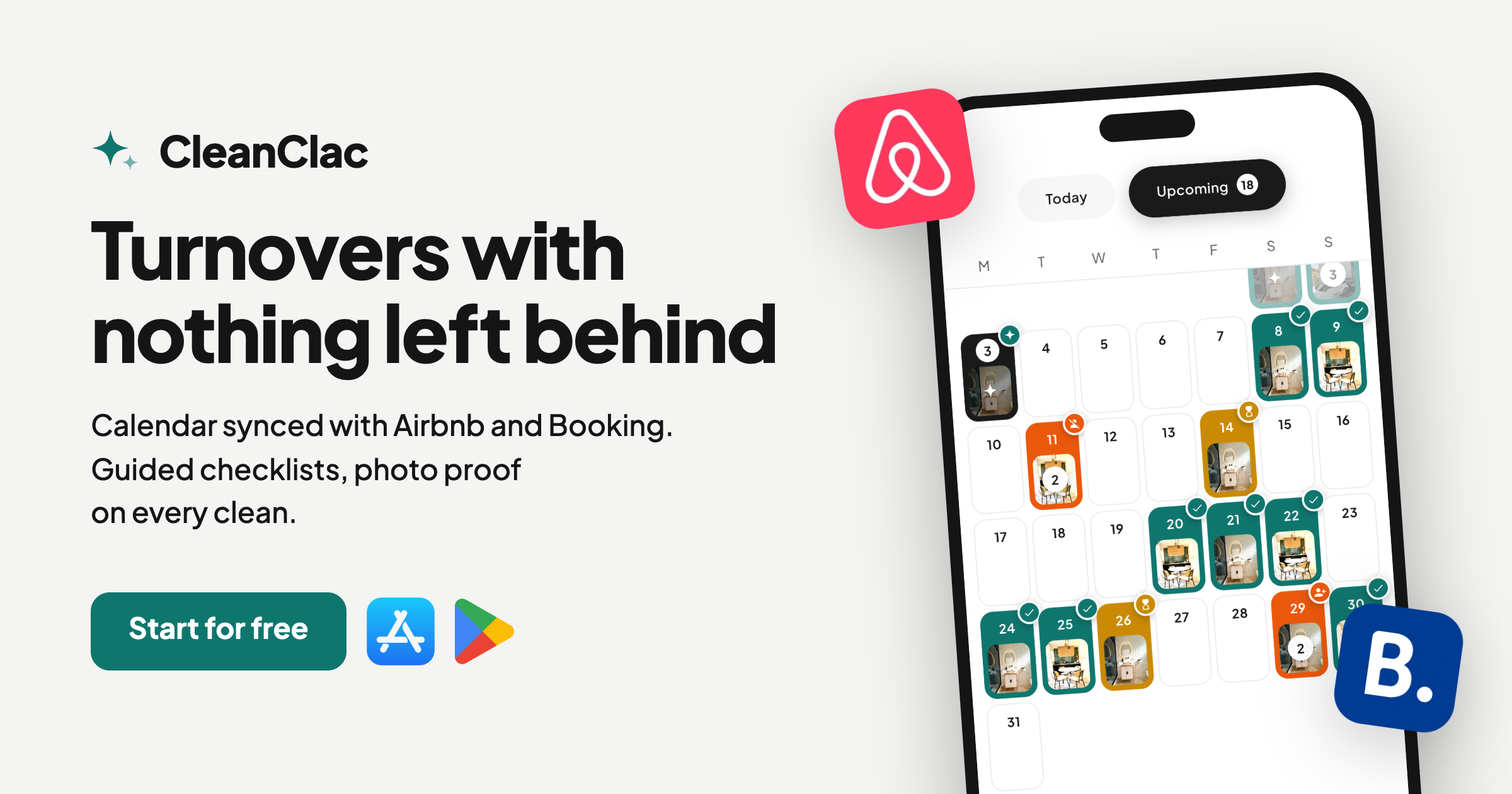
- Individual mobile access for each cleaner, making it easy to report a found item the moment it is discovered.
- Centralised storage of photos and cleaning reports, accessible at any time by the property manager.
- Automatic notifications that alert the contact person as soon as a report mentions a forgotten item.
- Automatic notifications that alert the contact person as soon as a report mentions a forgotten item.
Our free plan lets you try this approach with no commitment, and our pricing page details the different tiers according to the number of properties managed. If your cleaning team needs dedicated on-site access, our cleaner app overview shows how it works day to day.
Frequently asked questions
How long should you keep a forgotten item before disposing of it?
Host feedback on Airbnb community forums commonly points to a window of 30 to 90 days before donating or discarding an item if the guest does not respond, a timeframe you can set according to the item category. Sensitive or high-value items deserve more careful handling, sometimes including a report to the authorities before any disposal.
Who should pay the shipping costs for a forgotten item?
Standard practice is to ask the guest to cover the actual shipping cost before dispatch, supported by an invoice from the postal provider. Airbnb community discussions also recommend using the platform's resolution tool to secure that reimbursement rather than negotiating privately.
Should a forgotten item be reported to the authorities?
For a high-value item where the guest has not responded, filing a report with the local police before disposal remains the safest precaution.
How long should you keep the photos and data linked to a found item?
The ICO's storage limitation principles require you to set a justifiable retention period and to delete or anonymise data once it is no longer needed. Once an item has been returned, donated or disposed of, keep only the evidence required for the file, then delete the rest in line with your internal policy.
Sources
- A guide to the data protection principles | ICO
- Code of conduct for the short-term rental accommodation industry | NSW Government
- Handling customer luggage & belongings | VisitBritain
- Solved: Lots of bags left behind. - Airbnb Community


