Managing Cleaning at a Remote Rental Property
Learn how to manage cleaning at a remote rental with a hybrid approach: automate scheduling and delegate to a reliable local contact. Protect yourself from disputes.

Jonathan Lalinec
The safest way to manage cleaning at a remote rental is a hybrid approach: automate the scheduling of jobs and delegate the work to a reliable local contact. Neither full automation nor full delegation works on its own. One handles the calendar, the other handles the property.
Two actions to take today, before you even choose a tool:
- Write your standardised checklist and your evidence rules: what the agent must check room by room, and the requirement for timestamped, geolocated photos at every job.
- Set up a local contact right now: a written mandate, a concierge service, or an identified contractor, with their details saved and booking notifications sent to them automatically.
Everything else, insurance, the legal framework, digital tools, builds on that foundation. But without a checklist and an operational local contact, no software will save you from a property that is not ready on a Friday evening.
Key takeaways
Managing a remote rental requires combining automated scheduling, systematic photo evidence, and a written contractual framework to avoid any dispute.
| Point | Details |
|---|---|
| Document everything systematically | Carry out a comparative inspection with timestamped photos at every check-in and checkout. |
| Choose the right local contact | Match the delegation model, property manager, contractor, or concierge, to the actual turnover rate of your rental. |
| Secure the legal framework | Combine a written mandate, landlord insurance (PNO), rent guarantee insurance (GLI), and eIDAS-compliant electronic signatures. |
| Standardise checklists | Use room-by-room checklists with photo sign-off before the listing goes back live. |
| Automate with CleanClac | CleanClac syncs reservations and centralises evidence and reports for remote oversight. |
Contents
- How to manage cleaning at a remote property without risking a dispute at the checkout inspection
- Should you delegate to a property manager, a concierge service, or a local contractor?
- What digital tools let you manage cleaning without being on site?
- Mandates, insurance, and electronic signatures: what to check before you leave
- What checklists and routines should you use between stays?
- How CleanClac makes remote cleaning management easier
- What remote management really reveals about property owners
- Automate your remote cleaning with CleanClac
- Sources
- Frequently asked questions
How to manage cleaning at a remote property without risking a dispute at the checkout inspection
The checkout inspection is the moment when remote management either proves itself or falls apart. The distinction between fair wear and tear and damage attributable to the tenant determines whether you can withhold any of the security deposit, and this is precisely where remote owners most often lose their case for lack of evidence.
A comparative inspection, check-in then checkout, with dated photos taken from the same angles in each room, remains the most solid method. Without being there in person, that comparison is your only credible argument if there is a disagreement. Specialist property management guides are clear on this: room-by-room checklists and timestamped, geolocated photos turn a simple visual check into usable evidence.
Pro tip: Always ask for a photo of the shower sealant and the empty fridge at every checkout. These are the two areas most frequently disputed in security deposit claims, and the least often documented.
Before making any deduction from the security deposit, a straightforward process protects your position:
- Compare the check-in and checkout inspections, photo against photo, on the same checkpoints.
- Attach a quote or professional invoice that precisely values the damage found.
- Keep the report from the person who carried out the cleaning or inspection, dated and signed.
An inspection record without photo evidence comparable to a prior reference point has virtually no probative value when a tenant disputes it.
For the contractual side, the European eIDAS regulation and decree n°2018-347 recognise the legal value of qualified electronic signatures and electronic registered mail. In practice, you can sign a management mandate, a tenancy agreement, or an addendum from another country, without printing a single sheet of paper or travelling back to the property.
Should you delegate to a property manager, a concierge service, or a local contractor?
Three delegation models exist, and the right choice depends mainly on your rental's turnover rate, not on personal preference.
A trusted representative or someone you know suits long-term rentals with few turnovers. They step in occasionally, cost little, but offer neither guaranteed availability nor professional traceability of the work done.
An independent local cleaning contractor suits owners who handle the tenant relationship themselves but cannot travel between stays.
A full concierge service handles guest welcome, cleaning, and listing management. It is the model best suited to intensive short-term rentals, but also the most expensive. Industry guides put concierge costs at 15 to 25 % of rental income, depending on the local market and the level of service.
Before signing with any of these providers, ask these questions in order:
- Do you hold valid professional public liability insurance?
- Can you supply a timestamped photo at every job, including in an emergency?
- What is your replacement turnaround if you are unavailable on a scheduled checkout day?
- Do you charge per job, per hour, or on a monthly retainer?
- Will you accept an automatic escalation clause to a backup provider in case of absence?
Pro tip: Always negotiate a named replacement clause into the contract, not just a verbal promise. A contractor with no backup solution on a checkout day costs far more than ten minutes spent drafting a contractual clause.
The precise scope of the contract, the schedule, frequency, and procedure in the event of an incident, must be set out in writing. That document is what protects you when you are a thousand kilometres away and something goes wrong.
What digital tools let you manage cleaning without being on site?
Cleaning management software does not replace a good contractor, but it turns ad-hoc coordination by text message into a reliable process. The features worth looking for are specific, not decorative.
- Automatic synchronisation of reservations from Airbnb, Booking.com, or Vrbo, to generate jobs without manual re-entry.
- A scheduler that assigns cleaning slots based on actual arrival and departure dates.
- Digital checklists by job type, with timestamped and geolocated photos required before the job can be closed.
- Automatic notifications sent to the agent as soon as a reservation confirms a new checkout.
- A PDF report or dashboard accessible remotely, with a full history of past jobs.
Setup does not take weeks. Create a template job for each property type, define the mandatory photo rules room by room, then set up a sign-off step where you, as owner, visually confirm the job meets your standards before marking it complete.
| Feature | Concrete benefit for a remote owner |
|---|---|
| Reservation sync | Prevents missed slots and last-minute cancellations |
| Standardised checklist per job | Guarantees consistent cleanliness regardless of which agent does the job |
| Timestamped and geolocated photo | Serves as evidence in disputes with a tenant or contractor |
| Automatic notification to the agent | Removes manual text exchanges for every new reservation |
| Centralised dashboard | Enables quality control without travelling to the property |
Automating reservation sync concretely reduces missed slots, a common problem when the calendar is updated manually by an owner thousands of kilometres from the property. And requiring photo evidence for every critical task, kitchen, linen, bathroom, fundamentally changes the nature of sign-off: it is no longer blind trust, it is a file you can consult.
Mandates, insurance, and electronic signatures: what to check before you leave
A written management mandate gives the remote owner legal protection, especially when a third party acts on their behalf to sign documents, collect rent, or represent the property to a third party. The Hoguet Act governs property management mandates in France, which means a mandate given to an unlicensed professional can undermine the entire contractual chain.
Two types of insurance deserve particular attention when you are not on site to react quickly:
- PNO (landlord non-occupier insurance) covers damage to the property outside periods when the tenant is responsible. It is an essential safety net for a property left empty between lets.
- GLI (rent guarantee insurance) protects rental income against missed payments, a risk that grows when you cannot chase a tenant in person.
For expatriate owners or those who are simply far away, a management mandate combined with these two types of insurance is a commonly recommended approach to protect both rental income and responsiveness when something goes wrong.
On the signing side, the eIDAS framework already mentioned allows a mandate, tenancy agreement, or addendum to be signed without being physically present, provided you use a qualified electronic signature service recognised within the European Union. Before making any security deposit deduction, keep this reflex: a comparative photographic record plus an itemised professional estimate. Without both, a tenant dispute is likely to go against you.

What checklists and routines should you use between stays?
A room-by-room checklist only has value if it is followed to the letter, job after job, with no shortcuts for an agent in a hurry on a Friday evening.
For the bedroom: linen changed and checked for stains, dust under the bed, condition of curtains and light switches. For the kitchen: inside the oven and fridge, sink clear of residue, crockery complete and put away according to the original inventory. For the bathroom: sealant, mirror, toiletry supply levels, towels matching the number of incoming guests.
- Build in a buffer of at least two hours between one guest's checkout and the next arrival, to absorb the unexpected without compromising quality.
- Require a photo sign-off from the agent before the listing goes back live on booking platforms.
- Set up a written emergency protocol: who to call first, within what timeframe, and who authorises bringing in a replacement.
- Arrange a limited power of attorney for urgent interventions that need a quick decision, so you are not holding things up from the other side of a time zone.
Practical industry guides recommend short turnaround processes between guests, with standardised checklists and systematic storage of evidence to resolve quickly any issue reported by the next guest.
- Keep a single named point of contact per property, never three different numbers depending on the day.
- Anticipate seasonal maintenance needs, heating in winter, air conditioning in summer, before they become complaints.
- Automate reporting so you are not depending on a text message that gets forgotten on a Sunday evening.
This approach, centralise, anticipate, automate, is the model recommended by several specialist remote property management guides. It works just as well for a holiday home let for a few weeks a year as for a portfolio of properties on intensive short-term rental.
How CleanClac makes remote cleaning management easier
CleanClac addresses the needs listed above directly: reservation sync from Airbnb, Booking.com, or Vrbo, timestamped jobs sent automatically to the agent, individual mobile access for each cleaner, and reports viewable in real time from your dashboard.
In practice, an owner sets up a template job for their property, with mandatory photo rules by room. As soon as a reservation is confirmed on the platform, the agent receives their job with the corresponding checklist. They document the visit with photos, and the owner signs off from their phone, wherever they are.
Each cleaner has their own smartphone login, which removes the need for manual coordination by scattered messages and centralises all tracking in a single dashboard accessible remotely.
- Accurate supply tracking to avoid stockouts discovered too late by the guest.
- Search for a local cleaning contractor in an emergency, directly from the app.
To assess whether the tool suits your property volume, the page presenting the CleanClac app details the features available based on the number of properties managed.
What remote management really reveals about property owners
Most guides on remote rental management sell a simple promise: delegate everything and sleep soundly. This view underestimates something that experience on the ground repeatedly contradicts. Total delegation without documented oversight creates as many disputes as no delegation at all. A trusted representative with no obligation to provide photo evidence reproduces exactly the same grey areas as an owner left entirely to themselves.
What truly matters is not the degree of delegation but the quality of the audit trail. An owner who automates their schedule and requires timestamped evidence at every job holds a stronger position in a tenant dispute than one who has handed everything to an expensive concierge service without ever checking a report.
The priority, before buying any tool or signing any mandate, remains the same: define your evidence rules. Everything else, software, contractor, insurance, simply supports that basic requirement.
, Jonathan
Automate your remote cleaning with CleanClac
Unlike a local property manager who charges a flat fee without ever showing you usable evidence, CleanClac gives you a dashboard where every cleaning job is documented with a timestamped photo, viewable from your phone wherever you are in the world.
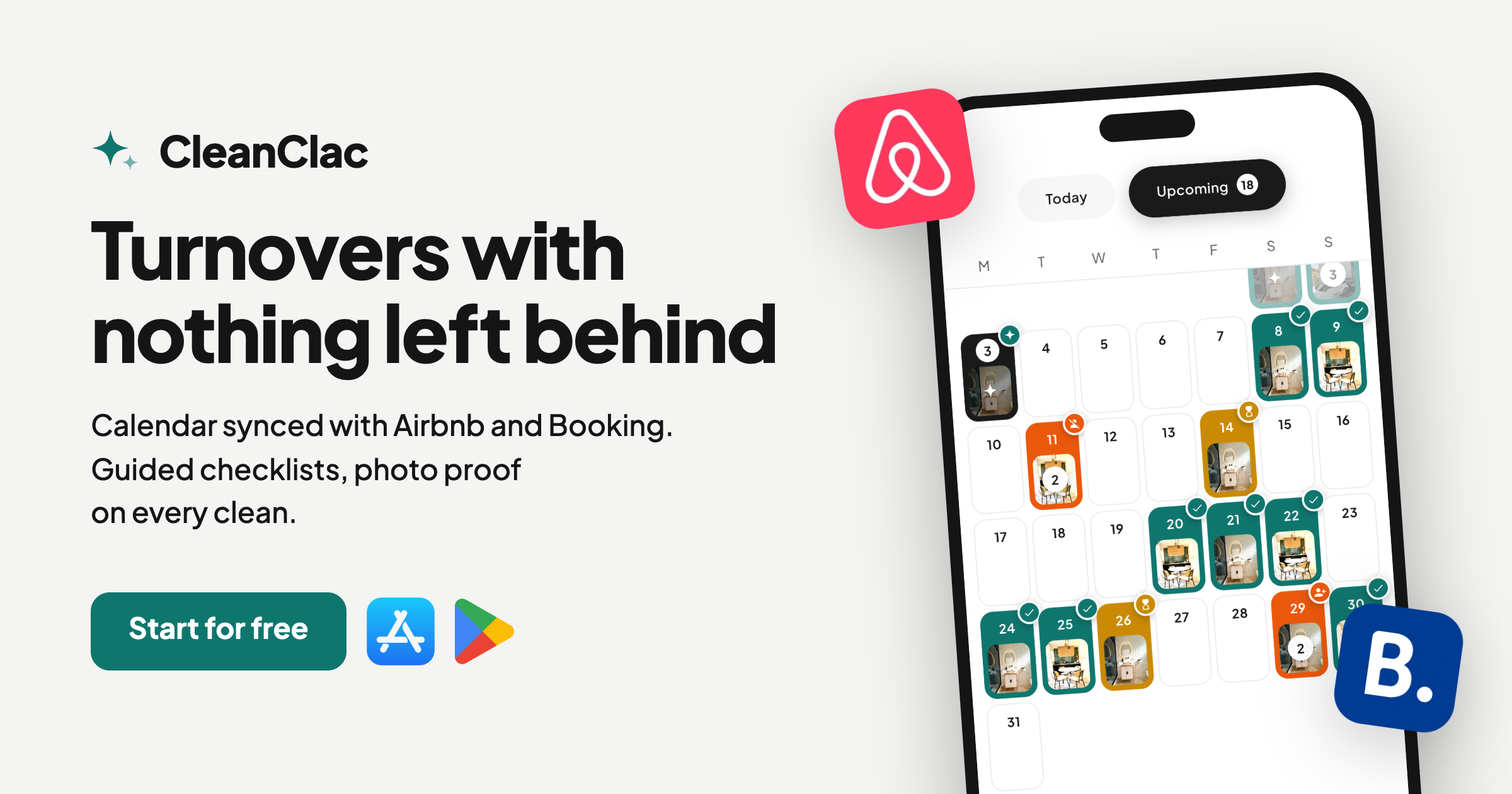
The app is particularly well suited to owners managing one or more short-term rental properties without being able to travel between stays: automatic reservation sync, jobs sent directly to the agent via their own mobile login, and supply tracking to avoid stockouts discovered by the next guest. To compare the options available based on your property volume, see the Airbnb cleaning software comparison or start your trial directly from the CleanClac product page.
Sources
Legal references (eIDAS, LRE decree), practical Airbnb checklist guides, and CleanClac pages for more on automating cleaning management.
- eIDAS regulation and LRE decree (Legifrance)
- Cleaning management for short-term rentals - Livret Accueil
Frequently asked questions
Does the property need to be cleaned before the checkout inspection?
Yes, the property must be returned in a state of cleanliness comparable to its condition at check-in. If it is not, the owner can legitimately withhold an amount from the security deposit, provided they supply a comparative record and an itemised professional estimate.
What are the 3 essential rules for cleaning between tenants?
Standardise the room-by-room checklist, document every job with a timestamped and geolocated photo, then carry out a visual sign-off before the listing goes back live on booking platforms.
How do you choose the right cleaner or cleaning provider remotely?
Always check public liability insurance, the ability to supply photo evidence, genuine availability, and include a written replacement clause in case of unavailability, whether that applies to a tenant or a contractor.
Can a tool like CleanClac replace a written management mandate?
No. CleanClac automates the scheduling and collection of cleaning evidence, but it does not replace the written management mandate that governs the legal relationship with a property manager under the Hoguet Act.
Can a management mandate be signed remotely without travelling to the property?
Yes. The eIDAS regulation and the decree on electronic registered mail allow a management mandate or tenancy agreement to be signed remotely with full legal force recognised in France.


