Late Checkout and Cleaning: the Rule Every Host Needs
Manage cleaning after a late checkout: know when to accept, charge or refuse, and check feasibility in seconds with property management software.

Jonathan Lalinec

Accept a late checkout only when your schedule and your team can guarantee the property will be ready in the time remaining. If they cannot, refuse or charge a fee. An AHLA survey shows that guests expect personalised cleaning rather than a fixed routine, which is pushing property managers to set clear, formal rules. A PMS or an app such as CleanClac lets you check feasibility in seconds rather than relying on gut instinct.
In brief:
- The feasibility of a late checkout must be checked in advance using software or an app, to avoid a rushed or substandard clean.
- A late checkout request for 1 pm or 2 pm can reduce the cleaning window to two hours or less, increasing the risk of delays and a property that is still damp from the previous guest's shower.
- Setting clear rules, such as a minimum two-hour cleaning window or specific fees, makes late checkouts much easier to manage.
- Automating coordination through dedicated tools lets you send notifications, track stock levels and reassign time slots quickly, avoiding chaos.
- Refusing a late checkout during peak season or when the next guest is arriving the same day is sometimes the best decision to protect the quality of the next clean.
Table of contents
- How a late checkout affects your cleaning operation
- Rules and policies: accept, refuse or charge for a late checkout
- Adapting your operation: scheduling, teams and logistics for late checkouts
- Tools and automation to reduce late-checkout friction
- Practical checklist for cleaners after a late checkout
- When refusing a late checkout is the right call
- An app to automate cleaning management
- Sources
- Frequently asked questions
How a late checkout affects your cleaning operation
A delayed departure cuts directly into the cleaning window. According to Lodgify, the standard checkout time is around 10 am to 11 am, while the next check-in typically starts from 3 pm, which normally leaves four to five hours to prepare the property. A checkout pushed back to 1 pm or 2 pm can reduce that window to two hours or less, especially once travel time between properties is factored in.
That compression creates real risks: a rushed clean, a team arriving late for their next job, or a guest discovering a property still damp from the previous guest's shower. The problem is all the more pressing because guest expectations are shifting.

The AHLA survey reveals that many guests do not want daily cleaning as a matter of course, and a large number prefer cleaning on request, reflecting a broader trend towards personalisation, according to AHLA data. That same desire for flexibility applies to late checkouts: guests are requesting it more and more, but it must never come at the expense of the next clean.
Rules and policies: accept, refuse or charge for a late checkout
A late checkout policy cannot be improvised at the moment a guest asks. It needs to be built in advance, around simple criteria that your team can apply without making judgement calls on the spot.
- Next guest arrival: refuse automatically if a check-in is scheduled the same day and the slots are tight.
- Minimum cleaning time: set a threshold, for example two full hours, below which the request is automatically refused or charged.
- Property type: a studio turns over faster than a multi-bedroom house, which justifies different rules for each.
- Availability of a backup team: accept more readily when extra help can step in.
On pricing, the models used in the hotel industry provide useful benchmarks. XO Hotels sometimes offers free late checkout until noon for direct bookings, with an hourly rate beyond that subject to availability. MEININGER Hotels charges a flat fee of €15 per room to extend until 2 pm. A short-term rental manager can use these as reference points when building their own pricing structure, integrated into the house rules or the booking page, with an automated reminder sent the evening before checkout.
Adapting your operation: scheduling, teams and logistics for late checkouts
Absorbing a late checkout without compromising quality means rethinking some scheduling habits rather than reacting to each request as it comes.
- Build a daily buffer slot into every cleaner's schedule, reserved for last-minute changes.
- Keep a backup team or split the clean between two people to halve the turnaround time at high-volume properties.
- Group jobs by geographic area to cut travel time and recover the minutes lost elsewhere.
- Standardise linen and product stock in each vehicle or storage unit to avoid back-and-forth trips.
- Run a quick photo quality check before handing over the keys, with clear escalation steps if a blocking issue is found.
Pro tip: always keep a quick-clean kit (cloths, multi-surface spray, spare linen) ready in each vehicle. It lets you cover a late checkout without going back to the supply room.
These adjustments cost little to put in place but make a real difference to the margin available on a busy day. A team that knows exactly where its supplies are and which slot it can use responds faster than one that only hears about the request at the last minute.
Tools and automation to reduce late-checkout friction
Manual coordination by text or phone call quickly hits its limits once a manager is handling more than a handful of properties. A cleaning management tool changes things on this specific point by centralising the request, the feasibility check and the team notification.
- Automatic notifications sent to the cleaner as soon as a late checkout is confirmed, with the updated arrival time.
- Real-time slot reassignment when an unexpected change disrupts the day's schedule.
- Individual mobile access for each cleaner, with no need for centralised phone coordination.
- Photo and video reporting at each job so the property can be verified before the next guest arrives.
This kind of automation makes it possible to set acceptance rules for late checkouts up to a given time, with a dedicated mobile interface for each cleaner and real-time tracking of linen and product stock. That said, no tool replaces an available team. Lodgify notes that an automated message sent the evening before increases guest compliance with the rules and simplifies team planning, but the human constraint remains real, and a subscription is a cost that needs to be factored into profitability calculations.
Practical checklist for cleaners after a late checkout
When the window shrinks, the order in which tasks are done matters as much as doing them well.
- Check property security first: doors, windows, appliances switched off, before anything else.
- Change the bed linen and towels. This is the most time-consuming task, so it comes first.
- Clean the bathrooms, the area the next guest will scrutinise most closely.
- Work through the high-impact surfaces: kitchen, countertops, mirrors, before less visible finishing touches.
- Photograph each room for the report, with an immediate alert if a problem cannot be resolved in the time available.
Pro tip: set a target time for each area, for example 20 minutes for the bathroom and 15 minutes for the kitchen, rather than a single overall total. It helps the team prioritise without panicking under the clock.
Spotless high-touch surfaces (door handles, light switches, remote controls) are non-negotiable even when time is tight. They are usually the first thing the next guest notices.

When refusing a late checkout is the right call
Refusing is not a commercial failure when the situation demands it: a same-day arrival, peak season, a team already at capacity. A professional refusal, paired with an alternative such as luggage storage or a rate for an extra night, protects the property's reputation far better than a rushed clean. Saying yes every time to keep one guest happy often ends up penalising the next, with a direct impact on online reviews.
, Jonathan
An app to automate cleaning management
Formalising a late checkout policy becomes significantly easier with a tool that checks feasibility and alerts your team without any manual input.
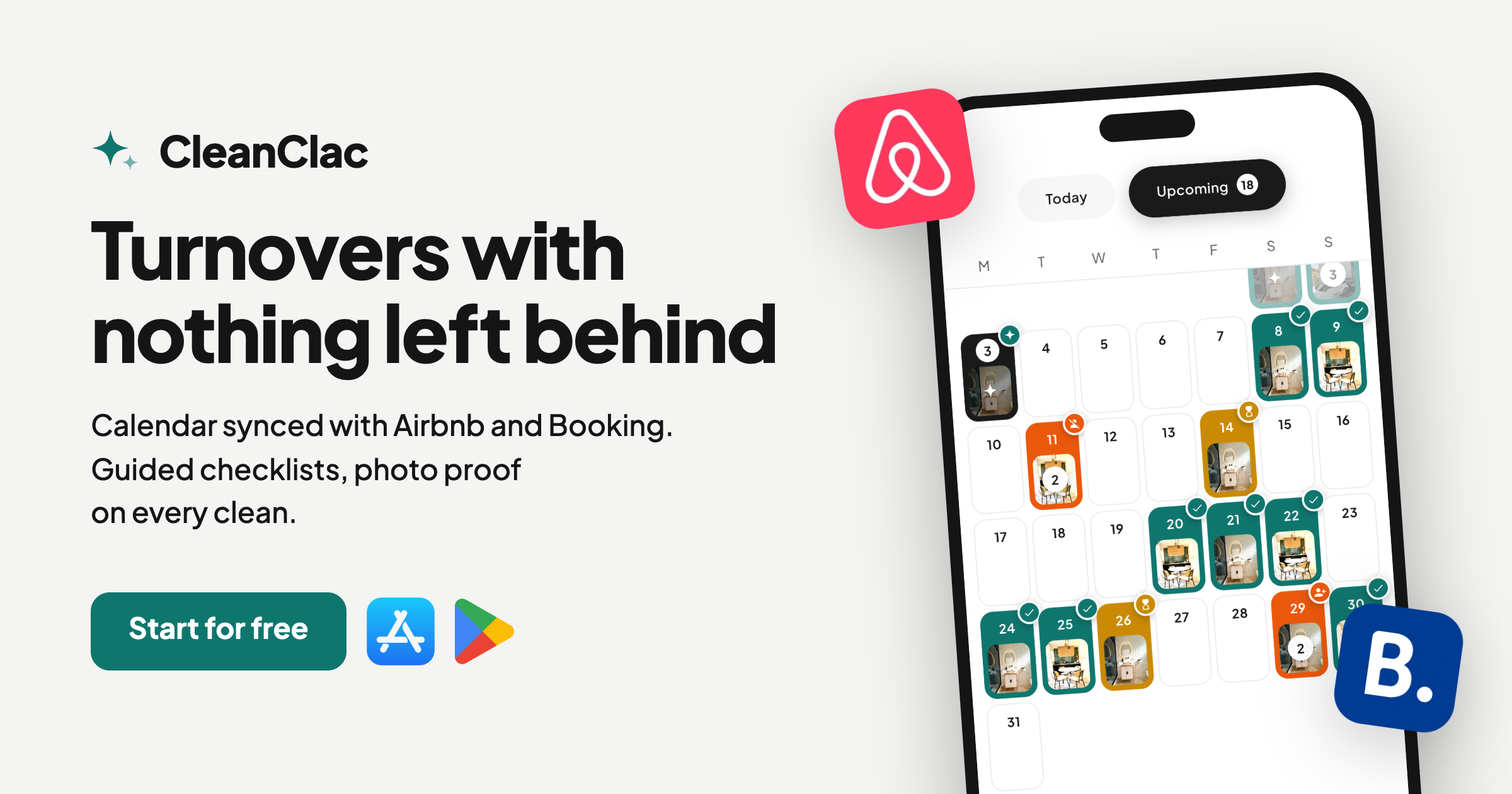
- Automatic notifications as soon as a late checkout is confirmed, with no phone coordination needed.
- Linen and product stock tracking to avoid running out during express turnovers.
- Local cleaner search when an unexpected gap appears in the schedule, via the provider matching platform.
This approach delivers the most value for multi-property managers, outsourced cleaning teams and high-turnover rentals, where manual coordination quickly becomes unmanageable. Pricing starts at €9.99 per month for two properties, with tiers up to €19.99 per month for five properties, available on the pricing page. Cleaning teams have their own dedicated workspace via the cleaner app.
Sources
To calibrate your own rules and pricing, refer to the AHLA survey on cleaning preferences, Lodgify's definition of late checkout, the pricing policies of XO Hotels and MEININGER Hotels, and the Marriott front-desk procedures for guest communication.
- Survey: Hotel Room Cleaning Practices Reflect Guest Preferences | AHLA
- What is late checkout? · Lodgify Encyclopedia
- Check-in and checkout at XO Hotels | Times and options
- Can I request a late checkout at MEININGER Hotels?
Frequently asked questions
How much does a late checkout usually cost?
Rates in the hotel industry vary by property. XO Hotels sometimes offers free late checkout until noon for direct bookings, with an hourly rate beyond that, while MEININGER Hotels charges €15 per room to extend until 2 pm.
How do you request a late checkout from a host or hotel?
The best approach is to ask in advance, by message or at the front desk, specifying the time you need. Marriott procedures note that approval always depends on the availability of the property and the cleaning team.
How long does it take to clean a room or a rental property?
Setting target times by area (bedroom, bathroom, kitchen) helps the team stay organised rather than aiming for a rough total duration.
What time do guests generally need to check out?
The standard checkout time is usually between 10 am and 11 am, with the next check-in often starting from 3 pm, according to Lodgify's definition of late checkout. That window is the normal cleaning slot, and any late checkout eats into it.


