Bathroom Consumables Tracking for Short-Term Rentals
Learn how to combine par levels, turnover checklists, two-bin Kanban and mobile alerts to eliminate stockouts and streamline restocking across all your rentals.

Jonathan Lalinec

Combining par levels, a turnover checklist, the two-bin Kanban method and automated mobile alerts solves the problem of bathroom consumables tracking once and for all. This system eliminates stockouts, streamlines restocking between stays and gives real-time visibility into the status of each property, without the need for permanent manual counting.
In brief:
- Par level calculations are based on average consumption, reorder lead time and a safety buffer of 1.5 to 2 times that consumption.
- The two-bin Kanban method automates restocking without permanent counting, using the reserve bin as the order signal.
- A quarterly review of par levels, adjusted for seasonality, keeps stock stable throughout the year.
- An automated mobile app triggers alerts as soon as an item drops below its critical threshold, making multi-property management easier.
- CleanClac provides integrated digital tracking with photo reports, accessible via mobile for each cleaner, allowing precise consumables traceability.
Table of contents
- Why dedicated bathroom consumables tracking matters for short-term rentals
- Calculating par levels for bathroom consumables
- Restocking checklist and on-the-ground method with two-bin Kanban
- Digital tools and useful integrations for automating alerts and restocking
- Step-by-step implementation for a property manager
- Editor's perspective: why this approach works in the field
- How CleanClac makes day-to-day consumables tracking easier
- Sources
- Frequently asked questions
Why dedicated bathroom consumables tracking matters for short-term rentals
An empty shower gel bottle or a missing roll of toilet paper directly affects the guest experience, and therefore reviews. Airbnb recommends storing supplies in a central location and scheduling recurring orders to limit this risk. The cost of consumables per stay is modest per unit, but it adds up quickly across a portfolio of several properties managed at once. Structured tracking makes it possible to buy in bulk rather than in a rush.
Occupancy rates and seasonality complicate the equation further: back-to-back bookings during peak season deplete stock faster than quiet periods, which is why restocking thresholds need to be adjusted according to the calendar.
- Insufficient stock generates negative reviews and requests for partial refunds.
- Excess stock ties up cash and creates storage headaches in often small properties.
- Structured tracking makes it possible to shift from emergency purchases to bulk orders, which cost less.
Calculating par levels for bathroom consumables
The par level is the minimum stock to maintain to cover the period between two restocking runs without ever hitting zero. The reference formula, described by Hospitality, reads as follows: par = (average consumption × reorder lead time) + buffer. This approach, developed for the hotel industry, applies directly to short-term rentals by replacing the supplier lead time with the cycle between two stays.
- Measure average consumption per turnover from cleaning history or PMS data.
- Estimate the actual reorder lead time, from placing the order to the product being available in the property.
- Apply a safety buffer to absorb extended stays or unexpected back-to-back bookings.
A buffer of 1.5 to 2 times the average consumption per turnover is recommended to absorb unexpected variations, according to PalliteGroup, which limits stockout risk without overloading storage cupboards.
A practical example: an apartment uses an average of 2 bottles of shampoo per stay, with a reorder lead time of 3 stays before the next order. The base par level would be 6 bottles; with a buffer of 1.5, it rises to 9 bottles in permanent stock. For linen, keeping 3 to 4 sets of towels per bathroom (one in use, one in the wash, one in reserve) remains a proven practice, directly transposable from hotel standards to furnished rentals.

Restocking checklist and on-the-ground method with two-bin Kanban
A standardised restocking checklist, as described by Lodgify, organises checks by room and by item with a precise target quantity for each turnover. It also serves as the basis for calculating the actual cost of consumables per stay.
- Check the level of each bottle (shower gel, shampoo, soap) and top up to the target quantity.
- Check toilet paper and tissue stock, always restocked to full.
- Inspect bath linen and replace any stained or worn pieces.
- Note any missing or damaged item before leaving the property.
In practice, the two-bin Kanban method, documented by Planview, remains the simplest standard to apply: one full bin stays in reserve while the second is in use, and switching to the reserve bin automatically triggers the reorder, with no precise counting needed at each turnover.
Pro tip: Have cleaners photograph every supply cupboard at the end of each clean. The visual record prevents disputes with agents and speeds up order approval.

Digital tools and useful integrations for automating alerts and restocking
A dedicated app turns the paper checklist into a continuous alert system. The most useful features for a multi-property manager share a common logic: detect the critical threshold before a stockout, rather than discovering it after the fact.
- Automatic alerts triggered as soon as an item drops below its defined par level.
- Centralised dashboard showing stock status property by property.
- Photo evidence integrated into the cleaning report to document each restock.
- PMS integration to cross-reference actual consumption with the booking calendar.
Inventory software predicts demand by cross-referencing occupancy rates and history, and can trigger automatic reorders. Hospitality.Institute
CleanClac illustrates this logic applied to short-term rentals: each cleaner has their own individual mobile access to report stock levels, the app centralises supply tracking property by property, and cleaning reports include photos and videos to document every visit. Task assignment, automatic or manual, draws on the same data to distribute restocking tasks among available agents.
Step-by-step implementation for a property manager
Setting up reliable consumables tracking does not require a complete operational overhaul, but a clear sequence avoids gaps.
- Carry out an initial stock audit in each property, item by item.
- Set a par level for each consumable using the formula and recommended buffer.
- Build the restocking checklist by room and train cleaners in the two-bin Kanban method.
- Configure alert thresholds in the mobile app used by the team.
- Define the order workflow: who approves, who purchases, from which budget.
- Review par levels every quarter to account for seasonality, as Hospitality.Institute recommends.
A monthly or quarterly audit, standard practice in hotels for linen according to a study published on ResearchGate, makes it possible to spot losses and adjust thresholds before they become unfit for purpose. The same audit rhythm applies naturally to bathroom consumables, particularly for high-turnover properties.
Pro tip: Align the quarterly par level review with the peak season calendar. An adjustment made just before a surge in bookings prevents the stockouts that cost the most in guest reviews.
Editor's perspective: why this approach works in the field
Consumables tracking rarely fails through lack of goodwill. It fails because there is no clear rule about who checks what and when. Managers who rely solely on their cleaners' memory accumulate stockouts, while those who combine par levels with two-bin Kanban turn a recurring problem into a nearly invisible routine. The difference comes down less to the sophistication of the tool than to the discipline of the checklist, applied at every turnover without exception.
, Jonathan
How CleanClac makes day-to-day consumables tracking easier
Moving from a paper checklist to automated tracking makes a concrete difference for a multi-property manager: each cleaner reports stock levels from their own mobile access, and real-time reports go directly to the manager with no follow-up calls or messages needed.
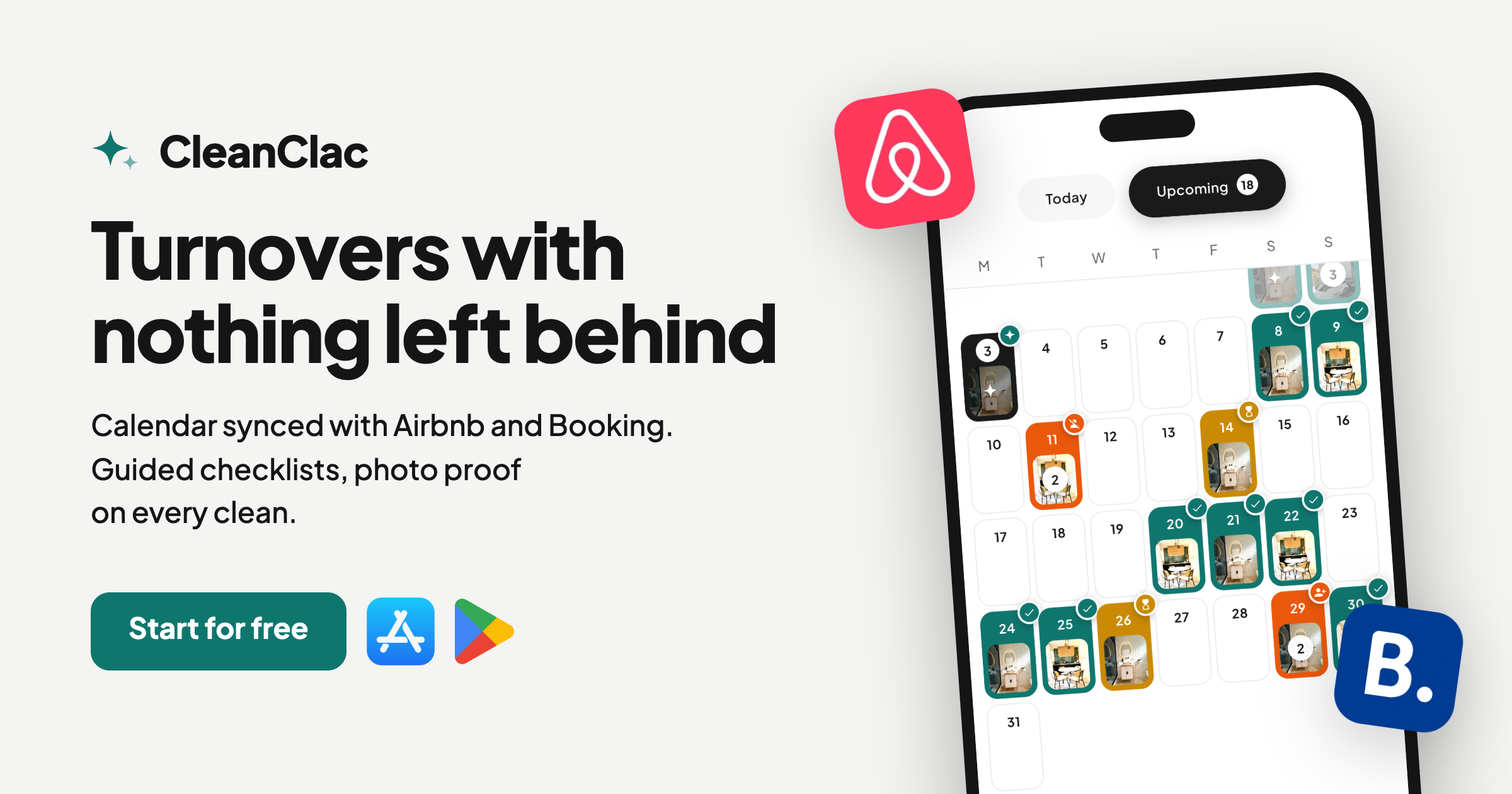
- Individual mobile access for each cleaner, with no shared account.
- Centralised stock tracking and alerts, property by property.
- Cleaning reports with photos and videos to document every restock.
- Integration with major PMS platforms to cross-reference consumption and bookings.
Pricing starts with a free plan to get started, with a plan at 9.99 € per month for two properties. Cleaners have their own dedicated access via the cleaner app, designed for field use with no complex setup.
Sources
The recommendations in this article draw on Hospitality.Institute for par levels, Lodgify for the restocking checklist and Airbnb's host resources for storage best practices. To align this tracking with the guest arrival process, see also this guide on the check-in workflow.
- Hospitality
- What is a Restocking Checklist? | Lodgify encyclopedia
- Article on the 2-bin Kanban system | Planview
- Article on the safety stock formula | PalliteGroup
Frequently asked questions
What is a par level in short-term rental management?
A par level is the minimum stock to maintain for a given consumable between two restocking runs, calculated from average consumption, reorder lead time and a safety buffer. This method, detailed by Hospitality.Institute, prevents both stockouts and overstocking.
How does the two-bin Kanban method work for supplies?
Two bins hold the same item: one is in use, the other stays in reserve. When the first bin empties, the cleaner switches to the second and triggers a reorder, a method documented by Planview that removes the need for permanent counting.
How often should par levels be reviewed?
A quarterly review is recommended to account for seasonal occupancy changes, as Hospitality.Institute suggests. More frequent audits can be added during peak season when bookings are back to back.
What buffer should be applied to avoid stockouts?
A safety buffer of 1.5 to 2 times the average consumption per turnover is recommended to absorb extended stays or unexpected situations, according to PalliteGroup. This buffer is added on top of the base par level calculation.
Does CleanClac allow consumables stock to be tracked between cleans?
Yes, CleanClac centralises supply tracking by property and lets each cleaner report stock levels from their own individual mobile access. Cleaning reports include photos that document stock status after every visit.


