Cleaning Supply Inventory: Method for a Profitable Agency
Master cleaning supply inventory with simple, proven methods to cut waste, avoid stockouts, and boost your cleaning agency's profitability.

Jonathan Lalinec

To take control of your cleaning supply inventory, start with an ABC classification crossed with reorder points, a FIFO principle for rotation, and mobile scanning to track every item out. These four habits are enough to eliminate most of the stockouts and waste found in cleaning agencies.
Concretely, here are the actions to take this week:
- Classify your references as A, B or C based on their value and consumption frequency
- Set a reorder point for each category
- Use the oldest products first (FIFO), especially for liquids and fragranced items
- Equip one designated person with a mobile scanner to log items in and out
- Test these rules on a small scope before rolling them out across all sites
An app like Cleanclac speeds up this rollout by centralising supply tracking directly from each cleaner's smartphone.
Key takeaways
Effective cleaning supply inventory management rests on ABC classification, mobile traceability, and regular monitoring of three simple indicators: turnover rate, stock coverage, and reorder point.
| Point | Details |
|---|---|
| Classify before you invest in tools | Apply ABC and FIFO before any technology spend to stabilise the foundations. |
| Set clear thresholds | Calculate the reorder point from your actual lead time and a safety stock buffer. |
| Digitalise progressively | Move from a shared spreadsheet to mobile scanning once you need to coordinate across multiple sites. |
| Separate sensitive categories | Isolate perishables, fragile items, and unsold stock to avoid losses and counting errors. |
| Manage with Cleanclac | Cleanclac centralises supply tracking via each cleaner's mobile access and real-time reports. |
Table of contents
- Why cleaning supply inventory is strategic for a cleaning agency
- Which inventory management methods work best for a cleaning agency?
- What level of digitalisation should you choose for stock tracking?
- Which KPIs and thresholds should you monitor daily?
- How to implement stock control in 6 steps
- What results should you expect from a tool like Cleanclac?
- How to manage perishable and fragile products in cleaning stock
- How to handle product returns and unsold stock
- How to manage suppliers and lead times
- How to forecast demand for cleaning products based on activity
- How to make the most of your storage space
- Why starting small and measuring quickly matters
- Cleanclac automates your cleaning supply tracking
- Sources
- Frequently asked questions
Why cleaning supply inventory is strategic for a cleaning agency
Poor stock management costs you twice: once through cash tied up in overstock, and again through delayed jobs when a product runs out at the wrong moment. Companies spend on average more than 1% of their revenue building stock, and inventory represents 10.6% of turnover according to widely cited sector data. For an agency managing dozens of properties, that is a budget that deserves the same rigour as team scheduling.
The hidden costs are often the heaviest:
- Expired products thrown away because no one tracked the expiry dates
- Extra trips by a cleaner sent to buy a missing product in a hurry
- Jobs delayed or done poorly because the right supplies were not on site
- Dormant stock sitting in a storeroom, never reused, never counted
Before thinking about automation, you need visibility and simple rules first. A shared spreadsheet and a clear classification are often enough to cut these losses before you invest in anything more sophisticated.
Which inventory management methods work best for a cleaning agency?
Four methods structure inventory management across most sectors, and they translate well to professional cleaning, provided you respect certain limits specific to the trade.
- ABC classification ranks your references by value and turnover rate. Category A products (concentrated disinfectants, quality linen) often account for 20% of references but 80% of the value tied up in stock. They need strict individual monitoring, unlike category C products (sponges, bin bags) that can be ordered in bulk without daily oversight.
- FIFO (first in, first out) prevents disinfectant or detergent bottles from expiring at the back of a cupboard while newer ones are used first. This rule is non-negotiable for any liquid or fragranced product whose effectiveness degrades over time.
- EOQ (economic order quantity) calculates the quantity that minimises both storage costs and order processing costs. It helps avoid ordering too frequently in small quantities, which multiplies delivery charges.
- Just-in-time (JIT) keeps stock to the strict minimum by synchronising deliveries with actual consumption. This method only works if your suppliers meet reliable lead times. An agency dependent on a single supplier with frequent delays takes a real risk adopting JIT without a safety net.
For a small agency, start with ABC and FIFO, which require very few tools. Multi-site operations benefit more from combining EOQ and JIT once consumption traceability is reliable.
Pro tip: Never roll out JIT on your category A products until you have at least six months of reliable consumption history. Without it, you risk a stockout at the worst possible moment, right in the middle of peak season.
What level of digitalisation should you choose for stock tracking?
The right tool depends mainly on the size of your agency and the number of sites you manage, not on your budget. A shared spreadsheet works fine for a single storage location with fewer than ten cleaners. It quickly becomes unmanageable once you need to synchronise several mobile teams.
Mobile scanning, via barcode or QR code, changes operations: every item taken out is logged in seconds from the field, with no manual re-entry. Digitalisation through barcodes, RFID, and WMS systems improves data reliability and reduces input errors, while enabling automatic reorders once a threshold is reached.
Criteria to compare before choosing:
- Cost: a lightweight mobile solution costs significantly less than a full ERP, which is often out of reach for a mid-sized agency
- Deployment complexity: a WMS or ERP requires technical integration, whereas a mobile app can be up and running in a few days
- Multi-site management: beyond three or four sites, a centralised tool becomes necessary to avoid duplicate orders
- Essential features: outgoing stock traceability, automatic low-threshold alerts, consumption reports by site and by cleaner
The gains observed after digitalisation concentrate around two areas: fewer stockouts thanks to automatic alerts, and less waste thanks to better rotation that is visible in real time.
Which KPIs and thresholds should you monitor daily?
Three indicators are enough to keep on top of the essentials: turnover rate, stock coverage, and reorder point. Tracking KPIs such as turnover rate, stock coverage and lead time is essential for adjusting replenishment parameters as seasons and activity levels change.
| Indicator | Formula and use |
|---|---|
| Turnover rate | Annual consumption divided by average stock. A low rate signals dormant overstock. |
| Stock coverage | Available stock divided by average daily consumption, expressed in days of autonomy. |
| Reorder point | Consumption during the lead time plus safety stock. |
| Safety stock | A buffer calculated from demand variability and supplier reliability. |
A rolling inventory replaces the full annual count, which is too heavy to organise. The procedure is:
- Count category A products every week, category B every month, category C every quarter
- Designate a site lead responsible for validating gaps between theoretical and physical stock
- Log every outgoing item in a register, paper or digital, with the date and the cleaner's name
- Escalate any discrepancy above 5% to the purchasing manager for investigation
Spreading the responsibility this way prevents one person from bearing all the quality control burden, which is a classic source of team tension.
How to implement stock control in 6 steps
A gradual rollout over four to twelve weeks depending on agency size limits resistance to change and lets you course-correct before going agency-wide.
- Initial audit (1 week): list all references, their average consumption and any recent stockouts.
- Tool selection (1 week): decide between a shared spreadsheet, a mobile app, or a heavier system based on the number of sites.
- Pilot on a limited scope (2 to 3 weeks): test on three or four sites before any general rollout.
- Team training (a few days): show concretely how to scan an outgoing item and read a low-stock alert.
- Automated reordering (1 to 2 weeks): link thresholds to supplier orders to reduce manual re-entry.
- Monthly KPI review: adjust reorder thresholds based on observed gaps between theoretical and actual stock.
Pro tip: Validate each step with a simple indicator before moving to the next. A successful pilot is measured by the number of stockouts avoided during the period, not by how happy the team says it is.
What results should you expect from a tool like Cleanclac?
A cleaning management tool must deliver fine-grained supply traceability, not just scheduling. Cleanclac gives each cleaner individual access from their smartphone, removing the centralised manual management that slows down smaller operations.
Concrete things to observe before and after adopting such a tool:
- Real-time reports on property status and remaining supply levels
- Individual tracking by cleaner, useful for spotting consumption gaps between teams
- Searchable history to compare actual consumption month over month
- Automatic notifications when a product hits its critical threshold
Before rolling out, always ask for before-and-after pilot data: number of stockouts avoided, time saved on manual entry, consumption variance by site. These figures, specific to your own operation, justify the investment. A generic promise does not.
How to manage perishable and fragile products in cleaning stock
Not all cleaning products age the same way. A concentrated disinfectant loses effectiveness after opening, a fabric freshener evaporates slowly even in a sealed bottle, and linen stored damp can mildew within days. These constraints call for differentiated management that goes beyond simple FIFO.

For perishable products, the opening date matters as much as the manufacturing date. Label every opened bottle with today's date and set a clear rule: any opened product that has not been fully used within three months goes through a quality check before reuse. For fragile items such as glass dispensers or diffusers, the storage area should be elevated and away from high-traffic zones where knocks are most likely.
Linen deserves separate treatment. It is often the costliest item to replace and the most vulnerable to moisture. A ventilated storeroom, open shelving rather than closed bins, and a strict rotation between clean linen and linen waiting to be laundered all help limit losses.
Finally, physically separate chemically incompatible products. Certain disinfectants must never be stored near chlorine-based products. This is as much a safety rule as an inventory rule, and it prevents costly incidents on top of material losses.
How to handle product returns and unsold stock
A cleaning inventory will always generate some unsold stock: a product switched to a new supplier, a format discontinued, an excess order after a busy period. Letting these references pile up in a corner of the storeroom means tying up cash with no return.
The first rule is to physically isolate these products as soon as they are identified as overstock, so they do not pollute the count of active stock. A dedicated area, even a small one, is enough to keep a clear picture of what is actually turning over.
Next, prioritise internal redistribution before any other solution. A product in excess on one site may cover an urgent need on another. This circulation avoids duplicate purchasing and reduces waste accordingly. When redistribution is not possible, negotiate a supplier return, especially for recent large-quantity orders. This is a commonly overlooked option, yet many suppliers accept it within a reasonable window.
For products that can neither be redistributed nor returned, it is better to sell them at a reduced price to cleaners or partners than to store them indefinitely. Any product that has not moved for six months should automatically trigger a disposal decision, not an automatic extension of storage.
How to manage suppliers and lead times
Supplier reliability directly affects your safety stock. The longer or more variable a lead time is, the larger a buffer you must hold, which ties up cash unnecessarily when that lead time could be negotiated down.
Diversifying suppliers for critical products (category A) reduces this risk, as long as you do not spread across so many contacts that you lose negotiating power on volumes. Two reliable suppliers are better than one, but also better than an unwieldy spread across five poorly managed accounts.
Tracking actual delivery lead times, not the figure promised in the contract, should become standard practice. If a supplier promises 48 hours but delivers in 72 on average, your reorder point must reflect that gap, not the commercial promise.
Finally, formalise recurring orders through framework agreements rather than repeated one-off orders. This stabilises prices, secures lead times, and simplifies procurement administration for high-volume consumables such as detergents or paper towels.
How to forecast demand for cleaning products based on activity
Cleaning product consumption rarely follows a flat curve. It varies with seasonality, the occupancy rate of managed properties, and the type of service carried out. This makes forecasting more complex than a simple monthly average.
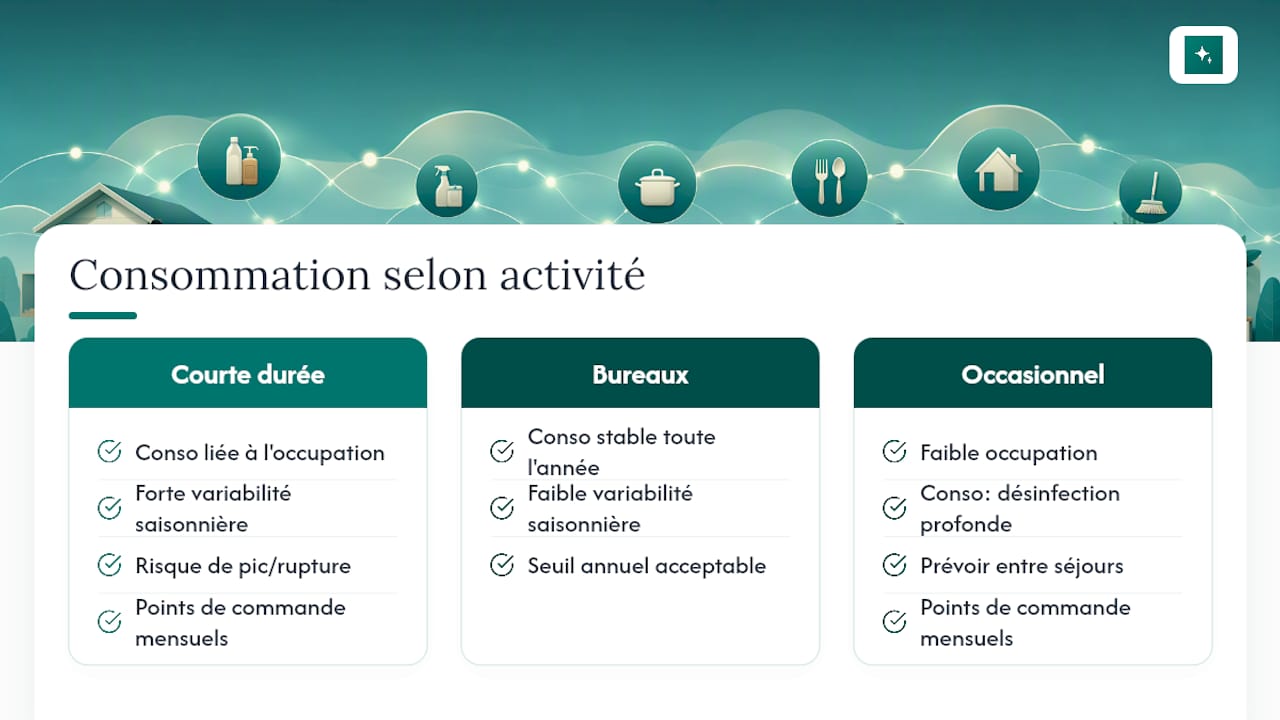
A good starting point is to cross consumption history with the planned activity calendar. An agency managing short-term rentals will see consumption rise mechanically with occupancy, unlike an office cleaning contract where consumption stays stable year-round.
Segment your forecasts by property type rather than using a global average. A high-traffic property consumes proportionally more everyday cleaning products, while an occasionally occupied property mainly needs deep-disinfection products between stays. Modern forecasting solutions powered by AI help anticipate demand and protect service levels even in highly variable contexts.
Then adjust your reorder points monthly rather than annually. Demand in short-term rental cleaning moves quickly, and a threshold locked in for the whole year will expose you to stockouts during peaks and overstock during quieter periods.
How to make the most of your storage space
A poorly organised storeroom costs time on every visit, even when the stock itself is correctly sized. Storage layout should follow the logic of consumption, not the order in which deliveries arrived.
Place high-turnover products (category A) at hand height and near the entrance, to minimise the distance cleaners travel when restocking their supplies several times a week. Low-turnover products can occupy less accessible spots, higher up or at the back of the room.
Vertical space is the simplest lever for gaining room without expanding the storeroom. Shelving up to the ceiling, with heavy or bulky items at the bottom, makes use of space that is often wasted. Also provide clearly labelled bins or zones by product category. This speeds up counting during rolling inventories and reduces picking errors.
For multi-site agencies, a satellite storeroom per geographic zone cuts empty trips, but requires stricter coordination of reorder thresholds across sites. Without that coordination, you end up with overstock on one site while another is out of stock, exactly the problem that good inventory management is meant to solve.
Why starting small and measuring quickly matters
The natural reflex is to want to digitalise everything at once. That is a mistake. A short pilot on three or four sites reveals in a few weeks the real friction that theory never shows: a cleaner who bypasses the scanner, a threshold set too high, an ABC category that needs reclassifying. Involve the field team in that feedback, and document every gain with reports and before-and-after photos. These concrete figures, not tool promises, are what persuade the rest of the agency.
, Jonathan
Cleanclac automates your cleaning supply tracking
Cleanclac transforms inventory management for an agency by giving each cleaner individual mobile access, with no shared spreadsheet to update manually every evening.

You get a consolidated view without having to collect information site by site.
To judge the real benefit, run a pilot on around ten properties for four weeks, with a simple goal: reduce the number of reported stockouts and the time spent on manual restocking. Visit the Cleanclac product page to get started, or first compare Airbnb cleaning software prices if budget is your primary decision criterion.
Frequently asked questions
What are the 4 inventory management methods?
The four most widely used methods are ABC classification, FIFO, economic order quantity (EOQ) and just-in-time (JIT). Each addresses a different need: prioritising references, managing rotation, minimising order costs, or reducing tied-up stock.
How should cleaning products be stored?
Cleaning products should be stored at a stable temperature, away from direct light, and grouped by chemical compatibility. Certain disinfectants must never be stored near chlorine-based products. Opened liquids should be labelled with their opening date and used first.
What are the 3 rules of cleaning?
The three commonly recognised rules are: always clean from the cleanest area to the dirtiest, from top to bottom, and from the inside of a room to the outside. These principles prevent dirt from being transferred back to an area that has already been cleaned.
What is the most efficient order for cleaning?
The most efficient sequence starts with dusting high surfaces, moves on to cleaning surfaces and equipment, and finishes with floors. This order prevents a freshly cleaned area from being dirtied again.
Can an app like Cleanclac replace manual stock tracking?
Yes, for an agency managing multiple properties, Cleanclac is a clear upgrade over a shared spreadsheet. It centralises consumption reports and alerts directly on each cleaner's phone.


