Back-to-Back Cleaning: The Complete Operational Guide
Learn how to run a back-to-back turnover with prioritised checklists and automatic notifications. Keep every checkout-to-checkin window on track.

Jonathan Lalinec
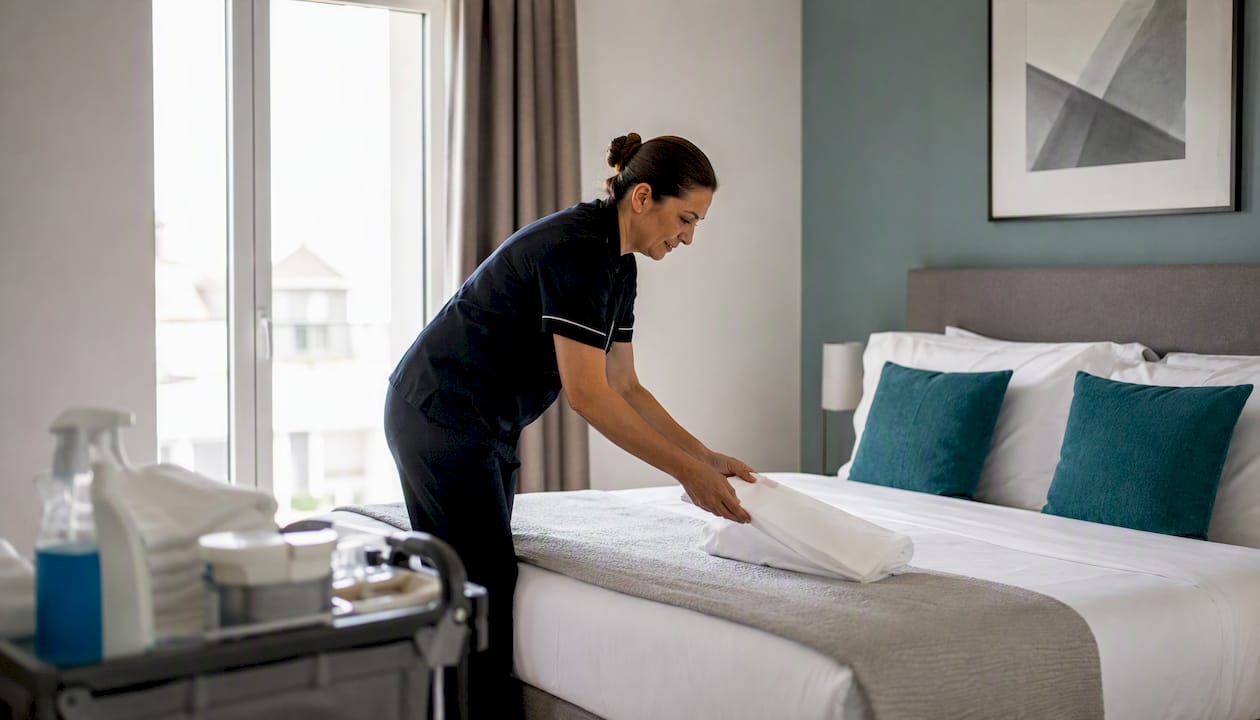
A back-to-back clean is a turnover carried out on the same day between two consecutive bookings, within a tight time window. It is, according to La Paume Digitale, the most repetitive and most critical task in property management, precisely because the time constraint leaves no room for improvisation. To pull it off consistently, two actions are essential right now:
- Apply a prioritised checklist: tackle the bed, bathroom, floors and bins first, then optional tasks if time allows.
- Trigger the cleaner notification through your scheduling tool: automatic assignment as soon as checkout is confirmed eliminates manual coordination delays.
Key takeaways
A successful back-to-back clean rests on three inseparable pillars: a prioritised checklist, realistic time benchmarks by property type, and automated scheduling that removes manual coordination.
| Point | Details |
|---|---|
| Prioritised checklist | Tackle the bed, bathroom, floors and bins first. Optional tasks wait. |
| Time benchmarks | From 45 min for a studio to 300 min for a large house. Plan a two-person team beyond 3 hours. |
| Cost per turnover | Between €80 and €255 depending on size, linen and travel. Factor it into your cleaning fee. |
| Photo evidence required | Timestamped photos of critical areas after every turnover, to track quality and limit disputes. |
| Cleanclac for automation | Calendar sync, automatic assignment and real-time photo reports, with no manual coordination. |
Contents
- When do you really need a back-to-back clean?
- The prioritised checklist for a fast turnover
- How long to allow by property type
- How to schedule rounds and organise teams
- Which tools to choose for automated turnovers
- What budget to plan for a back-to-back clean
- How to verify the property is truly ready
- What to do with a late checkout or early check-in
- How to onboard and train cleaners quickly
- Why automation genuinely changes results
- Cleanclac, built for back-to-back turnovers
- Sources
- Frequently asked questions
When do you really need a back-to-back clean?
A same-day turnover is unavoidable in three concrete situations: a check-in scheduled on the same day as a checkout, a peak season where every night counts, and availability windows too short to block out a full day. The Académie française notes that "back-to-back" means "one after another, in immediate succession," which captures the operational reality well: two bookings with no empty night between them.
Measurable benefits:
- Occupancy rate protected, with no lost nights between stays.
- Higher cleanliness scores when the process is standardised.
- Lower fixed costs per turnover through consolidated travel.
Risks to anticipate:
- Scheduling pressure when a checkout runs late or a check-in is early.
- Need for a buffer stock of clean linen so the clean is never held up.
- Incidents (breakage, damage) missed because there is no time for a thorough inspection.
Pro tip: Always build in a 30-minute buffer between the planned end of the clean and the next guest's arrival time. That buffer absorbs late checkouts without derailing the turnover.
The prioritised checklist for a fast turnover
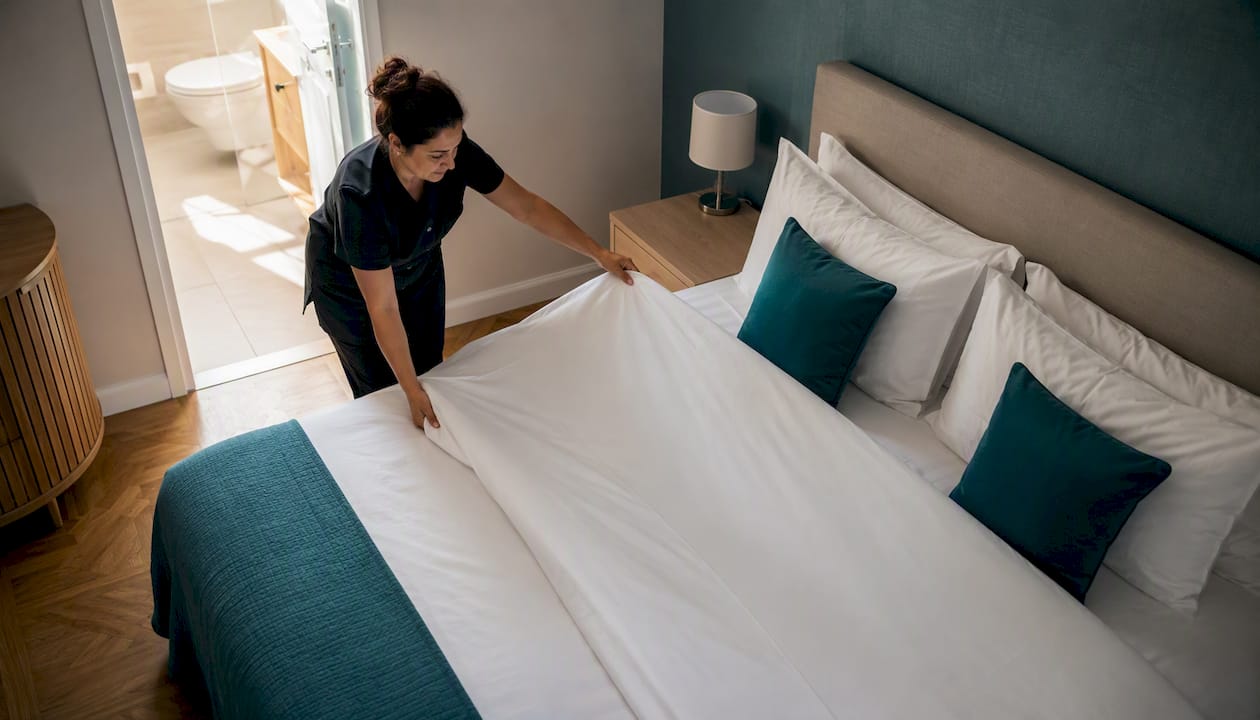
A professional clean in a short-term rental covers cleaning, linen, restocking consumables, resetting the space and a final check. In a tight window, the order of tasks makes all the difference.
Essential tasks (absolute first priority):
- Strip dirty linen and replace with clean linen (the bed first, as it takes the longest).
- Full bathroom clean: toilet, sink, shower or bath, floor.
- Empty bins in every room.
- Vacuum and mop floors in high-traffic areas.
- Quick safety check: windows closed, appliances off, nothing left behind by the previous guest.
Optional tasks (if time permits):
- Clean windows and mirrors.
- Degrease the oven and hob.
- Deep-tidy cupboards and storage.
Finish with "after" photos of the critical areas: made bed, bathroom, kitchen. These timestamped photos, recommended by Leazly, shift quality from something that depends on the individual to something that depends on the process, and protect you in any dispute.
Pro tip: Always start with the main bedroom. While the bed linen is being changed, the cleaner can move straight on to the bathroom. The two longest tasks then run in parallel.
How long to allow by property type
The benchmarks below are indicative ranges observed under normal conditions: property left in reasonable condition, standard number of sleeping places.
| Property type | Estimated total time | Bed and linen | Bathroom | Kitchen and floors |
|---|---|---|---|---|
| Studio (1 sleeping place) | 45–60 min | 15 min | 10 min | 15 min |
| 1-bed (2 sleeping places) | 75–120 min | 25–35 min | 15 min | 20 min |
| 2-bed (3–4 sleeping places) | 120–180 min | 40–55 min | 20 min | 30 min |
| House (5+ sleeping places) | 180 min | 60 min | 30 min | 40 min |
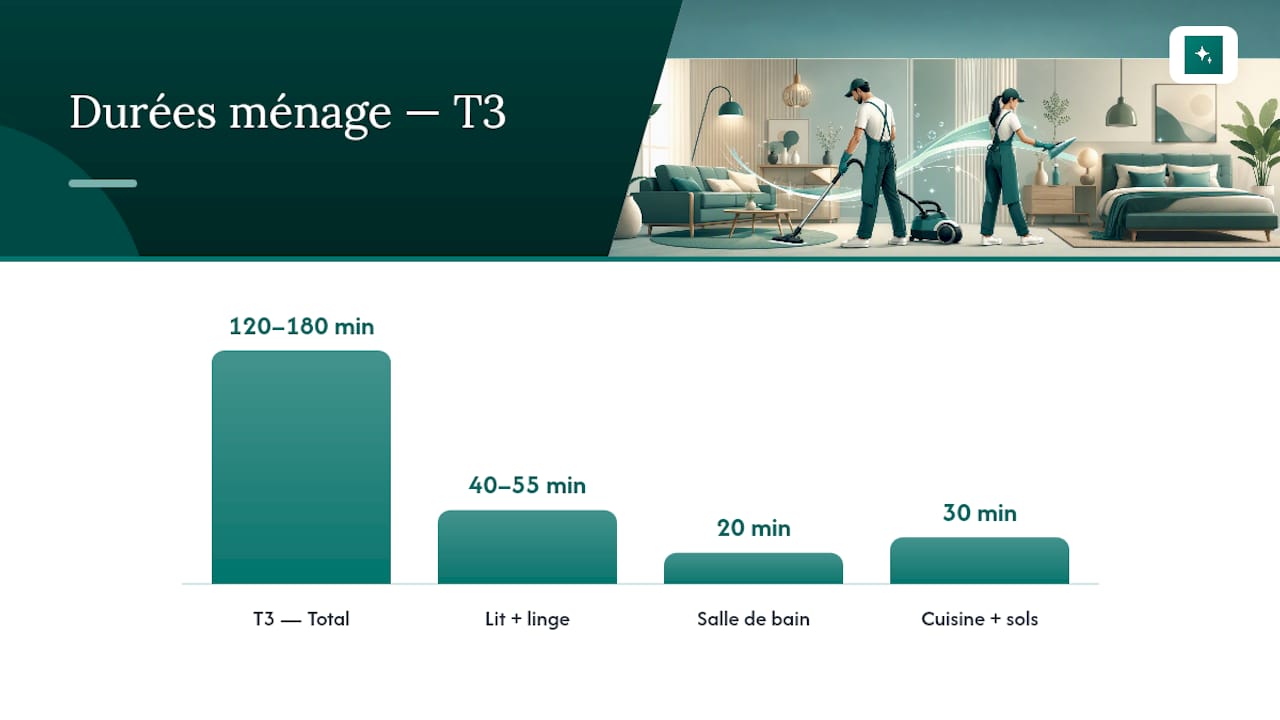
These figures help you calculate how many turnovers a cleaner can handle in a day and size your team for peak season. For a 2-bed property with a 3-hour window, a two-person team is often necessary.
How to schedule rounds and organise teams
The operational complexity lies less in the cleaning itself than in the coordination: property access, linen availability, precise timing. Leazly recommends standardising methods and always having a backup plan ready.
Principles for effective scheduling:
- Group cleans by area to reduce travel time between turnovers.
- Prioritise properties with the earliest check-in.
- Keep a buffer stock of clean linen on site or at a local depot so you are never waiting on the laundry.
- Secure access in advance: key safe, smart lock or access code given to the cleaner ahead of time.
Assignment models:
A dedicated cleaner per property ensures familiarity with the space and reduces handover time. A pool of local cleaners offers more flexibility when someone is unavailable, provided each cleaner knows the property checklist. To find available cleaners in your area, the Cleanclac cleaner marketplace lists local professionals ready to take on assignments.
Pro tip: Always identify a backup cleaner for every property. If someone cancels at the last minute, you trigger the replacement with a single message rather than an hour of phone calls.
Which tools to choose for automated turnovers
A reliable back-to-back workflow follows five repeatable steps: scheduling, assignment, cleaning, photo check, restocking. Automation reduces coordination errors and the time spent chasing cleaners manually, as Apel58 details in its analysis of property management processes.
Key features to look for in a tool:
- Automatic sync with Airbnb, Booking.com, Vrbo and your PMS calendars.
- Automatic or manual task assignment based on availability and location.
- Mobile notifications sent to the cleaner as soon as a checkout is confirmed.
- Digital checklists accessible from a smartphone.
- Timestamped photos submitted as proof of completion.
- Consumable stock tracking with restocking alerts.
A typical operational workflow:
- The calendar syncs: a checkout is detected and a turnover is created automatically.
- The cleaner receives a notification on their mobile app with the time, address and checklist.
- The cleaner completes the clean following the checklist and takes the required photos.
- The report is sent to the manager in real time: status, photos, any incidents flagged.
- The manager approves or triggers a redo if a point is non-compliant.
To compare the solutions available on the market, Cleanclac's Airbnb cleaning software comparison covers PMS integration, notifications and automatic assignment in detail.
What budget to plan for a back-to-back clean
The cost of a turnover breaks down into several items. UniMénage publishes indicative rates: from €60 incl. VAT for a studio and from €100 incl. VAT for a property with up to 3 bedrooms.
| Item | Indicative range | Notes |
|---|---|---|
| Cleaning (labour) | €60–€180 | Depending on size and duration |
| Linen (rental or laundry service) | €15–€40 | Per turnover, depending on number of sleeping places |
| Consumables (gel, paper, etc.) | €5–€15 | Restock frequency varies |
| Travel | €0–€20 | Depending on distance and provider policy |
| Estimated total per turnover | €80–€255 | Excluding any redo |
To estimate your cost per turnover: add cleaning + linen + consumables + travel. Factor this amount into the cleaning fee charged to guests to protect your margin. Management software costs add to this calculation but reduce coordination overhead.
How to verify the property is truly ready
Apel58.fr describes the final check as a non-negotiable step: post-checkout inspection, checklist validated point by point, photos of critical areas, incident tracking. Without this process, a single oversight can generate a negative review that is hard to recover from.
End-of-turnover check process:
- Validate every point on the digital checklist before closing the job.
- Take photos systematically: made bed, clean bathroom, tidy kitchen, entrance.
- Report any incident (breakage, stain, faulty equipment) through the app with a supporting photo.
- Set a redo threshold: if more than two points are non-compliant, the cleaner corrects them before signing off.
- Send the incoming guest a message if the arrival time is confirmed as delayed.
What to do with a late checkout or early check-in
These are the most common disruptions and the most destabilising for a tight turnover. The response works on two levels: immediate prioritisation and a backup plan activated in parallel.
Prioritisation in a compressed window:
- Focus the cleaner on critical areas only: bedroom, bathroom, kitchen.
- Push optional tasks to the next turnover or a planned deep-clean slot.
- Let the incoming guest know about a delayed entry with a simple gesture: a late check-in waived, or a personalised welcome message.
Backup plans to activate:
- A pre-identified backup cleaner, reachable within 15 minutes.
- A stock of clean linen on site so you are never waiting on a laundry service.
- Self-sufficient secure access (key safe, smart lock) so the cleaner can enter without waiting for the manager.
For last-minute cancellations, reschedule the clean to the next available slot and check whether a cleaning marketplace can supply an emergency replacement.
How to onboard and train cleaners quickly
A structured onboarding process reduces errors from the very first turnover. The goal: a cleaner working independently on your property within two supervised cleans.
Onboarding steps:
- Training on the property-specific checklist: task order, linen folding standards, location of consumables.
- Hands-on practice with the mobile app: receiving the notification, checking off points, submitting photos.
- On-site test clean with photo check supervised by the manager.
- Sign-off to work independently after two compliant turnovers.
Minimum SOPs to document:
- Task order and priority areas for each property.
- Bed presentation standard (folding, duvet cover, pillows).
- Incident procedure: photo, report in the app, wait for approval before leaving.
- Consumable restock thresholds and stock location.
KPIs to track:
- Average time per turnover (vs benchmark by property type).
- Redo rate (number of cleans requiring a correction).
- Average cleanliness score across booking platforms.
Why automation genuinely changes results
The case for automating turnovers is not theoretical. Property managers who standardise their processes with digital checklists and automatic notifications see fewer oversights, even when a substitute cleaner works a property they have never seen before. Timestamped photo evidence creates a level of traceability that manual SMS follow-up cannot reproduce at scale. What changes in practice: less time spent coordinating, fewer redos, and more consistent cleanliness scores over time. SOPs and real-time reports are not gadgets for the hyper-organised. They are the only tools that let you sustain a back-to-back pace without depending on a single irreplaceable cleaner. Testing an automated workflow on one property for two weeks is usually enough to measure the difference.
Cleanclac, built for back-to-back turnovers
Zero manual coordination between two bookings: that is the concrete gain Cleanclac delivers to hosts managing multiple short-term rentals.
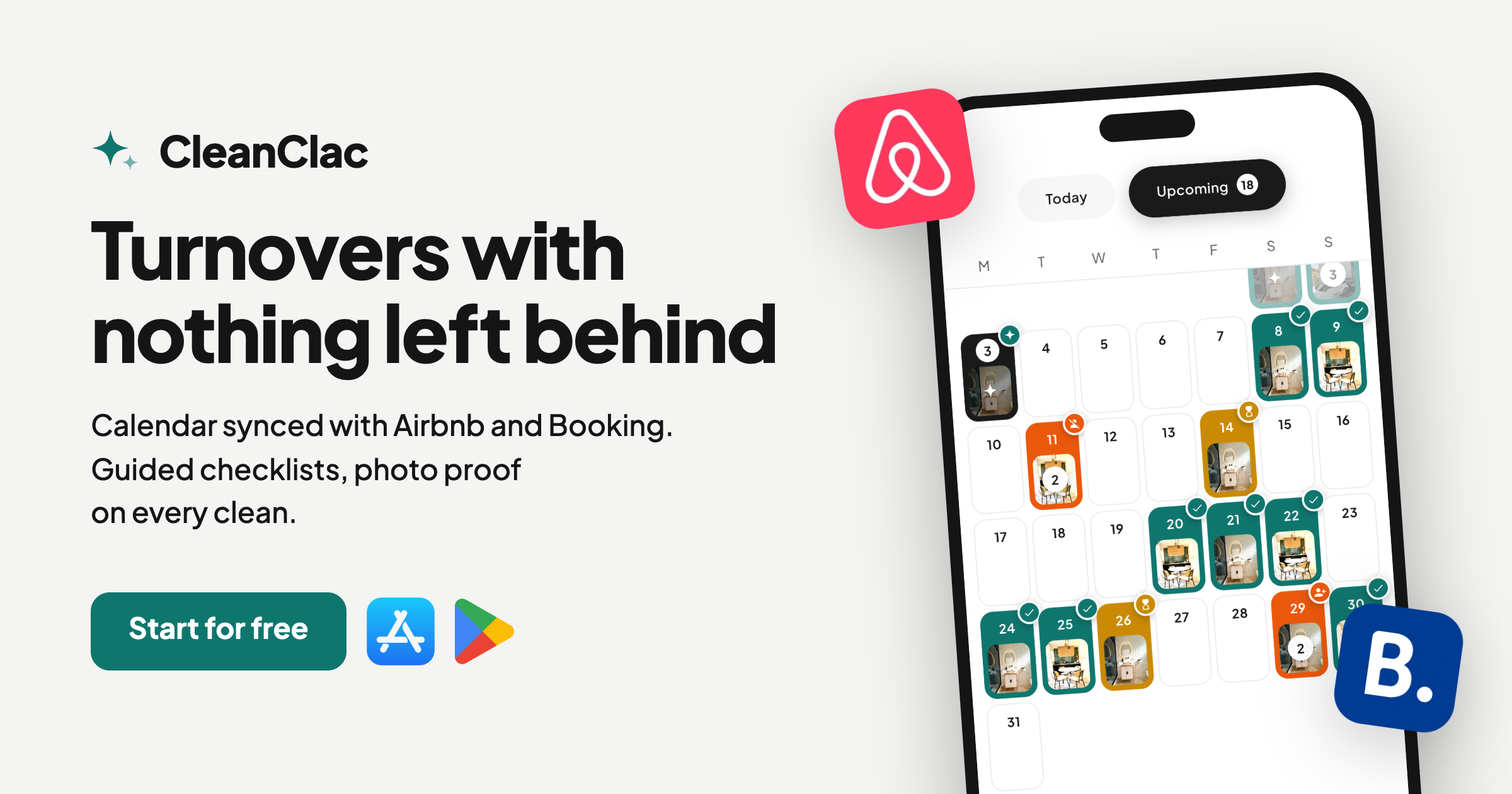
As soon as a checkout is confirmed on Airbnb, Booking.com, Vrbo or your PMS, Cleanclac automatically creates the turnover, assigns it to the available cleaner and sends a notification to their mobile app. The cleaner follows the property's digital checklist, takes the required photos and closes the job from their phone. You receive the report in real time, with status and photo evidence, without making a single call. Consumable and linen stock tracking is built in, so you never run out at the worst moment. To see whether Cleanclac fits your volume and budget, check the pricing page and start a free trial directly from the Cleanclac app.
Sources
- Airbnb cleaning: the turnover guide for short-term rentals | La Paume Digitale
- Cleaning between lettings: Airbnb and seasonal rental turnover | UniMenage
- Airbnb cleaning: turnover checklist and cleanliness standards
- "Back-to-back" for "one after another, in immediate succession" | Académie française
Frequently asked questions
What is a back-to-back clean in short-term rentals?
A back-to-back clean is a turnover carried out on the same day between two consecutive bookings, within a tight time window.
How long does a back-to-back clean take?
When the clean takes more than 3 hours, a two-person team is recommended to hold the window.
What is the typical cost of a turnover between two bookings?
Once linen and consumables are added, the total cost per turnover generally falls between €80 and €255.
How do you avoid mistakes during a back-to-back clean?
Use a digital checklist validated point by point and require timestamped photos of critical areas at the end of every clean. These two practices turn quality into a repeatable process that does not depend on who is doing the work.
Can Cleanclac automate back-to-back cleans on Airbnb?
Yes. Cleanclac syncs Airbnb, Booking.com and the main PMS calendars, automatically creates turnovers at each detected checkout, notifies the cleaner on their mobile app and centralises photo reports in real time.


