Mid-Stay Cleaning: Is It Worth It?
Learn when mid-stay cleaning makes sense, what to include, how to price it, and how to coordinate cleaners without the admin headache.

Jonathan Lalinec

Yes, a host can offer mid-stay cleaning, provided the scope is clearly defined and the guest agrees before anyone enters. This option makes real sense for long stays (beyond a week), premium guests, or specific hygiene needs. For a short stay of two or three nights, it is rarely worthwhile.
In brief:
- Any mid-stay cleaning must be clearly scoped and approved by the guest to avoid misunderstandings.
- Tasks typically cover a light clean of bathrooms, floors, linen, and a tidy-up, with kitchen and bedding changes as optional extras.
- The right frequency depends on the length of stay: daily or weekly, with secure access and at least 24 hours' notice before each visit.
- Costs range from €35 to €40 per hour, or a flat fee, depending on the property size, frequency and scope of tasks.
- Automating coordination through a digital platform significantly reduces errors and makes it easy to prove the work was done with photos and reports.
Table of contents
- Why offer mid-stay cleaning
- What does a mid-stay clean actually cover?
- Do you need the guest's agreement before entering?
- How to organise the schedule and property access
- How much does a mid-stay clean cost in short-term rentals?
- Who should do the cleaning: concierge, independent cleaner, or digital tool?
- What automation actually changes on the ground
- Practical tips and mistakes to avoid
- Cleanclac simplifies mid-stay cleaning management
- Sources
- Frequently asked questions
Why offer mid-stay cleaning
The main benefit is not just guest comfort. It is also a way to protect your property over time. A flat occupied for two or three weeks accumulates dirt, wear on textiles and sometimes damage that an intermediate visit could have prevented. Operational guides on managing long bookings make this point clearly: beyond a certain number of nights, skipping any mid-stay clean increases the risk of deterioration and makes the final turnover much harder.
The concrete benefits can be summed up as follows:
- Maintaining a consistent standard of cleanliness throughout the stay, without waiting for checkout.
- Reducing premature wear on linen, towels and surfaces under heavy daily use.
- Generating better reviews, a factor that directly affects your future occupancy rate.
- Catching a maintenance issue early (a leak, a broken appliance) before it gets worse.
That said, the option is not cost-effective everywhere. On a studio rented for three nights, the logistical cost of a mid-stay clean often outweighs the benefit the guest actually notices.
What does a mid-stay clean actually cover?
A mid-stay clean is not a miniature checkout clean. It is a refresh, lighter in scope, focused on the areas that deteriorate fastest with daily use. The example published by Village Montana residence illustrates this well: making up the bedrooms, cleaning the bathrooms and floors, changing the towels. A full kitchen clean and a complete linen change usually fall outside the standard package unless explicitly requested.
To avoid any misunderstanding, a well-defined scope should specify:
- Tasks included by default: bathrooms (shower, toilet, basin), floors in main rooms, fresh towels, light tidy of common areas.
- Tasks excluded unless specifically requested: deep kitchen clean (oven, hob, fridge), full linen change, window cleaning.
- Package options: a "refresh" pack (30 to 45 minutes, bathrooms and towels), a "full" pack (one hour or more, including kitchen and bedding) and a customisable pack negotiated at booking.
- A simple contractual clause: one line in the listing stating what is provided free of charge and what costs extra.
This level of detail prevents complaints along the lines of "I thought everything was included" and makes the cleaner's job easier, since they know exactly where to stop. Our cleaning tips for short-term rentals include ready-to-use checklists for standardising this type of service.
Do you need the guest's agreement before entering?
Yes, every time. Entering an occupied property, even briefly and to provide a service, requires the guest's explicit consent. This is not a formality: it is the basic condition for avoiding any sense of intrusion, particularly in a property rented as a temporary home.
Best practice is to build the option directly into the house rules or the listing description, specifying the available time slots and the proposed frequency. Airbnb specifically recommends detailing amenities and house rules in the listing itself, so nothing surprises the guest once they arrive. The same principle applies to the house rules, which must explicitly mention any planned visit during the stay.
One more point is worth your attention: depending on your country or rental status, tax or reporting obligations may apply to this type of additional service. Check the local rules before charging a supplement, rather than relying on practices observed elsewhere.
How to organise the schedule and property access
Logistics often make the difference between an option that smooths the guest experience and one that creates friction. It starts with frequency: for a one-week stay, a single visit mid-stay is usually enough. Beyond two weeks, a weekly rhythm becomes more appropriate, with flexibility to adjust it at the guest's request.
Access then raises the question of security. Three solutions dominate the market:
- Temporary digital codes, generated for the duration of the visit and deactivated afterwards.
- Secure key lockboxes, practical but requiring rigorous tracking of codes issued.
- A direct key handover, viable only if the cleaner is a fixed and trusted contact.
On the communication side, giving the guest at least 24 hours' notice remains the standard, with a time slot confirmed the day before. The cleaner should receive a written briefing covering the exact scope of tasks, areas to avoid (personal belongings, workspaces) and any property-specific instructions.
Pro tip: Never let quality control rest on trust alone. Always ask for a signed checklist and before/after photos sent immediately after each visit. That is the only way to resolve a dispute quickly if a guest or cleaner disagrees about what was done.
This post-visit check should become a reflex: a standardised checklist, a few photos of sensitive areas (bathrooms, kitchen, bedding) and a brief report sent to the manager. Without this step, it becomes very difficult to prove that a service was completed to the agreed standard.
How much does a mid-stay clean cost in short-term rentals?
Two pricing models coexist, each with its advantages. A flat fee simplifies communication with the guest: they know the price upfront with no surprises. Hourly pricing adapts better to properties of very different sizes, but it requires transparency about the time actually spent.

In practice, one commercial example lists a mid-stay cleaning option at €35 for a standard visit, a useful reference point that varies considerably by region and property size. Sector observations also point to a common hourly rate of around €35 to €40 for one-off visits, a figure to treat as a general indication rather than a benchmark.
The factors that move the price:
- The size of the property and the number of rooms to clean.
- The requested frequency (a one-off visit costs proportionally more than a weekly arrangement).
- The scope of tasks (a full package including kitchen and linen logically costs more than a simple refresh).
Three ways to present the offer to the guest: a flat supplement added at booking, a one-off payment settled on-site, or full inclusion in the nightly rate for premium stays. This last option requires careful margin calculation upfront. Our comparison of Airbnb cleaning software provides useful benchmarks on the automation costs to factor into that calculation.
Who should do the cleaning: concierge, independent cleaner, or digital tool?
Three main options structure the market, each with its trade-offs. A full concierge service offers the highest reliability: it handles scheduling, cover when someone is unavailable and quality control, at a commission that weighs on your margin. A local independent cleaner hired directly usually costs less but means you manage cover yourself when something comes up. Guides on cleaning management in short-term rentals recommend always checking professional liability insurance and actual availability before committing to a self-employed cleaner.
To find a reliable cleaner, check three non-negotiable criteria:
- Insurance covering any damage caused during a visit.
- Confirmed availability during your peak booking periods.
- Verifiable references, ideally from other short-term rentals rather than standard domestic cleaning.
Franchise models, as documented in this overview of domestic cleaning franchises in the United Kingdom, show that services vary considerably from one brand to another, which reinforces the value of scoping the work carefully upfront rather than assuming a common standard.
This is where a digital tool changes the practical picture: syncing the bookings calendar with the cleaners' schedule mechanically reduces missed visits, and automatic photo proof limits the disputes that arise from a simple "I thought it had been done". To compare platforms that connect hosts with local cleaners, our comparison of Airbnb cleaning marketplaces details how each one works.
What automation actually changes on the ground
The difficulty of a mid-stay clean is not the task itself: it is the coordination. Knowing when to send someone, notifying the right cleaner, and proving the work was done properly. That is precisely where software like Cleanclac delivers measurable value.
Some platforms sync the cleaning schedule with bookings from Airbnb, Booking.com or Vrbo, removing the need to manually recalculate visit dates every time a new reservation comes in. Each cleaner can have their own mobile access, with their daily tasks and a property-specific checklist. At the end of a visit, they can send photos or videos directly from their phone, providing instant proof in case of any dispute with the guest.
Tracking linen and supplies can also help you anticipate a shortage before it disrupts a mid-stay clean planned for the following week. Feedback from property managers suggests that automatic sync combined with photo proof significantly reduces the operational disputes that arise when a clean has not been confirmed in time.
Practical tips and mistakes to avoid
The biggest mistake is offering mid-stay cleaning as a default on every booking, including two-night stays where the visit costs more than it generates. Always document the scope in writing and get the guest's explicit agreement before entering the property: that alone prevents nine disputes out of ten. Then automate what can be automated: scheduling, photo proof, invoicing. That is where the time saved becomes genuinely measurable.
, Jonathan
Cleanclac simplifies mid-stay cleaning management
Unlike a spreadsheet or a back-and-forth of messages to slot in each visit, some apps automate coordination between bookings and cleaners, with no manual input needed every time a new date comes up.
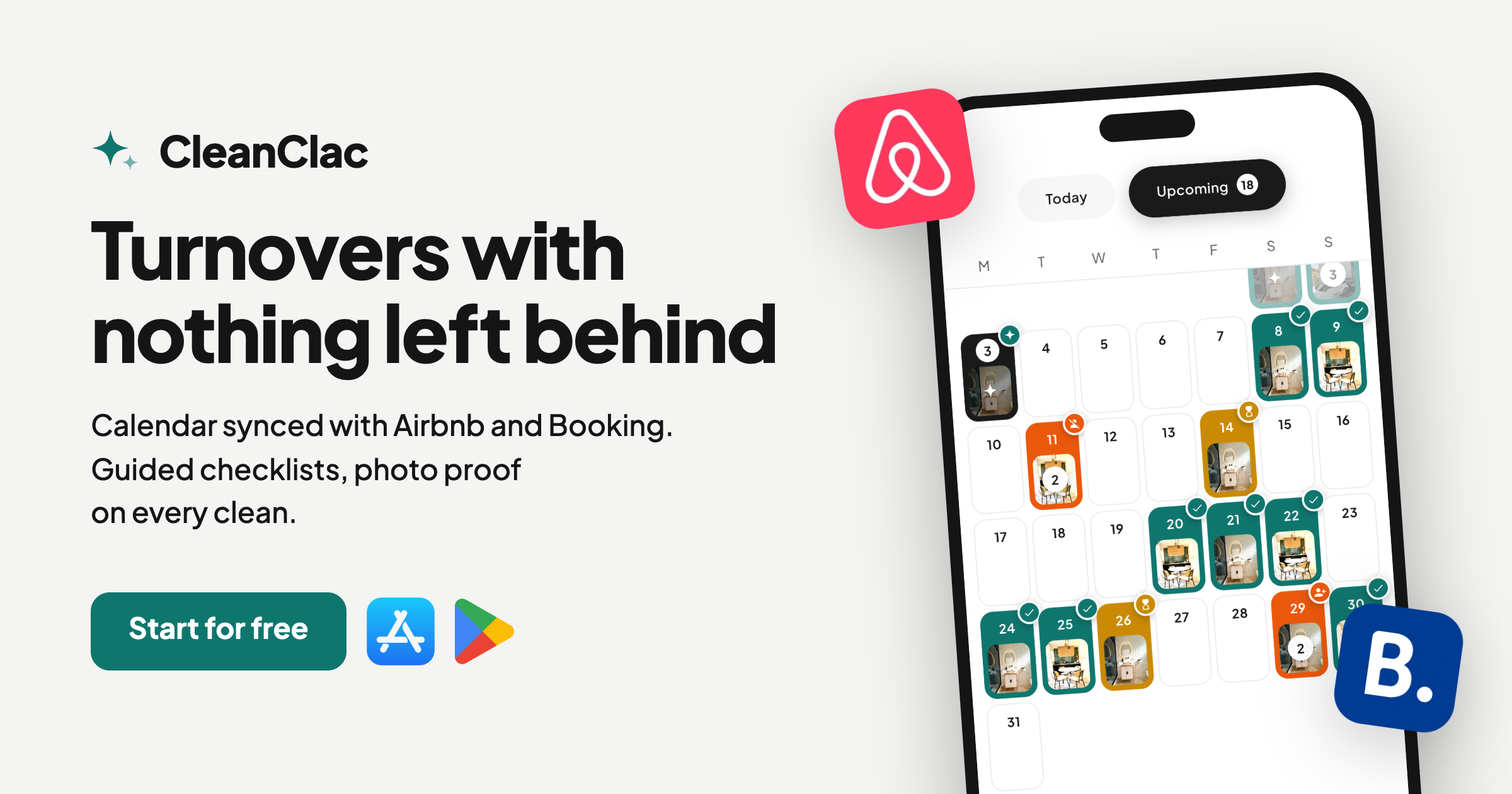
Some apps automatically sync the bookings calendar with the cleaners' schedule, send a notification as soon as a mid-stay clean needs to be scheduled, and let each cleaner follow a photo checklist directly from their smartphone. The result can include fewer scheduling errors, easily accessible proof of each visit, and less admin time on long stays. Tracking linen and supplies can prevent unpleasant surprises before a planned visit.
To see how it works on your own properties, you can discover the Cleanclac cleaning management app and run a trial on your first property today.
Sources
To go deeper on the operational management of mid-stay cleaning, several resources cited in this article are worth consulting directly: the guide on cleaning packages for long stays, the scope example from Village Montana, the practical guide on cleaning management in short-term rentals, and Airbnb's resources on amenities and house rules.
- Cleaning during your stay at Village Montana
- What are amenities and why are they important to guests? (Airbnb Help)
Frequently asked questions
Is mid-stay cleaning compulsory in an Airbnb?
No, it is not a legal requirement. It is a commercial option the host can offer, provided the guest's explicit agreement is obtained before any visit.
How much does an end-of-stay cleaning fee cost?
Fees vary widely depending on the size of the property and the tasks included. Some providers list mid-stay cleaning packages at around €35 for a standard visit, though this is one observed example and actual prices differ.
Are cleaning fees compulsory in short-term rentals?
No, they depend on the host's choice and the listing's pricing policy. Some hosts include them in the nightly rate, others charge them as an add-on or on request.
Can a tool like Cleanclac replace a cleaning provider?
No, Cleanclac does not carry out the cleaning itself. The app automates scheduling, communication with cleaners and quality tracking, while also helping you find a local cleaner when you need one.


