How to Prioritize Urgent Turnovers Without Missing One
Learn how to rank urgent cleaning jobs by deadline, complexity, and revenue impact, then auto-alert the nearest available cleaner before it's too late.

Jonathan Lalinec
Always prioritize turnovers where the next checkin is confirmed within a few hours and the estimated cleaning time exceeds the available window between checkout and checkin. Check three criteria first: the real time remaining before checkin, the complexity of the property, and the commercial impact of a delay. As soon as any one of those signals is red, trigger an automatic notification to the nearest available cleaner rather than waiting for manual confirmation.
In brief:
- Priority must go to turnovers confirmed within the next few hours that exceed the available window. Check deadline, property complexity, and commercial impact first.
- An urgent turnover generally takes 1 to 3 hours, but complex properties often need a larger safety margin, especially when linen or special equipment is involved.
- Automation through a concierge management tool like CleanClac triggers notifications, photo checklists, and skill-based assignments automatically as soon as a booking is confirmed, cutting the risk of human error.
- When something goes wrong, activate a backup cleaner identified in advance, or offer luggage storage rather than cancelling or delivering an unready property, and keep the guest informed honestly.
- Effective cleaner training must cover quick reading of property information sheets, stress management during urgent jobs, and confident use of the mobile app to keep processing time down.
Table of contents
- How to prioritize urgent turnovers step by step
- Which criteria actually drive the priority decision?
- Checklists, photo evidence, and quality control: the foundation of the process
- Automating prioritization: the rules to set up
- What to do when an urgent turnover is at risk of failing
- How CleanClac applies these principles day to day
- What training does a cleaner need for an urgent job?
- What does managing an urgent turnover actually cost?
- What good habits show up in successful turnovers?
- Sound prioritization protects your revenue and your reviews
- CleanClac automates what this article asks you to do manually
- Sources
- Frequently asked questions
How to prioritize urgent turnovers step by step
Sorting urgent turnovers is not a matter of instinct. It is a straightforward calculation that should run with every new booking, ideally without any human intervention.
-
Identify the available window. Calculate the gap between checkout time and the next checkin. This is what the industry calls the turnover window: the exact time left to clean, change the linen, and inspect the property.
-
Score the urgency on four criteria. Imminent checkin (less than 4 hours away), estimated cleaning duration, property complexity (floors, equipment, outdoor areas), and commercial impact if the turnover fails (negative review, refund, refused checkin).
-
Apply a quick decision rule. If the window is shorter than the estimated duration, immediately activate a backup cleaner or offer the guest luggage storage with a delayed entry. If no solution is available, block the property for that night.
-
Record the decision. Every call must be traceable in your management tool, with the time of the decision and the name of the cleaner assigned.
A standard turnover generally takes between 1 and 3 hours, but a same-day turnover calls for a stricter safety margin. Many experienced managers refuse to schedule a checkin less than 4 hours after a checkout, except for very simple properties.
Pro tip: never let a cleaner discover the urgency on the doorstep. The trigger must fire as soon as the booking is confirmed, not when the cleaner is already standing at the door.
Which criteria actually drive the priority decision?
Ranking high-priority turnovers means weighing several variables, not just checkin time. A 25 m² studio and a seven-bedroom villa cannot be compared the same way, even if both show a 3 p.m. checkin.
The available window varies considerably with size and equipment:
- A simple studio with no deep linen change can be cleaned in 45 minutes to 1 hour.
- A two-bedroom apartment with a full kitchen often takes 1 hour 30 to 2 hours.
- A large villa with a pool, garden, or multiple bathrooms can exceed 3 hours even with two cleaners.
Linen adds a constraint that is often underestimated. The par level system, sets of sheets and towels pre-positioned at each property, avoids waiting for a laundry return before launching an urgent turnover. Without sufficient par levels, a 24-hour laundry delay can be enough to sink a turnover that looked fine on paper.
A telling figure: cleanliness remains the top satisfaction criterion for guests, and a single negative review on that point can permanently drag down a property's rating.
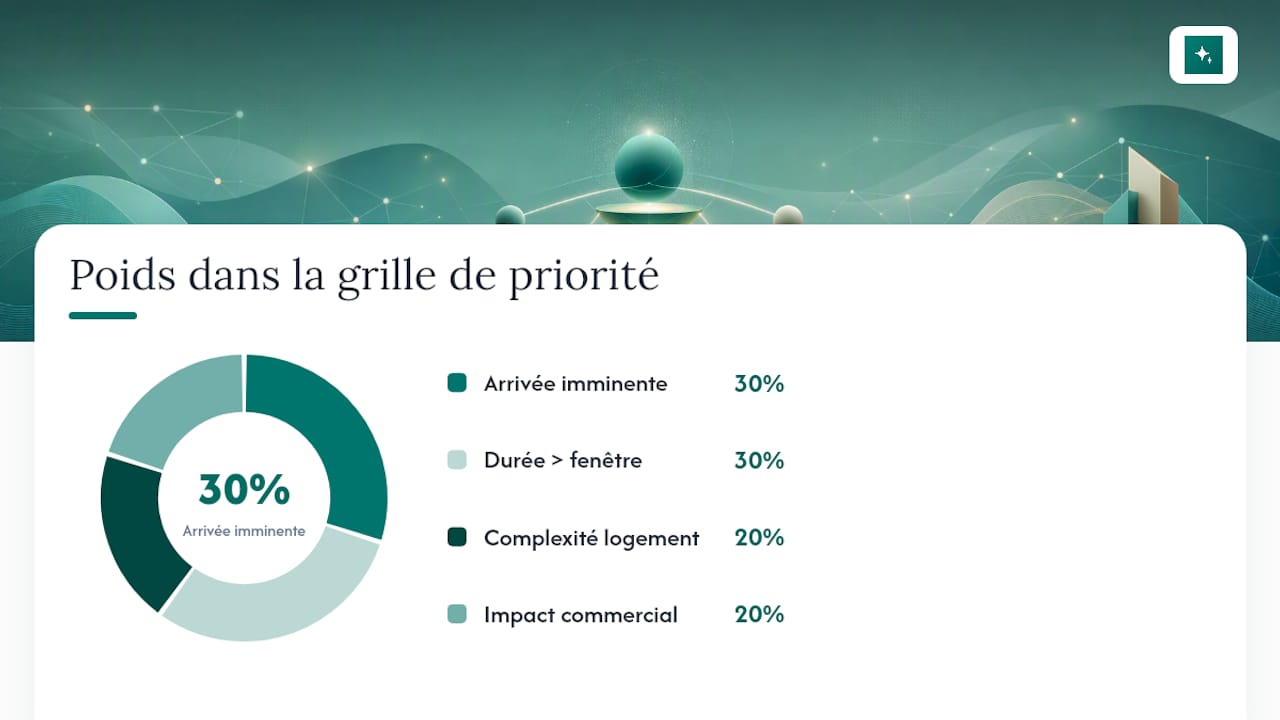
A simple weighting grid might look like this: imminent checkin (weight 3), estimated duration exceeding the window (weight 3), property complexity (weight 2), commercial impact (weight 2). Any property exceeding a threshold score moves automatically to the top of the queue.
Checklists, photo evidence, and quality control: the foundation of the process
A well-built turnover checklist eliminates back-and-forth trips and protects quality even when the cleaner is visiting the property for the first time.
It must cover, room by room:
- Bedrooms: linen changed, surfaces disinfected, dust under the bed.
- Bathroom: fixtures, taps, consumables restocked.
- Kitchen: appliances, dishes, bins emptied.
- Outdoor areas and special equipment (pool, spa, air conditioning).
At the end of the clean, the cleaner must produce a systematic photo inspection of every key area. These images serve as evidence in the event of a dispute, but also as a training tool: a manager can spot a recurring fault with a particular cleaner and correct the habit before it becomes a guest complaint.
Any anomaly found, a stubborn stain, broken equipment, must be escalated immediately through a written procedure, never by word of mouth. That information also feeds the scheduling of deep cleans, which are planned outside urgent slots so they never slow down a critical turnover.
Pro tip: always ask for a photo of the electricity meter or thermostat at the end of the clean. It is often the first flashpoint during a late checkin.

Automating prioritization: the rules to set up
Automation does not replace human judgment. It removes the repetitive decisions that slow the team down on straightforward cases.
- Automatic notification as soon as a booking is confirmed. The available cleaner receives their assignment before the manager has even opened the dashboard, cutting coordination time on same-day turnovers.
- Automatic stop-sell. If no cleaner is available within the required window, the property closes to bookings for that date rather than risking an empty checkin.
- Skill-based assignment. Some jobs require specific skills (pool, delicate linen): the system must distinguish between assigning to the first available cleaner and assigning by competence.
- Systematic timestamping. Every status change (accepted, in progress, completed) must be dated and archived for traceability and quality audits.
A well-configured concierge management tool turns these four rules into automatic reflexes, with no manual intervention needed on standard cases.
What to do when an urgent turnover is at risk of failing
Even with the best automation, something unexpected will eventually happen: a sick cleaner, a laundry delay, last-minute damage.
- First, activate a backup cleaner identified in advance, ideally through a cleaning marketplace where you can quickly reach a local replacement.
- If no replacement is available in time, offer luggage storage with a delayed entry rather than a full cancellation.
- Prepare a standard message for the guest, honest about the delay, with a clear gesture of compensation if a fee applies.
- As a last resort, block the property or push the checkin back rather than delivering a property that is not ready.
These contingency plans must be written up in advance. Improvising a guest message in the middle of a crisis is the surest way to word it badly.
How CleanClac applies these principles day to day
CleanClac automates the points described above. As soon as a booking is confirmed on Airbnb, Booking.com, or another channel, the job goes to the available cleaner via their own mobile access, with no manual data entry. The integrated photo checklists document every turnover and feed linen and consumables stock tracking, which limits delays caused by a forgotten restock.
The dashboard keeps a performance history by cleaner, making it easier to spot bottlenecks on complex properties. To set up reliable prioritization without losing control over edge cases, you simply define skill-based assignment rules and let the automation handle the rest.
What training does a cleaner need for an urgent job?
A cleaner facing an urgent turnover cannot afford a method error. They must know the checklist by heart before walking through the door, not discover it on the spot.
Training must cover three distinct skills. First, quick reading of a property information sheet: being able to locate the electrical panel, water shutoffs, and specific equipment within a few seconds, without wasting time searching. Second, time-pressure management: a trained cleaner knows that an urgent job is broken into priority sequences (bedding and bathrooms first, finishing touches after) rather than cleaned room by room in the usual order. Third, confident use of the mobile app for flagging anomalies and submitting end-of-clean photos, because a cleaner who struggles with the tool adds precious minutes to an already tight turnover.
Agencies that handle same-day turnovers well run short hands-on practice sessions, often using the most complex properties in their portfolio (large villas, special equipment). A cleaner who has already worked through an emergency scenario in training responds faster when it happens for real, without waiting for instructions.
What does managing an urgent turnover actually cost?
Prioritizing an urgent turnover has a direct cost, often higher than a standard cleaning fee. A last-minute job generally pulls a cleaner out of their normal schedule, which justifies a surcharge. The total cost of a same-day turnover ranges from $150 to $300 depending on property size in the North American market, a useful benchmark for calibrating your own urgency surcharges.
On top of that surcharge comes the cost of a backup cleaner billed at a spot rate, which is higher than a regular contract. You must also factor in the hidden cost of an accelerated restock: ordering linen or consumables at short notice almost always costs more than a planned replenishment.
Against that, the cost of an automation tool remains marginal. A price comparison of Airbnb cleaning software puts that amount in perspective against the real cost of a failed turnover: partial refund, negative review, and lost future bookings. The calculation almost always favors automation once a portfolio grows beyond two or three active listings.
What good habits show up in successful turnovers?
Managers who handle urgent turnovers well share simple habits, repeated across every property rather than reinvented with each crisis.
The first is documenting precise standard operating procedures (SOPs) by property type, which makes quality independent of who carries out the clean. A new cleaner can step into an urgent job with no prior knowledge of the property.
The second habit concerns guest communication: alerting a guest to a slight delay with a clear message and a token gesture of goodwill almost always prevents the negative review that silence would provoke. The third is regularly reviewing the properties that generate the most urgent situations, usually the same ones, to adjust their default booking window or beef up their linen stock.
Finally, blocking same-day arrivals by default on properties that cannot objectively be turned around in time is a simple commercial rule, but one that is rarely applied with consistency, even though it prevents the majority of repeat incidents.
Sound prioritization protects your revenue and your reviews
A failed turnover costs more than a one-off refund: it permanently damages a rating, and cleanliness remains the top complaint from guests. Automating the detection of urgent cases also reduces the mental load on the team, which stops reacting under pressure and starts following a process that is already written. That is an investment in organization, not just in tooling.
, Jonathan
CleanClac automates what this article asks you to do manually
CleanClac turns the rules described above, automatic notification, photo checklist, per-cleaner mobile access, into live settings that activate as soon as a booking is confirmed, without you having to monitor every turnover yourself.
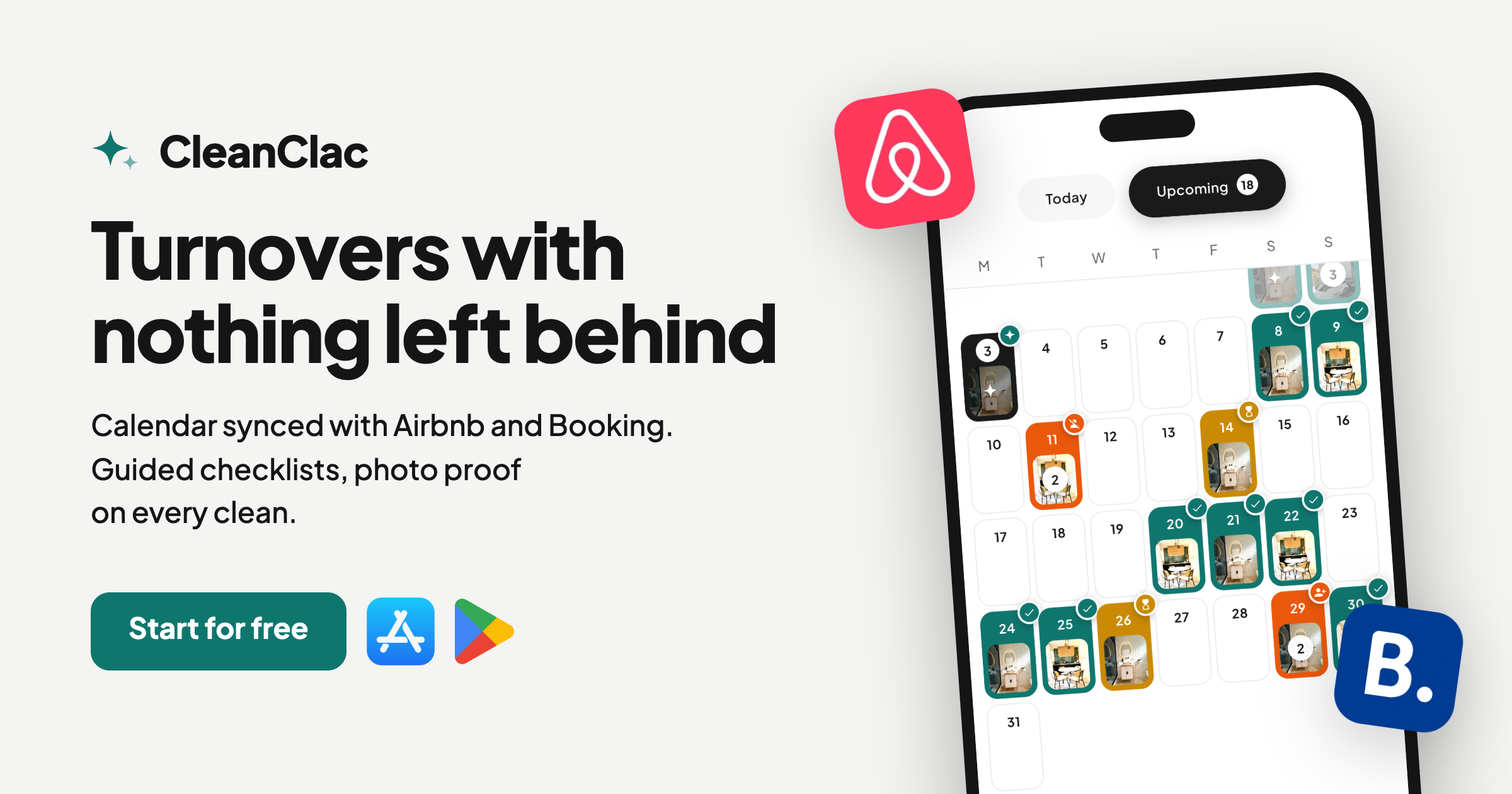
In practice, every cleaner has their own smartphone access to receive their assignment, work through the checklist, and submit end-of-clean photos, which cuts the manual back-and-forth with the manager. The built-in stock tracking flags linen or consumables shortages before they block an urgent turnover, a point that is often overlooked in standard scheduling tools.
To test these automations on your portfolio, the free plan covers up to two properties with no commitment, and paid plans start from €9.99 per month for two properties depending on the size of your portfolio. Cleaning teams can explore the dedicated cleaner app to see exactly how urgent jobs land directly on their phone. Check the pricing page to choose the plan that fits your number of listings.
Sources
To go deeper on managing urgent turnovers, see the encyclopedia entry on the turnover window, the guide to same-day transitions, and the checkin workflow best practices from the hotel sector. These resources complement the prioritization criteria detailed in this article.
- What is the turnover window? · Lodgify Encyclopedia
- Turnover cleaning for short-term rentals: how to nail same-day transitions (2026) | Hostfully
- Airbnb cleaning: the turnover guide for short-term rentals | La Paume Digitale
- Same-day turnovers: how to manage without missing a clean · Nowistay
Frequently asked questions
What exactly is the turnover window?
The turnover window is the exact time available between one guest's checkout and the next guest's checkin to clean, change the linen, and inspect the property. It is the reference metric for deciding whether a turnover can be completed without risk.
How much time should I allow for an urgent turnover?
A standard turnover generally takes 1 to 3 hours, but it is better to build in a reasonable buffer between checkout and checkin whenever the market allows. A complex property (large footprint, pool, multiple bedrooms) often exceeds that range.
How do I classify a cleaning job as high priority?
A job becomes high priority when checkin is imminent, when the estimated duration exceeds the available window, or when the property is particularly complex. The commercial impact of a failure, a refund or a negative review, must also weigh in the decision.
Can CleanClac automate the prioritization of urgent cleaning jobs?
Yes. CleanClac triggers an automatic notification as soon as a booking is confirmed and centralizes photo checklists to validate every turnover. Plans include a free tier for a small number of properties, with paid tiers for more listings available on the pricing page.
What should I do if no cleaner is available for an urgent turnover?
First, activate a backup cleaner identified in advance, for example through a cleaning marketplace. If no solution is available in time, offer luggage storage rather than delivering a property that is not ready.