Coordinate Cleaning and Check-in Without the Domino Effect
Automate turnover cleaning from the moment a booking is confirmed, give cleaners time-limited access, and require photo proof before marking your rental ready.

Jonathan Lalinec

The most reliable way to coordinate cleaning and check-in comes down to three habits: trigger the cleaning job automatically when a booking is confirmed, give the cleaner a time-limited digital access code rather than a physical key, and require a standardised checklist with photo proof before the property is considered ready. Everything else is just execution.
In brief:
- Automatically syncing bookings into your PMS or via iCal is essential to avoid missed jobs and ensure cleaning is assigned immediately.
- Generating and sending a time-limited digital access code, with proof of visit, strengthens security and gives you a clear audit trail.
- A systematic checklist check with photos, plus a human review, are non-negotiable before a property is marked ready for the next guests.
- Beyond 20 properties, full automation and a dedicated coordinator become necessary to maintain service quality without runaway costs.
- Handling incidents well means immediate communication or replacement via a backup list, avoiding any extended delay.
Table of contents
- Quick checklist to run the moment a booking comes in
- Detailed operational workflow: from checkout to check-in
- Access and technical automation: codes, locks, notifications
- How to structure the checklist and cleaning communication
- Scaling up and contingency plans
- How Cleanclac puts these principles into practice
- Three priorities that genuinely reduce incidents
- Discover Cleanclac to automate your cleaning
- Sources
- Frequently asked questions
Quick checklist to run the moment a booking comes in
Every confirmed booking kicks off a sequence of actions, and the order in which you handle them shapes the rest of the day. Syncing the booking into your PMS or via an iCal feed is always the first step. It eliminates double entry and missed dates, a point consistently confirmed by the centralised cleaning planning tools used by multi-property managers.
Here is the sequence to follow within minutes of a confirmed booking:
- Automatically sync the booking into your PMS or via iCal, with no manual data entry.
- Generate the cleaning job and assign it based on team availability.
- Create and send a temporary access code to the relevant cleaner, valid only for the scheduled window.
- Attach the property-specific checklist, including any special instructions around linen, fragile equipment, and Wi-Fi codes to renew.
- Set up proof of completion, either photos or a digital sign-off, along with an automatic notification when the job is done.
Pro tip: Never let job creation depend on a manual step on your part. A system that waits for your approval before assigning a clean introduces an invisible delay that costs you dearly on a busy Saturday in peak season.
Detailed operational workflow: from checkout to check-in
Turnover cleaning works like a supply chain, not an isolated task. A late checkout immediately pushes back the clean, which then pushes back the next guest's arrival. This domino effect can ripple across several properties on the same day when your team is moving between multiple addresses.
The buffer window between checkout and check-in should not be a fixed number applied uniformly to every property. It depends on the type of property, how far the cleaning team has to travel, and the time of year. A city-centre studio with an on-site team has very different needs from a suburban house served by a single person doing a three-property round.
In practice, your workflow needs to cover:
- Team assignments based on geographic proximity and property type, not a simple rotation.
- A systematic quality check: a completed checklist, before and after photos, and a minimum verification time before a property is marked ready.
- A straightforward incident procedure: if the cleaner flags a problem such as damage or a broken appliance, who decides to push back the check-in, and on what basis?
- A clear handover point between "clean complete" and "property approved for guests," which must never be automatic without a human check or photo confirmation.
This sequencing logic, rather than simple scheduling, is what separates an operation that holds up under peak-season pressure from one that generates last-minute calls all day long.
Access and technical automation: codes, locks, notifications
Two access models exist side by side, and mixing them up creates blind spots. A per-booking PIN changes with every stay and is automatically revoked when the window closes. Recurring access for regular contractors, by contrast, remains valid during a repeated time slot, typically the usual turnover day for your cleaning team.
A practical example from the field is to limit that recurring access to an 11 am to 3 pm window on cleaning day. This avoids handing over physical keys while strictly capping the entry window.
Three technical points are worth your attention:
- The smart lock's opening history serves as remote proof of visit, so you never have to call the cleaner to confirm they showed up.
- Automatic entry and exit notifications let you track in real time who came and when, which significantly cuts down on verification calls.
- A fallback is essential: a direct contact number and a single-use emergency code, in case the smart lock is unresponsive due to a low battery or network outage.
Key takeaway: an access system that combines recurring windows, a searchable history, and notifications turns multi-property management into repeatable, remotely verifiable tasks, as demonstrated by best practices for cleaner access management.
How to structure the checklist and cleaning communication
A generic checklist applied to every property always produces the same result: missed items in atypical rentals. A studio and a six-bedroom house do not share the same watchpoints, and your template needs to adapt to the size and type of property rather than staying identical across the board.
The recommended sequence is to clean from top to bottom and prioritise the kitchen and bathroom first, the two areas guests scrutinise most closely on arrival. Before and after photos are worthless without a clear acceptance standard: a made bed is not the same as a made bed with no visible crease on the duvet cover.
| Format | Main content | Send frequency |
|---|---|---|
| Studio / one-bed checklist | Essential points: kitchen, bathroom, linen, Wi-Fi | Every job |
| 4+ bedroom house checklist | Extended areas: outdoor spaces, multiple appliances, per-room stock | Every job |
| Guest message D-1 | Estimated arrival time, access instructions | Automatic |
| Cleaner message D-3 | Job reminder, property-specific instructions | Automatic |
The same priority watchpoints recur across every property: condition of linen, functioning of appliances, and no visible marks in the photographed areas. The 72-hour window after a turnover is also the right time to check meters and test safety equipment, a habit borrowed from long-term property management that is just as relevant in short-term rentals.
Scaling up and contingency plans
The number of properties you manage determines the level of automation you actually need. Up to 10 to 15 properties, a shared schedule with automated messages is usually enough. Between 20 and 25 properties, automating tasks becomes an undeniable efficiency lever. Beyond that, a dedicated cleaning coordinator often becomes necessary to maintain quality without costs spiralling.
- 10 to 15 properties: automate notifications before considering any additional hiring.
- 20 to 25 properties: centralise your PMS, digital guest guide, and cleaning coordination tool into a single operational stack.
- 35 properties and above: appoint a dedicated cleaning coordinator and track delay metrics by team, not just by property.
For incidents, the rule is simple: an absent or late cleaner triggers immediate replacement via a pre-established backup list, never a same-day improvisation. Pre-season preparation also includes checking consumables stock, which is often the real limiting factor when several check-ins fall on the same day.
Pro tip: Track one metric above all others: the average gap between the end of a clean and the announced check-in time. If it repeatedly drops below 30 minutes, you have a sequencing problem, not a staffing problem.

How Cleanclac puts these principles into practice
Cleanclac applies this sequencing logic directly in its day-to-day operation. The cleaning management app generates the cleaning job automatically from a confirmed booking on Airbnb, Booking.com, or Abritel, with no manual data entry on your part.
Each cleaner can have their own individual smartphone access, which eliminates the management of shared physical keys and removes any uncertainty about who is on site and when. Reports can come back in real time with photos, making it easy to verify a property's condition before guests arrive without needing to be there in person. A supplies tracker helps you avoid running out of stock at the worst possible moment. Detailed use cases by portfolio size are covered in the 2026 software comparisons published regularly on the site.
Three priorities that genuinely reduce incidents
Technology does not replace rigour. It simply makes rigour visible and verifiable.
, Jonathan
Discover Cleanclac to automate your cleaning
Some solutions offer fully automated cleaning management, generating jobs from the moment a booking is confirmed, distributing individual mobile access to each cleaner, and returning photo reports in real time.
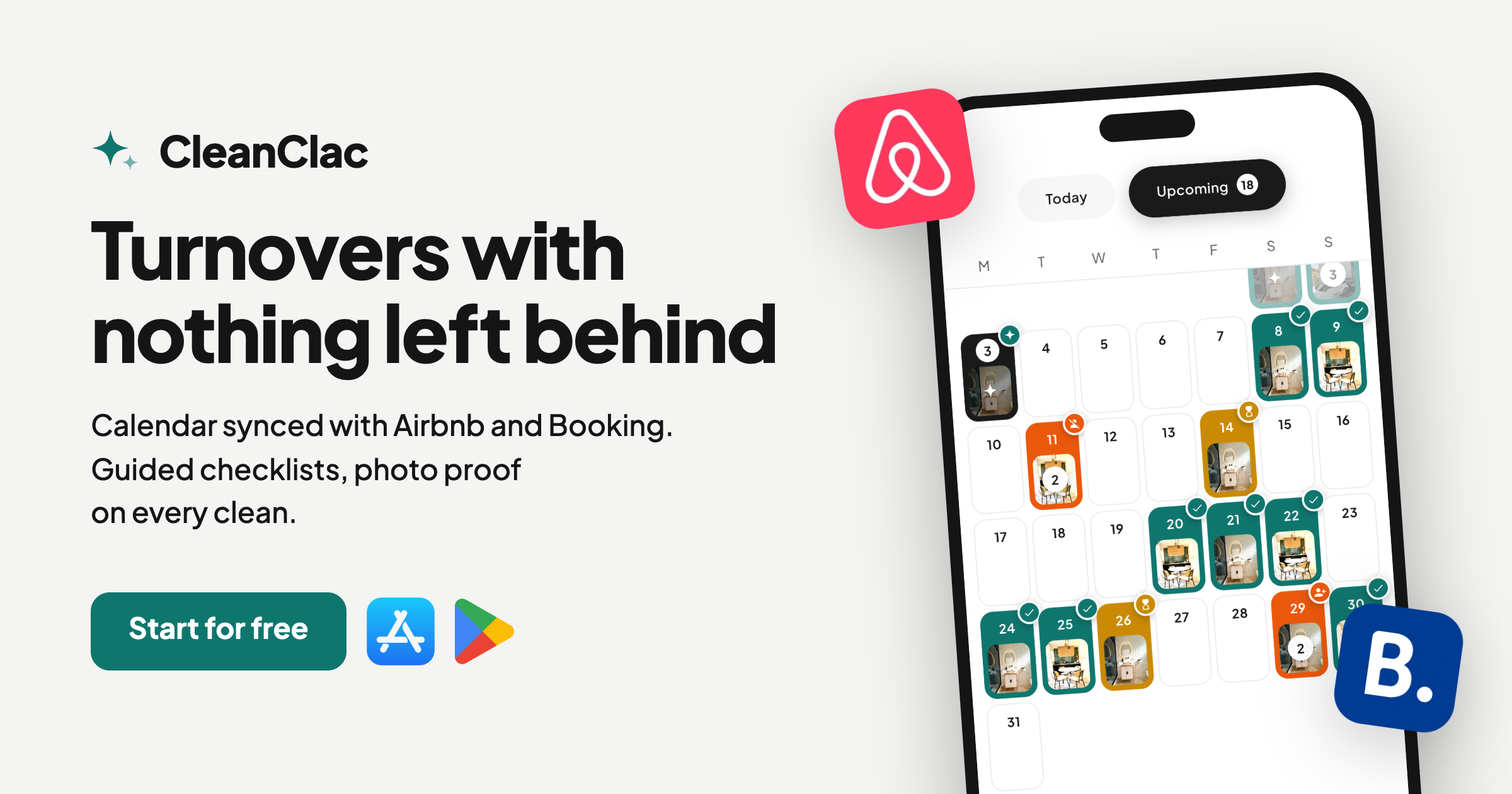
A free trial lets you test the sync with your existing bookings without any immediate commitment. Cleanclac delivers the most value once you are managing more than 5 properties or working with several cleaners at the same time, the threshold at which manual tracking starts generating missed jobs. If something comes up and no cleaner is available, the local provider search lets you find backup cover quickly. To compare the options available on the market, see the cleaning marketplace comparison.
Sources
- Cleaning between checkout and check-in: managing access | 1Control Blog
- Running a concierge service: processes, tools and planning
- The 72-hour moving plan that avoids months of open boxes and gets you settled by Sunday evening
Frequently asked questions
How do you automate the creation of cleaning jobs?
Syncing your PMS or an iCal feed with a tool like Cleanclac generates the job as soon as a booking is confirmed, with no manual data entry.
What time window should you give a regular cleaner?
A typical window of 11 am to 3 pm on turnover day avoids handing over physical keys while strictly limiting access to the property.
What should you do if the assigned cleaner is unavailable on check-in day?
Activate a pre-established backup list immediately rather than improvising, and let the guest know about any possible delay to their access time.
From how many properties does automating cleaning make sense?
From 10 to 15 properties, automating notifications becomes worthwhile. Beyond 20 to 25 properties, a dedicated coordinator often becomes necessary.
What proof should you require to sign off a completed clean?
Before and after photos checked against a standardised checklist, supplemented where possible by the smart lock access history.


