Handle Peak Season Cleaning Turnovers
Plan ahead, standardize with checklists and PAR levels, and automate your booking-to-job flow to handle peak season cleaning without dropping quality.

Jonathan Lalinec
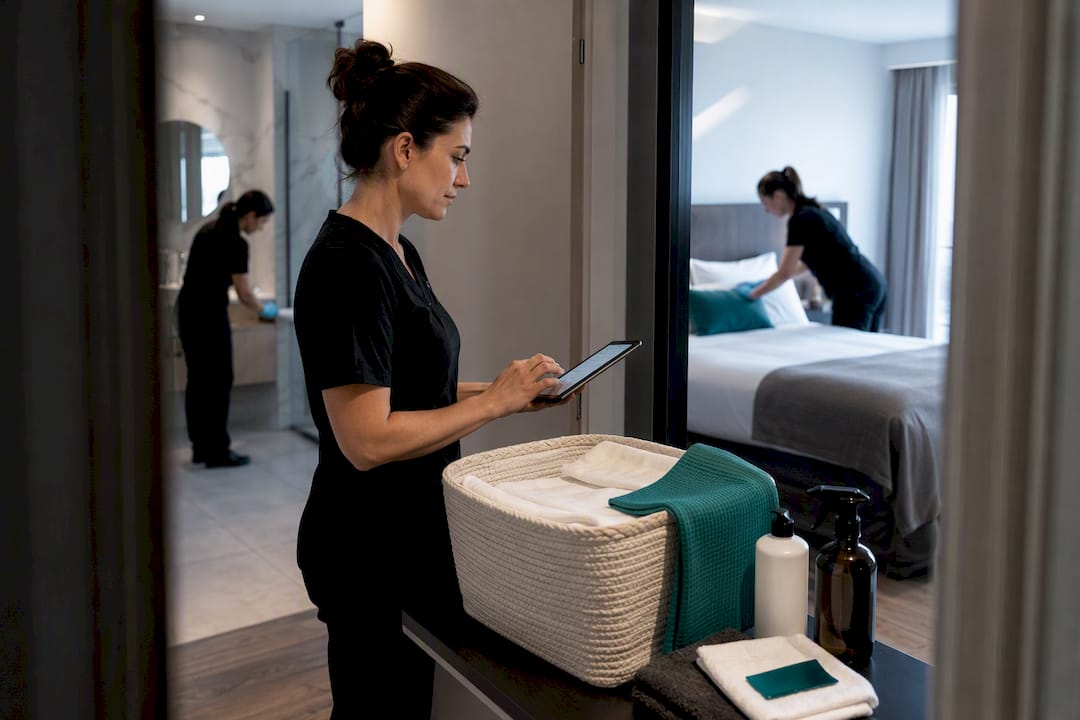
To handle a peak season cleaning surge, the priority is straightforward: plan ahead, standardize your procedures with checklists and the PAR method, then automate the booking-to-job flow with a dedicated tool. The critical windows between checkout and check-in deserve particular attention, as does a systematic photo audit at every turnover. CleanClac shows concretely how that automation works day to day.
In brief:
- Forward planning must draw on your turnover history, weekly occupancy rate, and orphan nights to anticipate peak demand effectively.
- Operational consistency depends on digital checklists, the PAR method for consumables, and timestamped photo audits to maintain quality.
- Splitting work across three specialist teams optimises the management of intensive turnovers, especially on Saturdays, with a buffer of at least two hours between checkout and check-in.
- Automating tasks with a dedicated tool, including automatic booking import and mobile notifications, reduces human error and makes real-time tracking straightforward.
- Tracking key metrics such as re-clean rate and average cost per turnover lets you quickly adjust staffing, stock, or cleaners when something is off.
Table of contents
- How to anticipate peak season cleaning surges
- Standardizing operations: checklists, photo audits, and the PAR method
- How to organize teams during booking peaks
- Automating scheduling to keep pace with peak season
- Which metrics to track during and after the season
- Why industrializing cleaning does not mean dehumanizing it
- CleanClac fits into your peak season setup
- Sources
- Frequently asked questions
How to anticipate peak season cleaning surges
A seasonal peak never arrives without warning. It shows up in the calendar well in advance: school holidays, bank holiday weekends, local festivals, long weekends. These periods concentrate arrivals and departures on the same days, often Saturday, which multiplies the turnovers you have to manage within a few hours.
Forecasting rests on three minimum data points to collect at the end of each season:
- your turnover history (check-in and checkout dates over the past 12 months);
- occupancy rate by week, to spot troughs and peaks;
- orphan nights, those one- or two-night gaps between bookings that carry a high cleaning cost relative to the revenue they generate.
From those figures, build three capacity scenarios: baseline, high season, and peak season. Each scenario translates into concrete daily turnover requirements per team. A pricing strategy calibrated to orphan nights also helps absorb the cost of each turnover without eating into your margin, by covering those costs through a price adjustment or a cleaning fee.
Standardizing operations: checklists, photo audits, and the PAR method
A successful peak season clean never depends on a cleaner's memory. It depends on a written procedure, identical from one property to the next, and on a quality check that leaves no room for interpretation.
Three pillars hold up that standardization:
- Digital checklists by turnover type: a short checklist for a late checkout followed by a quick check-in, a full checklist for a deep clean at the start of the season, and a linen-only checklist for express turnovers.
- The PAR method for consumables, which sets a minimum and maximum stock level per property. For a one-bedroom, a suggested PAR of 3 to 6 toilet rolls prevents stockouts without overloading storage. Pre-packed kits prepared in advance at a logistics hub then simplify the cleaner's work: they simply collect a box that is already complete.
- A timestamped photo audit at the end of every job, with clear acceptance criteria: linen pulled tight, floors visibly clean with no marks, bathroom free of residue. This visual record serves both as a quality check and as evidence in any dispute with a guest.
Pro tip: Create a visual before/after acceptance standard for each room and share it with all your cleaners before the season starts. This cuts re-cleans caused by mismatched expectations, not by a lack of professionalism.
How to organize teams during booking peaks
Peak season creates a mechanical bottleneck: every Saturday turnover must be completed within a few hours. The solution is not to hire urgently and in bulk, but to divide responsibilities clearly.
Splitting work across three specialist teams reduces idle time and clarifies accountability:
- Team A, preparation: strips dirty linen, removes rubbish, and prepares consumable kits to the PAR levels defined for each property.
- Team B, main clean: works through the core checklist room by room during the most intensive part of the day.
- Team C, finishing and audit: checks the work, takes timestamped photos, and signs off on compliance before handing over the keys.
This division eases the Saturday bottleneck, when the workload is concentrated into a tight window. Also build in a buffer of at least two hours between checkout and the next check-in: a 100 m² property can take 4 to 5 hours to clean between stays, and that figure should drive your time slots rather than an optimistic estimate. For temporary reinforcement, formalize a framework agreement with a laundry partner and keep a list of local cleaners who can be called in at short notice. The guides on linen and laundry coordination cover the workflows to set up with those partners.
Automating scheduling to keep pace with peak season
A written procedure is not enough if it still relies on manual messages and spreadsheets updated by hand. In peak season, automating confirmations, property inspections, and shared schedules becomes necessary to absorb higher volumes without multiplying errors.
The typical flow looks like this: a booking comes in via the PMS or platform (Airbnb, Booking.com, Vrbo), it automatically generates a cleaning job, the cleaner receives a notification on their phone with the checklist included, they document the job with a timestamped photo, and an alert fires as soon as a PAR level drops below its minimum.
The features to prioritize in a management tool align with the needs identified by concierge professionals:
- automatic booking import from platforms;
- instant notifications to cleaners with no manual call or text required;
- mobile checklists with mandatory photo evidence before job closure;
- real-time stock tracking against PAR levels;
- reporting accessible to the owner or property manager.
Each automated step removes a source of human error: a property overlooked, two checklists confused, a stockout noticed too late. CleanClac applies exactly this model, with individual smartphone access for each cleaner, which means the manager does not have to piece together manually who is doing what every peak morning. The practical benefit shows up on three fronts: fewer re-cleans because the checklist guides the cleaner all the way through, better turnaround times because jobs appear the moment a booking is confirmed, and stronger visibility for the owner who reviews a photo report without having to call anyone.
Which metrics to track during and after the season
A well-run peak is measured, not just felt. Four metrics are enough to manage operations without drowning teams in dashboards:
- average turnover time per property;
- re-clean rate (jobs that fail the quality check and need to be redone);
- number of incidents per 100 turnovers (stockout, delay, non-compliance);
- average cost per turnover, consumables and labour included.
The review cadence should match the season's rhythm: a weekly check-in during busy months, a deeper monthly review to adjust PAR levels or renegotiate with the laundry partner. Gaps identified in July rarely call for a new checklist. They usually call for a stock adjustment, a team reallocation, or sometimes a change of cleaner for a specific area.
Why industrializing cleaning does not mean dehumanizing it
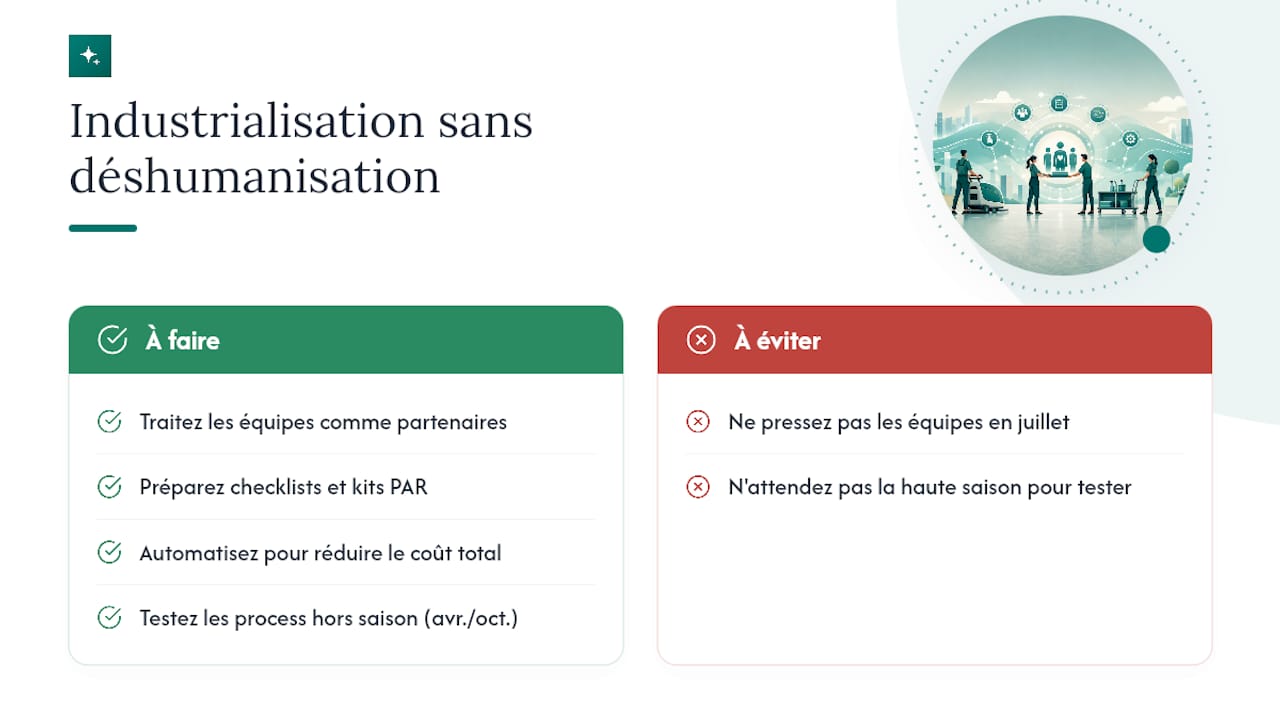
Standardizing does not mean turning your cleaners into interchangeable operatives. The best operations I observe treat their cleaning teams as strategic partners, not as a variable to squeeze in July and forget in January. A clear checklist and pre-packed PAR kits actually free up mental space for what matters: the relationship with the cleaner, flagging anomalies, and fine-tuning the setup.
Automation reduces the total cost of running your operation, not just the time spent on the phone. And above all, test your new processes in the off season, in April or October, when a PAR misconfiguration does not cost you a lost night's revenue. You will arrive in July with a system that has already been proven, not with an open work in progress.
, Jonathan
CleanClac fits into your peak season setup
CleanClac turns peak season preparation into an automated flow rather than a series of calls and manually maintained spreadsheets. The app imports your bookings from Airbnb, Booking.com, or Vrbo, generates the corresponding cleaning job, and pushes a notification directly to the assigned cleaner's phone, with their own checklist included.

Every job closes with a timestamped photo, visible in real time by the manager, and stock tracking against your PAR levels triggers an alert before a stockout rather than after. Pricing is detailed on the page covering Airbnb cleaning software costs. If you manage several properties and peak season is approaching, try the CleanClac app on your current portfolio before bookings start stacking up.
Sources
To go deeper on peak season logistics, see the guide on linen and laundry and the cleaning marketplace comparison. For check-in workflows, the hotel check-in process guide and the article on self check-in for vacation rentals offer useful additional perspective.
- Short-term rental logistics: the complete system for running your operation
- Managing a concierge service in peak season: 7 strategies for success · CRM-Loc
- How to manage cleaning for a vacation rental
Frequently asked questions
How far ahead should you prepare for a peak season cleaning surge?
Ideally two to three months before the busy period, to adjust PAR levels, test checklists during the off season, and secure backup capacity from local cleaners.
What is the PAR method applied to cleaning?
It is a system that sets a minimum and maximum stock level for each consumable in each property. For a one-bedroom, a suggested PAR of 3 to 6 toilet rolls prevents stockouts without over-ordering.
How much time should you allow for a turnover in peak season?
It depends on the size of the property. A 100 m² rental can take 4 to 5 hours to clean between stays, and that figure should drive your buffer window between checkout and check-in.
How does CleanClac help manage a peak season surge?
CleanClac automates job creation as soon as a booking is confirmed, pushes the checklist to the cleaner's phone, and centralises timestamped photo evidence for the owner's review.
Which metric should you watch most closely during a peak?
The re-clean rate and the number of incidents per 100 turnovers are the fastest signals of a staffing problem or a stockout that needs correcting.


