Cleaning Schedules for Short-Term Rental Managers
Learn how to sync bookings with cleaning schedules, avoid double-booking cleaners, and give your team mobile access to run a tighter short-term rental operation.

Jonathan Lalinec

The best approach is to centralise your cleaning schedule in a tool connected to your booking platforms, then automate notifications to your cleaners. This removes manual double-entry, reduces last-minute oversights, and ensures every property is ready for the next guest. Tools like CleanClac were built precisely for this use case: short-term rental, where the window between one checkout and the next checkin is sometimes measured in hours.
In brief:
- Centralising bookings in a connected tool eliminates double-entry and reduces oversights, improving property availability.
- An automated scheduling system prevents conflicts, cuts delays, and streamlines multi-property management, even across several cities.
- iCal sync can lag by more than three hours; direct API integrations offer much faster updates for last-minute bookings.
- Individual mobile access for cleaners makes it easy to check schedules, track jobs, and follow checklists, cutting the daily volume of calls and messages significantly.
- Testing your setup on a small number of properties before a full rollout lets you fine-tune buffers and processes, maximising ROI and avoiding operational errors.
Table of contents
- Why centralising cleaning and booking schedules changes your operation
- Essential features of a cleaning scheduling system
- Practical steps to configure scheduling and bookings
- iCal or API sync: which method fits your needs?
- Managing your team: mobile access, instructions, and quick cover
- Business automation and effective booking rules
- Costs, ROI, and a realistic rollout timeline
- How CleanClac helps short-term rental professionals
- Recurring scheduling and building rounds
- Adapting schedules to guest constraints and cleaner availability
- Linking your schedule to cleaning supply stock
- Tracking activity and measuring job performance
- Training and monitoring cleaners to maintain quality
- Personal data security and GDPR compliance in booking management
- What most cleaning schedule guides leave out
- How to get started with CleanClac today
- Sources
- Frequently asked questions
Why centralising cleaning and booking schedules changes your operation
A manager juggling an Excel spreadsheet, texts to cleaners, and calendars from three different platforms will always end up losing time, and often a guest. Coordinating cleaning and bookings through a single system removes that fragmentation. Every confirmed booking automatically triggers a cleaning job, without the manager having to open five tabs to check dates.
The business case is straightforward. Cleaning management software centralises team schedules, time tracking, and cleaner notifications, replacing hours of phone calls and cross-checks with a single interface available in real time. This is not just a comfort gain: it is a reduction in admin time that smaller operations feel within the first few weeks.
What centralisation changes in practice:
- Less time spent copying dates between spreadsheets and message threads.
- Instant visibility over available slots and risky ones, such as two checkouts on the same afternoon.
- A clear reduction in cleaners being double-booked on the same property.
- A searchable history for each property, useful when a dispute arises with a guest or a platform.
Pro tip: Never migrate a paper or Excel schedule to a digital tool overnight across your entire portfolio. Test it on three or four properties for two weeks, compare the admin time before and after, then expand.
Using a scheduling platform reduces the back-and-forth involved in booking jobs and prevents double-bookings which, in rental cleaning, translate directly into a cancelled night or a negative review. The logic is simple: every scheduling conflict spotted in advance is one that never turns into an emergency call at 8 in the morning.
The third benefit, often underestimated, concerns the end guest. A property cleaned late, or cleaned with a rushed checklist because the cleaner had to rush to the next job, almost always results in a lower rating on the booking platform. A reliable schedule therefore indirectly protects occupancy rates, since the ranking algorithms on Airbnb and Booking.com favour well-reviewed listings.
Essential features of a cleaning scheduling system
Not all cleaning management tools are equal, and some are little more than a shared calendar with no real operational logic. Here is what a proper system must cover for short-term rental.
An interactive calendar is the foundation. A day, week, and month view lets the manager spot busy days at a glance, several checkouts on the same afternoon, and quiet days when a cleaner could take on an extra one-off job elsewhere. This is not a visual gimmick: it is the tool that keeps improvisation out of your operation.
Self-service booking pages and forms allow an external owner, or a one-off cleaning client, to book a slot without a phone call. Combined with automatic email or SMS reminders, they also reduce no-shows, a recurring problem when an appointment is made several days in advance.
Features that professionals in this sector also expect include:
- Integrated payments and deposit management to secure one-off jobs.
- Multi-property management that consolidates several addresses under one dashboard.
- Resource and supply tracking (vacuums, linen, products) by property.
- Photo and video reports attached to each job, viewable by the manager without a site visit.
- Cancellation handling that automatically releases a slot for another cleaner or job.
Multi-property management deserves a special mention. A company managing fifteen apartments across three cities cannot operate with a single calendar and cleaners assigned at random. The system must allow filtering by geographic area, assigning a cleaner to a fixed zone, and quickly reassigning a job to a stand-in if the regular cleaner is unavailable.
Pro tip: Always check whether the tool offers shared resource management, such as a professional vacuum used across several properties. Many managers discover this gap too late, once two cleaners are scheduled at the same time with the same equipment.
Integrations with existing booking systems, PMS and OTAs, are what separates a simple calendar from a genuine operational tool. They trigger a cleaning job automatically as soon as a booking is confirmed on Airbnb, Booking.com, or Vrbo, with no manual action needed from the manager.
Practical steps to configure scheduling and bookings
Moving from an ad-hoc system to structured scheduling takes a method, not just good software. Here is the sequence that works for most short-term rental property managers.
- Build a catalogue of your services with standard time allowances. Cleaning a studio after a one-night stay takes a different amount of time from a deep clean after a two-week family stay. Set reference durations by property type and stay type, and adjust them after the first few real weeks.
- Create your booking pages and cancellation rules. If you offer one-off cleaning to external clients, set a minimum cancellation window with no charge (a window of around one day is common in the sector) and display it clearly on the booking form.
- Set availability windows and buffer time between jobs. A cleaner who finishes a job at 14:00 cannot be assigned to another property at 14:05 if the two are far apart. Always build in travel time.
- Test in real conditions on a small sample. A pilot on four to eight properties is generally enough to validate the setup and identify friction before rolling out across the full portfolio.
- Adjust based on feedback from your cleaners on the ground, not just your assumptions as a manager. They are the ones who know whether the buffer is too short or whether a checklist step is impossible to complete in practice.
Pro tip: The standard time you set at the start will almost always be optimistic. Add 10 to 15 minutes of margin to your first estimates while your teams settle into their processes.
Setting cancellation rules deserves particular attention because it directly affects the client relationship. A rule that is too strict discourages one-off bookings; a rule that is too lenient leaves your schedule with last-minute gaps you cannot fill. Most experienced managers converge on a two-tier policy: free cancellation beyond 24 hours, with a partial deposit retained inside that window.
Once these foundations are in place, the real value of the system shows in its ability to absorb growth without admin workload increasing at the same rate as the number of properties managed.
iCal or API sync: which method fits your needs?
The standard method for importing a booking calendar into a cleaning tool remains iCal sync, available on virtually all platforms including Airbnb, Booking.com, Vrbo, and Abritel. The principle is straightforward: copy the calendar URL from the relevant section of the rental platform, then paste it into the Connections or Settings tab of your cleaning software.
This method has a drawback that every professional in the sector knows: latency. iCal updates can take several hours to appear in the cleaner's schedule, which means a last-minute cancellation or an instant booking may not show up immediately in your management tool.
In practice, this delay creates real risk for bookings made less than three hours before a guest arrives. Without a compensating measure, a cleaner could turn up at a property that is still occupied, or not be notified of a booking that just came in.
How to limit this risk:
- Run a manual check of same-day bookings once a day.
- Set a systematic buffer between jobs rather than relying on minute-by-minute sequencing.
- Prefer a direct API integration where available: it offers significantly faster sync than standard iCal import.
- Train your cleaners to contact the manager when in doubt, rather than relying solely on the app.
Direct API integration is more complex to set up and is not always offered by every platform or software. It becomes worthwhile above a certain booking volume, when the cost of a scheduling error exceeds the cost of the technical investment. For a small operation managing a handful of properties, iCal import combined with solid internal rules is more than sufficient.
Managing your team: mobile access, instructions, and quick cover
A scheduling system is only as good as what the cleaners do with it on the ground. Professionals in this sector consistently point out that individual mobile access is the factor that tips adoption of a tool one way or the other.
Each cleaner must be able to view their daily schedule, their property-specific instructions, and the history of past jobs from their own smartphone, without depending on a call to the office. Providing this dedicated mobile access sharply reduces the volume of calls and messages directed at the manager, and mechanically improves checklist compliance.
What a solid field workflow must require:
- A mandatory photo before and after each job, automatically timestamped.
- A checklist for each property type, adapted to its layout (number of bedrooms, hot tub, specific linen).
- Immediate reporting of any damage found, with a photo attached, sent to the manager in real time.
- A quick reassignment function that redirects a job to another available cleaner in a few taps.
Pro tip: Make the end-of-job photo mandatory to mark a job as complete in the app. This is the detail that turns an optional checklist into a real discipline.
Managing the unexpected, a cleaner calling in sick, a transport delay, a broken piece of equipment, deserves a written process, not an improvised phone chain. The manager must be able to see at a glance which cleaner is free in the same geographic area and reassign the job without going through a chain of calls. This speed of reassignment is, in practice, what separates a well-organised operation from one that is caught out by every incident.
Business automation and effective booking rules
Automation only has value when it rests on clear rules, defined upfront rather than improvised as incidents arise. Three categories of rules come up consistently among experienced managers.
Buffer rules prevent impossible back-to-back jobs. A sufficient margin between two jobs at different properties, calibrated to the actual distance, absorbs small delays without derailing an entire day.
Round prioritisation rules organise the order of jobs by real urgency, not simply by booking time. A 15:00 checkin always takes priority over a courtesy clean with no strict time constraint.
Automation scenarios to configure first:
- Automatic creation of a cleaning job as soon as a booking is confirmed on a connected platform.
- Instant notification to the assigned cleaner, with the address, instructions, and time slot.
- Alert to the manager when a scheduling conflict is detected between two bookings on the same property.
- Automatic slot release and notification to available cleaners when a booking is cancelled.
- Automatic reminder 24 hours before a one-off job billed to an external client.
A central dashboard remains essential for monitoring the exceptions that automation cannot resolve on its own: a cleaner who has not confirmed their job, a booking that arrives outside normal hours, a property accumulating damage reports. Automation handles volume; the manager handles exceptions. Confusing the two roles, by trying to automate everything without oversight, is the most common mistake among operations that adopt a new tool too quickly.
Costs, ROI, and a realistic rollout timeline
Pricing models for cleaning management software often adapt to the size and structure of the operation, based on the number of active properties or cleaners managed. Choosing the right model depends mainly on your growth rate: a per-property subscription suits a stable operation, while a more flexible model adapts better to a strongly seasonal business.
Calculating the return on investment comes down to three straightforward axes: the admin time saved each week, the number of incidents avoided (double-booked cleaners, cleaners not notified, missed slots), and the impact on occupancy through better guest reviews. An operation that was spending several hours a week coordinating cleans by phone typically sees a clear reduction in that time within the first month of using a centralised tool.
A realistic rollout runs in three phases:
- Pilot phase: select four to eight properties that represent your portfolio and test the full setup for two to four weeks.
- Evaluation phase: compare admin time, scheduling error rates, and cleaner feedback before and after the pilot.
- Scale-up phase: extend gradually to the full portfolio, using lessons from the pilot to adjust buffers and checklists.
Running a pilot on a small sample validates the setup and measures real operational gains before committing the whole organisation. To sharpen your budget based on the size of your portfolio, a market rate comparison provides useful benchmarks before you commit.
How CleanClac helps short-term rental professionals
CleanClac was built specifically around the constraint that defines short-term rental: the often very short window between one guest leaving and the next arriving. The app automates the creation of a cleaning job as soon as a booking is confirmed, with no manual re-entry by the manager.
Features that address the points raised in this article directly:
- Automated scheduling based on bookings from Airbnb, Booking.com, Abritel, and Vrbo.
- Individual smartphone access for each cleaner, with their own schedule and property-specific instructions.
- Precise tracking of supplies and equipment available at each property.
- Real-time reports with photos and videos, viewable by the manager without a site visit.
- Search for a local cleaning contractor in case of an unexpected absence by a regular cleaner.
A clean, ready property depends less on a cleaner's goodwill than on the reliability of the system that notifies them on time. It is that reliability, more than the speed of execution itself, that separates operations that consistently earn five-star reviews from those that do not.
The concrete gain is usually visible in two places: the number of calls the manager no longer receives because the cleaner already has the information on their phone, and the number of double-booking incidents that no longer happen because the calendar syncs automatically. You can see how the app works in full on the CleanClac product page.
Recurring scheduling and building rounds
Not every cleaning job is a one-off. A studio rented continuously on Airbnb generates a turnover clean at every guest change, sometimes several times a week. That justifies a rounds-based approach rather than scheduling job by job.
Recurring scheduling lets you define fixed rules per property: standard frequency, standard duration, regularly assigned cleaner. The system then applies those rules automatically to every new booking detected, without the manager having to manually reconfigure each job.
Building rounds becomes worthwhile as soon as a cleaner handles several properties close to each other geographically. Grouping jobs in the same area in a logical order, rather than letting the cleaner navigate at random between neighbourhoods, cuts travel time and the risk of cascading delays.
Two principles structure an effective round:
- Group jobs by geographic proximity rather than strict chronological booking order.
- Leave margin in the round to absorb an unexpected issue on the first job without pushing the whole day back.
A cleaner who runs through five properties in the same building or street finishes their day earlier, with less travel fatigue, than one whose round crosses an entire city. This grouping logic, simple on paper, remains one of the most underused levers among smaller operations that still schedule manually.
Adapting schedules to guest constraints and cleaner availability
Two constraints are almost always in tension in cleaning and booking coordination: what the guest or owner requires, and what cleaners can realistically deliver given their hours and workload.
Fixed checkin times imposed by certain platforms put direct pressure on the cleaning window available between bookings. When that window drops below two or three hours, every minute of delay on the cleaner's side becomes critical. The scheduling system must flag those tight slots in advance, rather than leaving the manager to discover them on the day.
Practical levers for balancing both constraints:
- Identify high-risk slots in advance, those with less than three hours between two bookings, and assign the geographically closest cleaner to them as a priority.
- Distribute workload based on each cleaner's actual declared availability, not an assumption of total availability.
- Keep a floating cleaner available to absorb demand peaks without overloading the regular team.
- Adjust job times to the specific constraints of each property, difficult access, code retrieval, limited parking.
A system that automatically cross-references booking time constraints with each cleaner's declared availability saves the manager from doing that arbitration manually, booking by booking. This automatic cross-referencing is precisely what distinguishes a simple shared calendar from a genuine operational scheduling tool.
Linking your schedule to cleaning supply stock
A cleaner who arrives at a property without floor cleaner or clean linen cannot finish their job on time, regardless of how good the schedule is. Managing cleaning supplies must therefore be connected to the scheduling system, not handled separately in a corner.
The principle is simple: every scheduled job consumes a known quantity of supplies (products, linen, consumables). A system that tracks this link can alert the manager before a stock runs out, rather than after a cleaner has discovered the shortage on site.
What this integration must enable in practice:
- Automatically decrement estimated stock after each job recorded as complete.
- Alert the manager when a product stock falls below a defined threshold for a property or area.
- Associate a standard supply list with each property category (studio, family apartment, property with pool).
- Facilitate bulk ordering of supplies for several properties in the same geographic area.
This link between scheduling and stock is often the weak point of smaller operations, which still manage supplies by eye with no formal tracking. The cost of a stock-out discovered on site, a delayed job, an emergency call, sometimes a deferred checkin, far exceeds the cost of organised upfront monitoring.
Tracking activity and measuring job performance
A full schedule does not, by itself, guarantee that jobs are going well. Tracking activity and performance metrics is what separates an operation that is genuinely running well from one that is quietly accumulating delays and incomplete checklists.
The most useful day-to-day indicators remain simple: average time per job compared to the standard set, rate of jobs completed with a validation photo, rate of damage or anomaly reports, and rate of jobs started late relative to the scheduled slot.
What these activity reports should reveal to the manager:
- Which properties consistently take longer than expected, a sign that the standard time is poorly calibrated.
- Which cleaners regularly exceed their time, which may indicate a round that is too heavy rather than a skills issue.
- Which geographic areas generate the most scheduling incidents, cascading delays, insufficient buffers.
- How checklist compliance has evolved over several months, to check that quality is not slipping as the portfolio grows.
These statistics only have value if they are reviewed regularly, not just when a guest complaint comes in. A dashboard checked once a week allows you to correct a drift before it becomes visible in the property's public reviews.
Training and monitoring cleaners to maintain quality
The best scheduling system never compensates for inadequate training. A cleaner who does not know the precise expectations for a property, delicate materials, owner-specific instructions, the expected presentation standard, will produce inconsistent results regardless of how reliable their schedule is.
Initial training must cover the standard checklist by property category, the correct use of products by surface type, and the procedure for reporting damage or anomalies. This foundation sharply reduces variability between cleaners from the first few weeks.
Ongoing monitoring rests on three pillars:
- A regular review of the photos and videos submitted by each cleaner, not only when a problem is reported.
- Direct, prompt feedback to the cleaner when a checklist is incomplete, to correct the issue before it repeats.
- A periodic assessment combining punctuality, photo compliance, and guest feedback where available.
Individual mobile access plays a role here that goes beyond simply checking a schedule: it becomes the channel through which quality is measured and corrected continuously, job by job, rather than at the occasional on-site inspection.
Personal data security and GDPR compliance in booking management
Coordinating cleaning and bookings involves data that directly concerns identifiable individuals: guest contact details, property addresses, payment data for one-off cleaning clients, and personal information about the cleaners themselves. This brings the activity under European data protection regulation for any operation working within the European Union or processing data belonging to European residents.
Three principles structure compliant management. First, minimisation: collect only the data genuinely needed for the job (address, slot, instructions), not the guest's full stay history. Second, limited retention: data from a completed job has no reason to remain indefinitely accessible without justification. Third, access security: each cleaner should only see information related to their own jobs, not the entire managed portfolio.
Concrete points of vigilance for a manager:
- Verify that the tool encrypts sensitive data (contact details, payment information) in transit and at rest.
- Ensure that report photos and videos are accessible only to authorised persons, not shared by default.
- Document each cleaner's access and revoke it immediately when the working relationship ends.
- Check the server location and the software provider's contractual data protection guarantees.
A well-designed system treats this compliance as a baseline feature, not an option bolted on afterwards.
What most cleaning schedule guides leave out
Most content on this subject sells automation as a universal solution, as if connecting an iCal calendar fixed all coordination problems. Operational reality in this sector tells a different story. Automation handles volume and standard cases; it never replaces human judgement when something unexpected happens: a cleaner calling in sick, a damaged property, a last-minute booking that arrives within the iCal latency window.
The underrated point is mobile access for cleaners. Many managers invest in a polished dashboard for themselves and neglect the tool their cleaners actually use in the field, the very tool that determines whether the checklist is followed or rushed. A system that is powerful on the manager's side but frustrating on the cleaner's side produces exactly the same errors as a poorly maintained Excel spreadsheet.
My conviction, built on what the sector's workflows reveal: prioritise sync reliability and simplicity of mobile access before looking for advanced reporting features. A tool like CleanClac, designed from the outset around the constraint of short windows between bookings, illustrates this priority well: automate what can be automated, and keep the manager focused on the exceptions that truly matter.
, Jonathan
How to get started with CleanClac today
A dedicated app makes manual coordination by spreadsheet and text message for short-term rental cleaning and booking management far easier: every confirmed booking automatically generates a cleaning job, with no re-entry needed, and each cleaner checks their schedule directly from their smartphone.
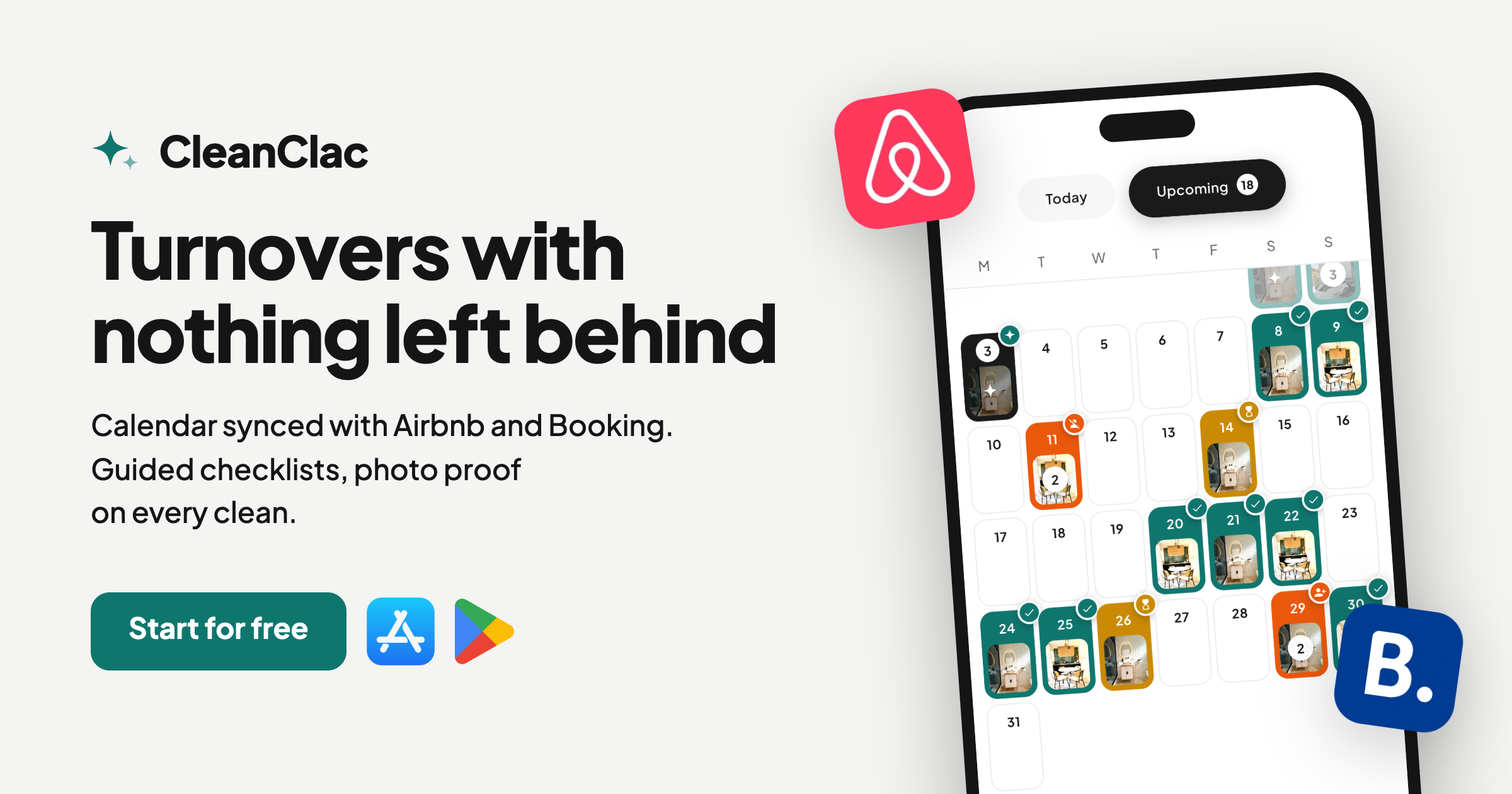
In practice, getting started happens in three steps: connect your booking calendars (Airbnb, Booking.com, Abritel, Vrbo) via iCal or a direct integration, add your cleaners with their zones and availability, then run a pilot on a few properties to validate standard times and buffers before extending to your full portfolio. During this phase, track two simple indicators: the weekly admin time spent on coordination, and the number of scheduling incidents avoided.
To get started, the app's product page covers all features in detail, while the page dedicated to finding cleaning contractors helps managers who do not have enough available cleaners to handle a booking peak. Those who want to structure their automation more broadly will also find practical resources in our guides on automation for short-term rental. For the guest welcome that follows directly after the clean, the guide on automating guest check-in is a useful complement.
Frequently asked questions
How do you build a cleaning schedule for short-term rentals?
Start by listing your properties and service types with standard time allowances per category, then connect your booking calendars to a centralised tool that automatically triggers a job every time a booking is confirmed. Add buffer time between jobs to absorb delays.
What are the basic rules for a reliable cleaning schedule?
Three rules come up every time: centralise all bookings in a single calendar rather than juggling platforms, build a buffer between each job, and check last-minute bookings manually as long as iCal sync can run several hours behind.
How do you put together a concrete action plan to get scheduling off the ground?
Start with a pilot on four to eight properties over two to four weeks, measure the admin time saved and the number of incidents avoided, then roll the system out gradually across your full portfolio once the setup is validated.
What daily cleaning schedule works best for a team of cleaners?
A schedule built around geographic rounds, where each cleaner moves through nearby properties rather than crossing the city, cuts travel time and prevents cascading delays. Each cleaner should view their schedule through their own mobile access, updated in real time.
Does CleanClac work for small operations managing only a few properties?
Yes: the app automates scheduling from the very first connected booking, with individual mobile access for each cleaner. This means a small operation does not have to build manual processes that a dedicated tool already handles natively.


