Turn Your Cleaning Checklist into an STR SOP
Build a cleaning SOP for short-term rentals with a digital checklist, photo proof, and room-by-room reference times to deliver consistent results every turnover.

Jonathan Lalinec
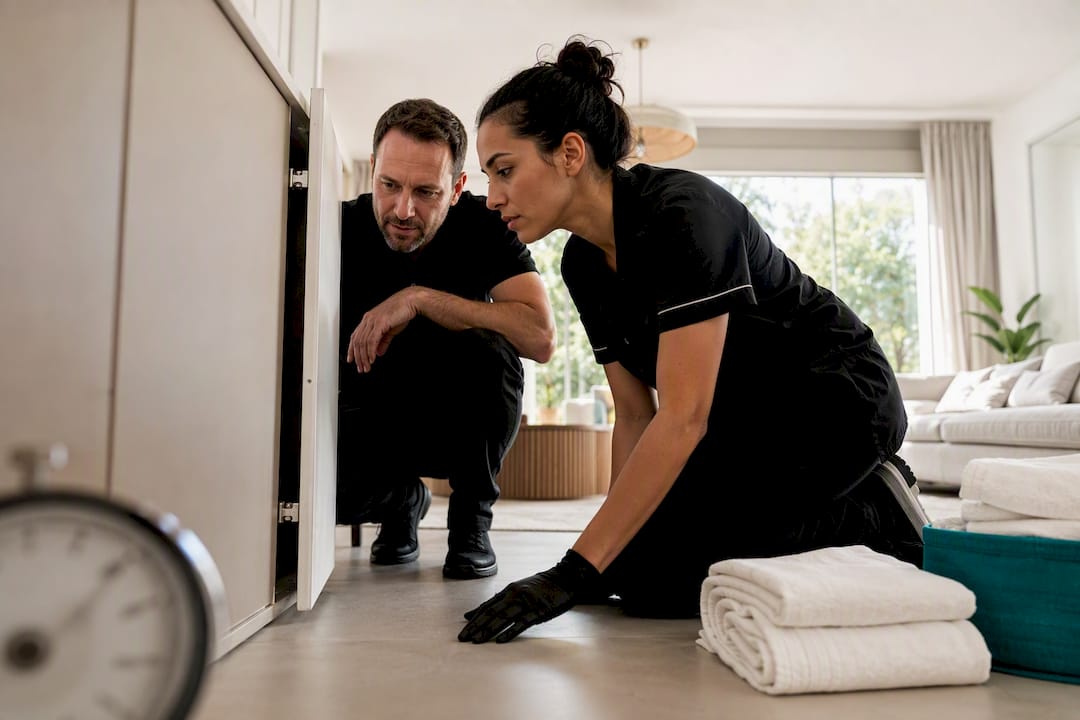
Formalize an SOP (standard operating procedure) paired with a digital checklist, drawing a clear line between standard cleaning and billable extras. Add a documented final inspection and room-by-room reference times. These three pillars are enough to guarantee consistent cleanliness, regardless of which cleaner works your property.
In brief:
- Standardizing cleaning rests on a clear SOP, a digital checklist, and a documented final inspection to ensure consistency regardless of who carries out the work.
- The boundary between standard cleaning and extras must be precise, with written instructions validated by photo, to prevent disputes and clarify surcharges.
- Regular training and audits, tracked through scores and photos, maintain quality and drive continuous improvement among cleaners.
- Moving to a digital checklist enables real-time tracking, proves compliance through timestamped photos, and simplifies management.
- Tailoring the SOP to the property type and specific guest expectations makes instructions more relevant while supporting growth.
Table of contents
- Which checklist standardizes your cleaning instructions?
- Writing a cleaning SOP step by step
- Standard clean or extra: where do you draw the line?
- Training, supervising, and auditing cleaning quality
- How digital checklists strengthen compliance
- Practical benchmarks: reference times by room
- How to update your instructions over time
- Do your instructions change by property type?
- Standardizing cleaning: an underrated commercial lever
- Sources
- Frequently asked questions
Which checklist standardizes your cleaning instructions?
A clear checklist, whether printed or digital, cuts oversights during fast turnovers between bookings. This is confirmed by the analysis of cleaning sheets for vacation rentals. Here is a compact template you can copy and adapt to your property today.
Bedroom
- Ventilate (at least 5 minutes, windows fully open)
- Empty all bins and replace liners
- Change all linen (sheets, duvet covers, pillowcases)
- Mandatory photo of the made bed and the bedside table
Bathroom
- Disinfect all fixtures (toilet, basin, shower or bath)
- Disinfect all contact points (handles, light switches, taps)
- Restock consumables (toilet paper, soap)
- Photo of the mirror and floor before leaving the room
Kitchen and shared areas
- Dishes put away, worktop disinfected
- Floors vacuumed then mopped
- Panoramic photo of the room at the end of the clean
The sequence matters as much as the list itself. Always start by ventilating, then empty before cleaning, and finish with the floors. This order prevents soiling an area you have already treated and structures the digital checklist as a series of consecutive boxes to tick.
Writing a cleaning SOP step by step
Turning a simple list into a standard operating procedure changes everything. Analysis of housekeeping SOPs consistently shows fewer errors, more predictable cleaning times, and a consistent guest experience across properties.
- List every recurring task room by room, in the exact order they must be carried out.
- Describe each action with a precise acceptance criterion: "bed made with crisp hospital corners" rather than "make the bed." Add a reference photo for each key room.
- Choose a distribution format: a PDF works to get started, but a shared document or digital checklist makes updates and audit trails much easier.
- Plan the rollout: initial training with your cleaner, a trial period covering two to three turnovers, then an annual SOP review to incorporate feedback from the field.
Some hotel teams take the logic further with a color-coding system for microfibre cloths: red for bathrooms, yellow for the kitchen, blue for general surfaces. This reduces the risk of cross-contamination between rooms.
Pro tip: Never write your first SOP alone at a desk. Shadow a cleaner through a full turnover, stopwatch in hand. You will spot details that never show up on a theoretical checklist, such as awkward access to a meter cupboard or a poorly placed storage unit.
Standard clean or extra: where do you draw the line?
Putting the boundary between standard and extra into words prevents most disputes with your cleaners. This is a point made by the analysis of cleaning checklists in Switzerland. Conflicts almost always stem from expectations that were never written down.
What generally falls under standard cleaning:
- Linen, bathrooms, floors, bins, contact points
- Restocking basic consumables
What counts as a billable extra:
- Cleaning inside the oven or refrigerator
- External windows, terrace, garden
- Ironing, washing curtains
In the contract or work brief, state it clearly: "the standard clean covers X; any additional task reported by photo and approved before the work begins may be invoiced as an extra." This validation process protects both parties.
Training, supervising, and auditing cleaning quality
An effective training program runs in three steps: pairing the new cleaner with an experienced one for the first turnover, handing over the standard reference photos for each room, and observing the first five inspections before granting full autonomy.
The final audit grid structures this check around a simple score, for example out of 100 points, with critical lines (linen, bathrooms, odors) weighted more heavily than secondary points. This approach turns the inspection from an administrative chore into a genuine targeted training tool, as highlighted by the hotel room cleaning protocol.
Professionals in the sector spot-check a small number of properties each week to maintain this level of vigilance without having to audit everything all the time.
Gaps identified feed into ongoing training rather than immediate disciplinary action:
- An isolated gap triggers a targeted reminder on the specific point
- A recurring gap justifies returning to the paired-working stage
- Audit photos enrich the SOP's reference image library
How digital checklists strengthen compliance
Moving from paper to digital changes the very nature of quality control. Timestamped photo evidence and a full history of each turnover significantly reduce disputes, as confirmed by the housekeeping SOP study. They also make it easier to onboard new cleaners, who discover your standards directly in the app rather than on a static document.
A well-built digital checklist typically includes:
- A mandatory photo field for each critical zone before sign-off
- A real-time progress status visible to the property manager
- A notes field for flagging an issue or damage
- Consumable stock tracking
An app like CleanClac automates turnover assignment based on Airbnb or Booking.com reservations and notifies the relevant cleaner directly, with no manual coordination by message or phone call.
Pro tip: Always require a photo of the made bed and a photo of the bathroom before sign-off.
Practical benchmarks: reference times by room
Planning your schedule properly means knowing your actual turnover times. Hotel protocols provide solid benchmarks: a full checkout clean (guest has left, no trace of the previous stay) takes 20 to 30 minutes per bedroom, while a stayover service (occupied room, routine maintenance) runs at 15 to 20 minutes, according to the hotel room cleaning protocol.
For a complete short-term rental turnover, these times combine as follows:
- Bedroom(s): 20 to 30 minutes each
- Bathroom: 15 to 20 minutes
- Kitchen and living room: 20 to 25 minutes depending on size
- Final check and photos: 5 to 10 minutes
A budget studio therefore cleans in roughly one hour, compared with nearly two hours for a premium three-bedroom apartment. These times become your baseline for scheduling windows between bookings and for setting fees that reflect the time actually spent, rather than an arbitrary flat rate.
How to update your instructions over time
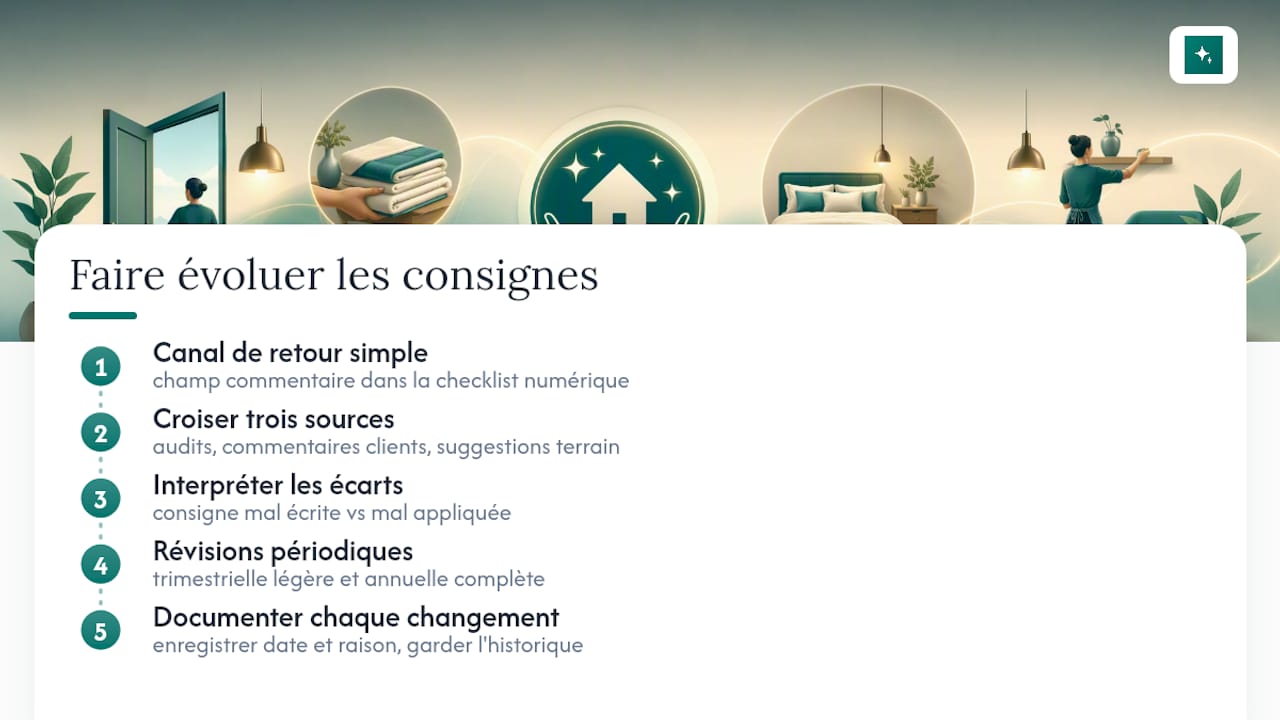
A frozen SOP loses its value within months. Guest expectations shift, new equipment arrives in the property, and cleaners discover more efficient methods than those originally written down.
Set up a simple feedback channel. Every cleaner should be able to flag an instruction that no longer works directly from the digital checklist, without sending an email that gets lost in an inbox. A comment field next to each task is often enough to collect this feedback.
Then cross-reference three sources to decide what to adjust: audit scores that point to tasks consistently done poorly, guest reviews mentioning a specific cleanliness issue, and direct suggestions from the field. An instruction that keeps generating gaps is not necessarily being applied badly; sometimes it is simply written poorly or unrealistic within the time allowed.
Schedule a light quarterly review for minor adjustments and a full annual SOP review. Between those two, document every change with its date and reason. This history prevents revisiting decisions that have already been made, and it helps a new manager or cleaner understand why a particular instruction exists in its current form.
Do your instructions change by property type?
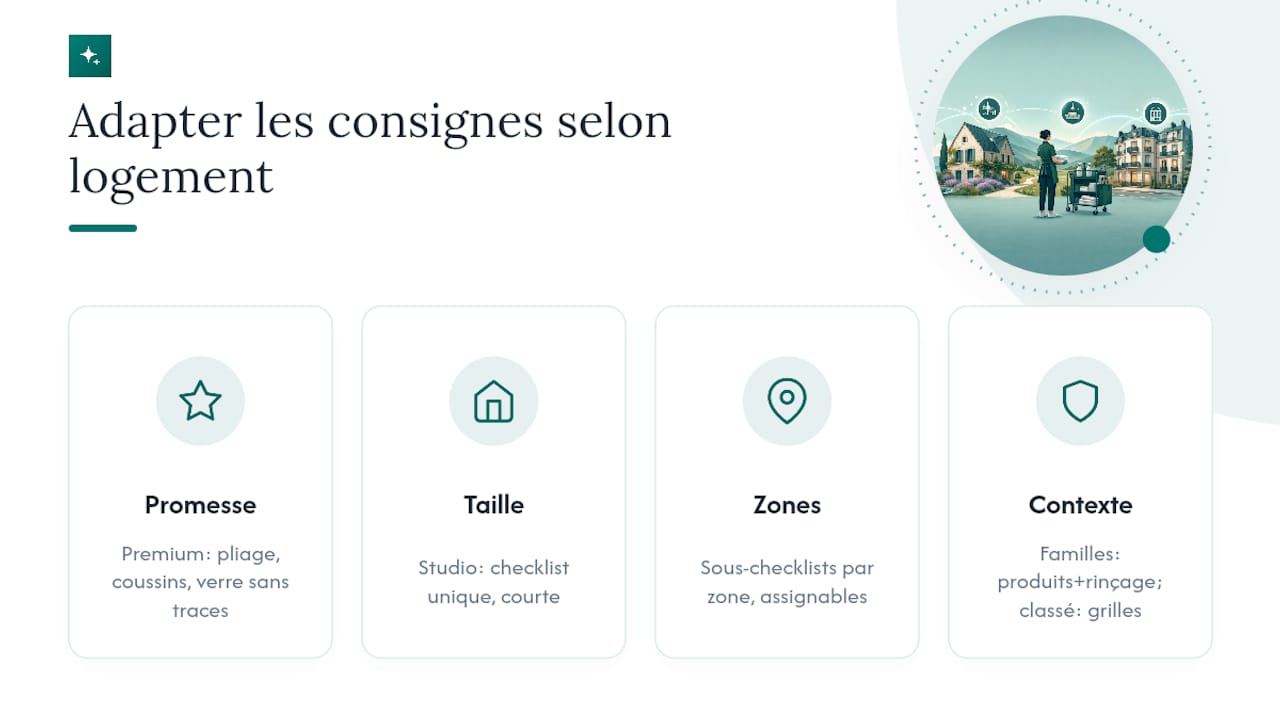
A budget studio and a luxury villa do not share the same finishing standard, even if the SOP structure stays the same. Match the level of detail in your instructions to the promise made to the guest. A premium listing justifies stricter acceptance criteria (folded towels, cushion arrangement, zero smears on glass) than a budget property where functional cleanliness is sufficient.
Property size also shapes the checklist format. A studio is covered by a single short list. A multi-bedroom apartment or a house with outdoor areas benefits from being split into zone-level sub-checklists, each assignable separately if you bring in several cleaners simultaneously for a large turnover.
The regulatory and hygiene context also matters. A property welcoming families with young children warrants extra care over which products are used and how thoroughly they are rinsed. A classified furnished tourist rental may also be subject to specific cleanliness grids depending on the commercial standards you are targeting. In every case the logic is the same: the SOP sets the shared framework, and short annexes cover the specifics of each property, rather than maintaining entirely separate documents for every listing in your portfolio.
Standardizing cleaning: an underrated commercial lever
Cleaning consistency is not just an operational concern. It shows up directly in your platform cleanliness scores and in the number of post-stay disputes you have to handle. A manager running three properties can tolerate the occasional inconsistency; one running twenty cannot afford variability across listings.
Standardization becomes the prerequisite for scaling. Digital proof, timestamped photos, and a full intervention history play a trust role that a simple confirmation text can never fill. They reassure the remote manager and provide a concrete rebuttal when a guest raises a complaint.
, Jonathan
Sources
For further reading on writing your procedures, the housekeeping SOP analysis details the structure of a complete procedure. The downloadable cleaning sheet template offers a concrete starting point to adapt. The hotel cleaning protocol provides room-by-room reference times, and the guide on standard versus extras helps you nail down your contracts. For end-of-tenancy cleans, this practical guide usefully complements the checklist approach.
Once your SOP is written and your checklist tested in the field, the next step is automating its day-to-day application. The guides on automating cleaning operations explain how a digital checklist replaces manual coordination by message, with automatic assignment based on your bookings and centralized photo proof for every turnover. You can try this approach directly on the CleanClac app.
- The checklist / cleaning sheet for vacation rentals (download)
- Hotel room cleaning protocol: steps, times, and checklist
- Cleaning checklist: standard or extra? | Clino
Frequently asked questions
What are the three rules to follow when cleaning?
Ventilate before you clean, work from cleanest to dirtiest (top to bottom, back to door), and always finish with the floors. These three principles define the sequence of any standardized checklist.
What order should you follow when cleaning?
Start by emptying and ventilating, then dust high surfaces, clean bathrooms and contact points, and always finish with the floors so you do not soil an area you have already cleaned.
What is the 6/10 method?
It is a cleaning workflow built around six zones tackled in a fixed order (for example: bedroom, bathroom, kitchen, living room, hallway, final check) repeated at every turnover. This standardizes the sequence regardless of which cleaner carries it out.
Can a full rental clean be done in two hours?
Yes, for a studio or a standard one-bedroom: combining reference times (20 to 30 minutes per bedroom, 15 to 20 minutes for the bathroom), a compact property is doable in one hour, and a larger apartment in two hours with an experienced cleaner.
Do you need a different checklist for each type of property?
No. Keep a shared SOP with a standard core, then add short property-specific annexes (premium finishes, outdoor areas, special equipment) rather than maintaining entirely separate documents for each listing.


